
ChatGPT Ads vs Google Ads (and Meta Ads): differences and when to use each
ChatGPT Ads vs Google Ads and Meta Ads compared: buying moment, targeting, bidding and measurement, plus a matrix to pick the right channel for your business.
Reading time: 11 min
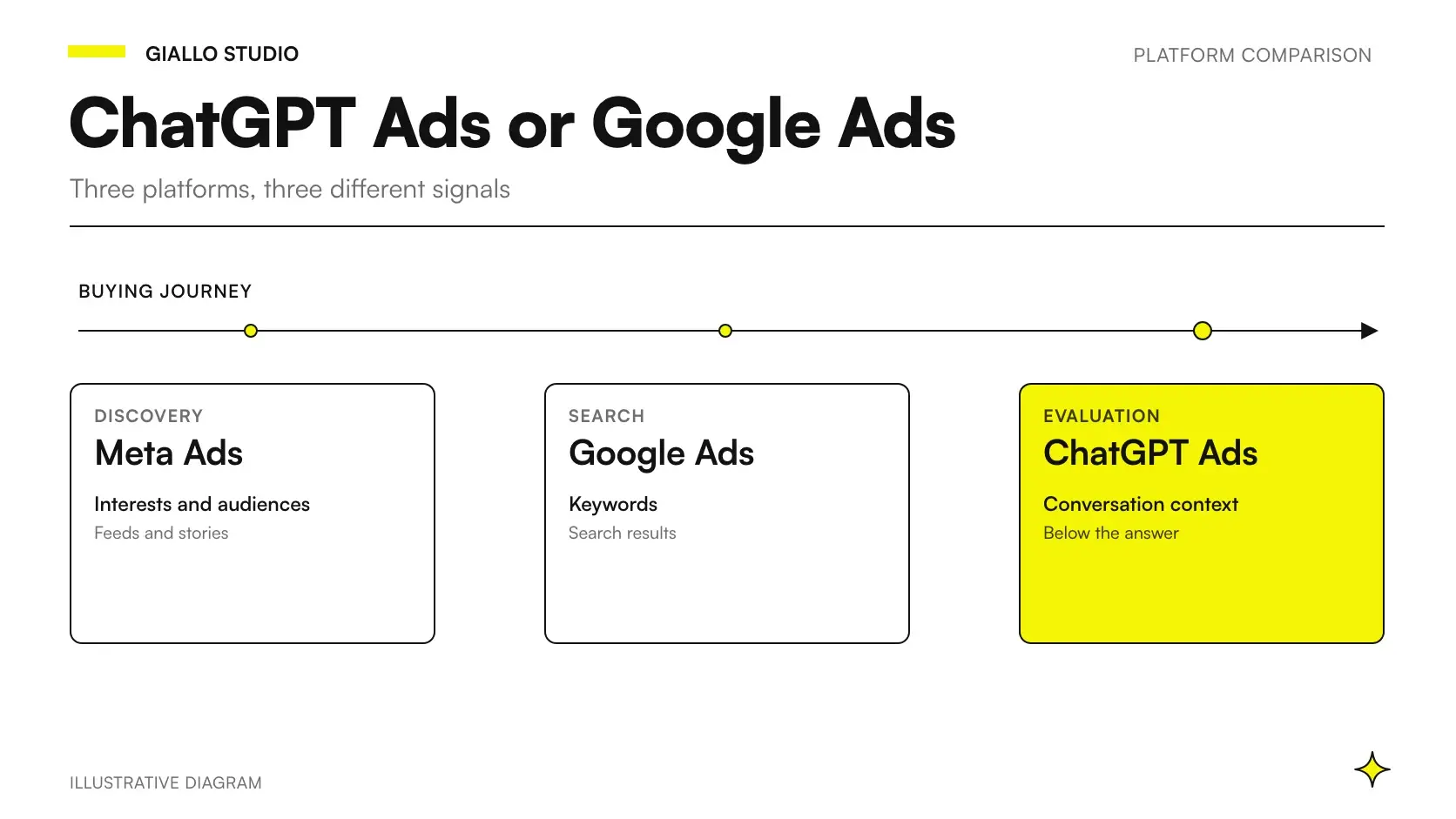
ChatGPT Ads vs Google Ads is, above all, a comparison between two different buying moments. Google Ads shows ads to people who search with keywords and already have a specific need. ChatGPT Ads shows ads below ChatGPT's answers to people who are still comparing options in a conversation. Meta Ads reaches people in Facebook and Instagram feeds, chosen by age, location and interests, even when they are not searching for anything.
For an Italian small business, the practical answer as of 19 October 2026 is this: Google Ads and Meta Ads remain the main channels, with mature tools and a track record; ChatGPT Ads, available on a self-serve basis in Italy since 31 August 2026, makes sense as a separate test when the customer decides after a long comparison. It is not a fit for businesses that sell urgent services, nor for the sectors that OpenAI's policies exclude outside the United States: finance, healthcare and legal services.
The big picture of who sees the ads and how they are chosen is in the complete guide to ChatGPT Ads.
In summary
- Google Ads matches ads to the keywords people search for; ChatGPT Ads matches them to the context of the conversation and to context hints, which are not exact-match.
- Meta Ads builds the audience on age, gender, location and interests and shows ads in feeds, Stories and Reels.
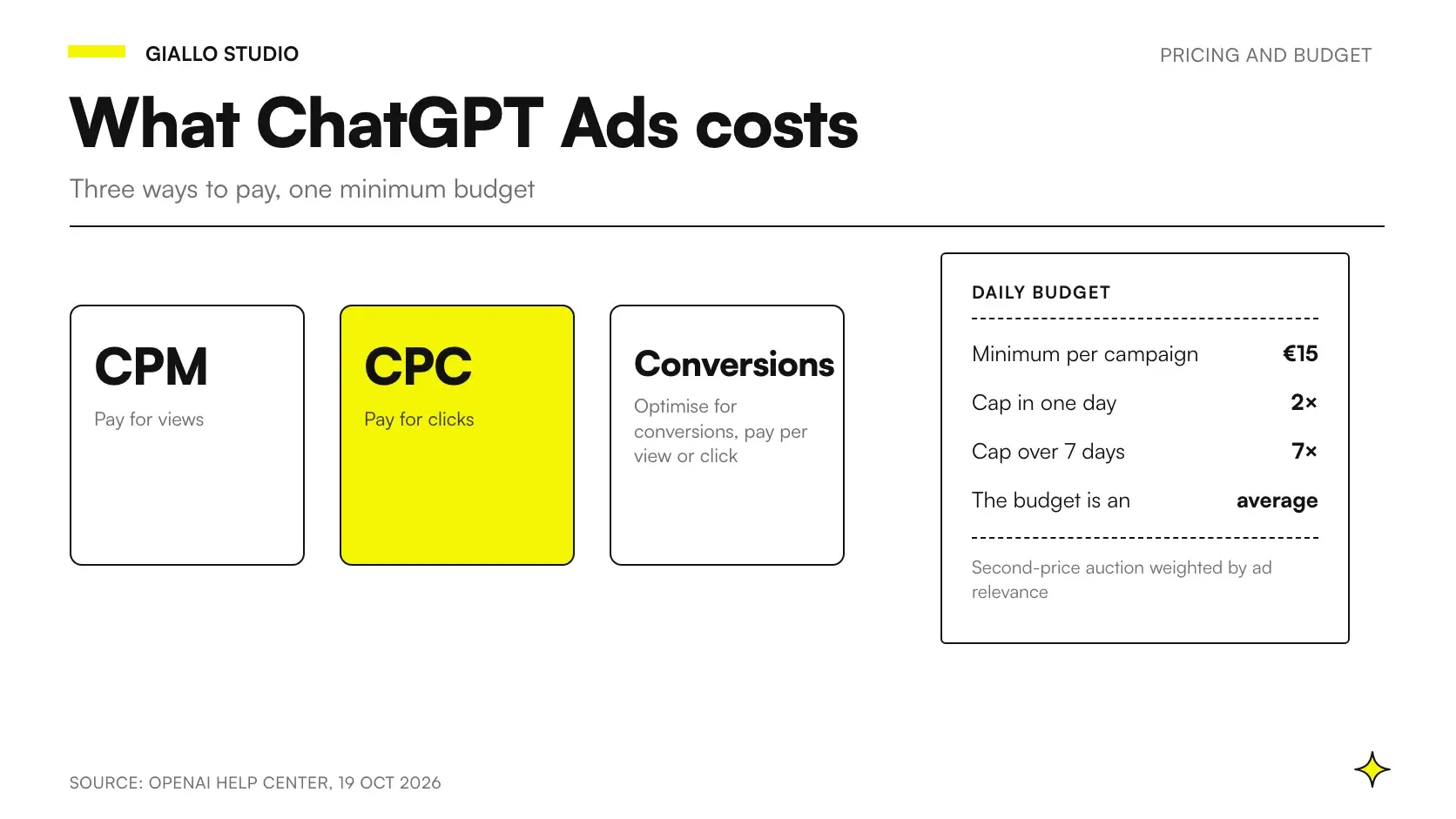
- ChatGPT Ads is bought on views (CPM), on clicks (CPC) or with conversion optimization, paid per impression or per click.
- OpenAI says it does not yet have performance benchmarks by industry, so a ChatGPT Ads test has no official yardstick.
- In Italy, Google does not yet show ads inside AI Overviews: according to its guide, they are live only in English and in 12 countries.
- For an Italian small business, ChatGPT Ads sits alongside Google and Meta on a separate test budget; it does not replace them.
What changes between ChatGPT Ads, Google Ads and Meta Ads at the moment of purchase?
The most useful difference is what the person is doing when they see the ad.
On Google the person types a short search, for example a service and a city. Keywords exist precisely to match ads to the terms searched, as explained in the Google Ads guide to keyword matching. The need is already spelled out.
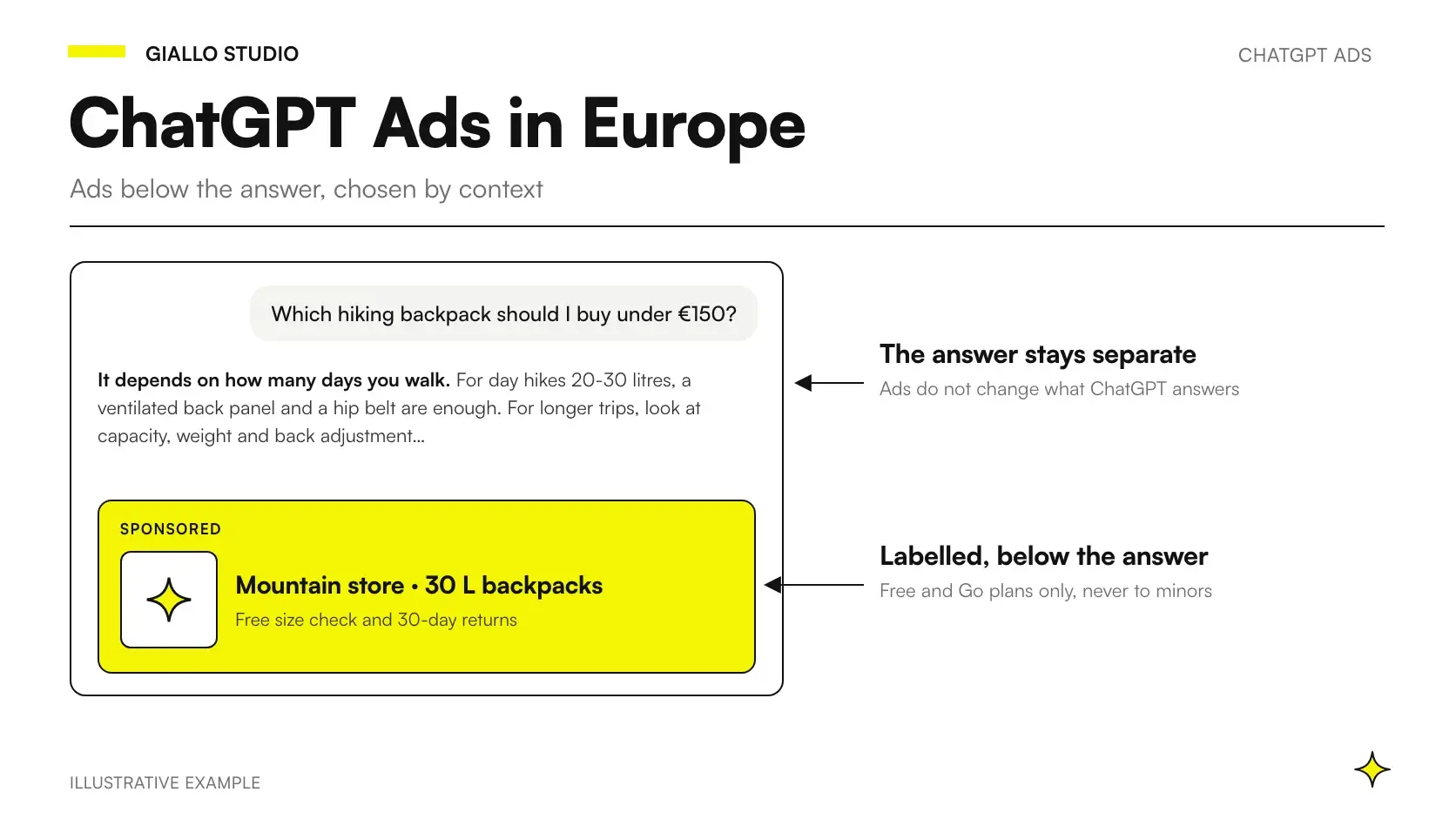
On ChatGPT the person describes what they want to achieve, what constraints they have and what matters to them. OpenAI's announcement of the arrival in Europe describes this audience as people who explore, compare and decide. Its guide to ads adds that writing for ChatGPT requires a different approach from keyword-based platforms, because matching is based on the intent of the conversation (OpenAI Help Center).
On Meta the person hasn't asked for anything: they scroll a feed, and the ad shows up because they fit an audience defined by age, gender, location and interests (Meta for Business).
In practical terms: Google captures demand that already exists, Meta creates it, and ChatGPT Ads sits in the middle, when the need is there but the solution has not been chosen yet.
ChatGPT Ads vs Google Ads (and Meta Ads): the comparison table
The sources are the official pages, accessed on 19 October 2026. ChatGPT Ads is in beta: before you plan anything, recheck every row.
| Criterion | ChatGPT Ads | Google Ads (Search Network) | Meta Ads |
|---|---|---|---|
| Where it appears | Below the ChatGPT answer, labeled as sponsored (OpenAI) | In search results, including above and below AI Overviews (Google) | Facebook and Instagram Feed, Stories and Reels, Messenger, Audience Network (Meta) |
| Typical moment | Comparison inside a conversation | Search for a need that is already spelled out | Discovery while scrolling |
| What triggers the ad | Conversation context and context hints | Keywords with broad, phrase or exact match | Audience by age, gender, location and interests |
| Geographic targeting | Country; smaller areas only where the selector offers them (OpenAI) | Countries, regions or cities, radius of at least 1 km (Google) | Location, with age, gender and interests |
| How you pay | CPM, CPC or conversion optimization, paid per impression or per click | Manual CPC, Smart Bidding on target CPA or target ROAS, CPM on YouTube and Display (Google) | An auction that doesn't pick the highest bid alone: estimated actions and quality count (Meta) |
| Measurement | OpenAI Pixel, Conversions API, static UTMs only | Conversion tracking, required for Smart Bidding | Meta Pixel and Conversions API (Meta) |
| Maturity | Beta, no official benchmarks (OpenAI) | Established channel | Established channel |
| Excluded sectors in Italy | Finance and healthcare generally prohibited, legal services prohibited outside the US (policies) | Its own rules, to be checked in Google's policies | Its own rules, to be checked in Meta's policies |
Two rows matter more than the others. What triggers the ad changes the work of whoever sets up the campaigns. The maturity changes how you read the results: on Google and Meta you compare them with months of your own campaigns, on ChatGPT Ads you start from zero.
Context hints or keywords: how do you decide where the ad appears?
On Google Ads you choose the keywords and the match type. Exact match gives more control and less volume; broad match widens the reach to related searches and, according to Google, should be used with Smart Bidding. Use negative keywords to block unwanted searches.
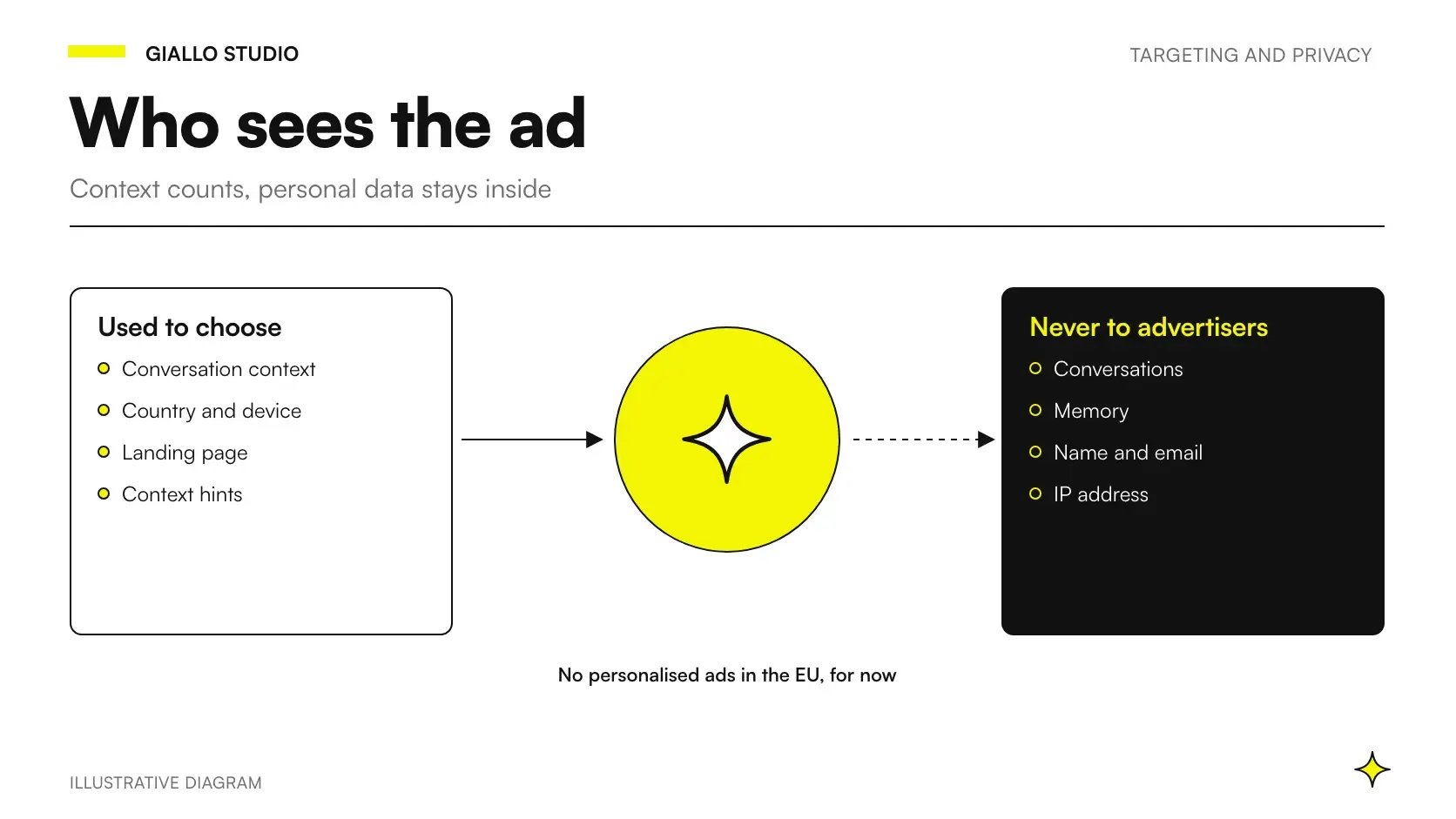
In ChatGPT Ads, for each ad group, you write context hints: descriptions of the conversations and topics where the offer is relevant. The basic guide for advertisers states that they steer matching but are not exact-match and do not guarantee that the ad will appear in specific conversations. The landing page, headline and text count as well.
For exclusions there are Negative Phrases, opened on 5 October 2026 to eligible advertisers only (OpenAI): not every advertiser can exclude every context.
Meta works on a third axis, the profile of the people: its targeting guide recommends starting with a broad audience and letting the system narrow delivery based on who interacts.
In Italy ChatGPT Ads is even more contextual: according to the OpenAI Help Center, ads personalized with history and memory are not initially available in the European Economic Area (EEA). Audiences and GDPR are the subject of the guide to ChatGPT Ads targeting and privacy in Europe.
Bidding, reporting and history: how mature is ChatGPT Ads compared with Google and Meta?
On bidding, the models are similar. ChatGPT Ads uses a second-price auction weighted by relevance and three objectives: views, clicks, conversions. With the conversions objective you set a ceiling, the Bid Cap, but you pay for the impression or the valid click, not the conversion, and in the pages consulted OpenAI gives no recommended amount (guide to conversion-optimized campaigns). Google Ads offers more automated strategies, from target CPA to target ROAS.
The real difference lies in the baseline data. An account on Google or Meta that has been active for a while already knows its cost per lead, its seasonality and the audiences that work. On ChatGPT Ads, OpenAI says it has no benchmarks for advertisers, industries or campaign types, and warns that during the beta, delivery and spend may fluctuate (Official FAQs).
Reporting is basic too: impressions, clicks, spend, average CTR, CPC and CPM, conversions. Spend can show up with a 7-8 hour delay (basics guide), conversions within 24-48 hours (Measure Results). Only static UTMs are used: dynamic macros are not supported.
The minimum budget is €15 per day per campaign in Europe (campaign guide). Pricing and the welcome credit are covered in the guide on how much advertising on ChatGPT costs; the link with the CRM is covered in the deep dive on measuring leads in ChatGPT Ads.
Does Google already show ads inside AI answers in Italy?
No, not inside the answers. According to the Google guide on ads and AI Overviews, accessed on 19 October 2026, ads inside AI Overviews are available in English in 12 countries, including the United States and Canada. Italy is not on the list.
Above and below AI Overviews, however, search, Shopping and Performance Max ads can appear in all the markets where AI Overviews exist. For ads inside AI Overviews, Google specifies that you cannot choose to appear only there, nor opt out, and that there is no separate report.
Microsoft is bringing ads to Copilot with Offer Highlights, for retail in English-speaking markets (Microsoft Advertising, 21 April 2026); there is no confirmation for Italy. Meta's news concerns personalization instead: since 16 December 2025, interactions with Meta AI are used to personalize ads (Meta), and its status in Italy has not been verified.
Of the platforms considered, only ChatGPT Ads has confirmed self-serve purchase of a placement below an AI answer in Italy. For more on how search is changing, see the comparison between Perplexity and Google.
Plumber in Bergamo, travel agency, clothing store: which channel?
Three examples built to show the reasoning, not real clients.
Plumber in Bergamo: for urgency, Google wins
A plumber in Bergamo mostly gets urgent requests: a leak, a blocked drain. Someone with water on the floor searches “emergency plumber Bergamo” and calls the first credible number.
On Google they can target a radius around their premises and put the phone number in the ads as a call asset, because since February 2026 new call-only ads can no longer be created (Google Guide). In Italy there are also Local Services ads, with a plumbers category, eligibility to be checked by area and payment only for leads (Google guide for Italy).
On ChatGPT Ads, local services are allowed: the limit is timing and geography. Outside the United States, country targeting is guaranteed, while smaller areas depend on the selector. And someone asking ChatGPT how to shut off the water valve is still trying to fix the problem on their own. Verdict: Google first; ChatGPT Ads is not a priority.
Tailor-made travel agency: ChatGPT Ads makes sense
A tailor-made travel agency sells a product that takes weeks to choose. Someone planning a honeymoon in Japan asks ChatGPT for itineraries, the best time to go, the days needed, how to get around. It is the conversation full of constraints where OpenAI places its ads, and travel and experiences are among the categories that its advertising policies focus on in the initial phase.
The agency writes context hints about those conversations, such as honeymoons in Asia, and sends the click to a page dedicated to the itinerary. Google remains useful for people already searching for an agency for Japan. The sale closes after days, often by phone: the quote request should be recorded as a conversion and followed up in the CRM. Verdict: ChatGPT Ads deserves a test alongside Google.
Clothing store already on Meta: Meta stays the engine
A clothing store with an online shop already invests in Meta, with Reels and Stories showing the clothes being worn: visual discovery works and there is a track record to reason from.
ChatGPT Ads covers another part of the journey: people asking how to choose a city coat. The product feed ads show the image, title, star rating, price and brand; items expire after two weeks, so the catalog must be synced automatically (feed guide). OpenAI lists them among the best-performing ads, a claim made by the platform itself. The visual format inside image generation is being tested only in the United States.
One practical limit: to show ads to a customer list, or to raise bids on it, you need at least 25,000 matched users (Help Center); below that threshold the list can only be used to exclude. It is a threshold that an independent store rarely reaches. Verdict: Meta stays the main channel; ChatGPT Ads is worth trying on the feed.
When should you use ChatGPT Ads, Google Ads or Meta Ads? The matrix by type of small business
| Type of activity | Main channel | Role of ChatGPT Ads today |
|---|---|---|
| Urgent local service (plumber, locksmith, electrician) | Google Ads, search and Local Services | Marginal |
| Tailor-made service with a long decision (travel, renovations) | Google Ads | Test with a separate budget |
| Ecommerce for visual products (fashion, accessories) | Meta Ads | Test on the product feed |
| Digital products and online courses | Google Ads and Meta Ads | Test, category allowed |
| Financial, healthcare and legal services | Google Ads and Meta Ads, with their own rules | Not usable outside the US |
ChatGPT Ads makes sense if
- the customer compares several options before deciding
- the category is allowed outside the United States
- every offer has a specific landing page
- conversion tracking is already in place
- the test has a budget that does not take resources away from what works
Better to stay on Google and Meta if
- demand is urgent and local
- the sector is finance, healthcare or legal services
- you need benchmarks to justify the spend
- the sale comes from visual discovery
- there is no time to follow a platform in beta
Which sectors pass review and how to write the ad copy is explained in the guide to ChatGPT ads and OpenAI's policies.
How do you split a test budget between Google, Meta and ChatGPT Ads?
The prudent rule: do not take budget away from a channel that delivers measurable results to fund an experiment.
- Keep the channels that work as they are. Google and Meta keep their budget; the ChatGPT Ads test gets a separate figure, decided in advance.
- Start from a sensible minimum. In Europe the minimum is €15 per day per campaign, as a seven-day average: on a single day, spend can reach double (OpenAI).
- Set a duration and an exit criterion. Decide how many weeks the test lasts and what cost per qualified lead would make it worth continuing.
- Use the same definitions everywhere. A lead only counts if it meets the same rule on Google, Meta and ChatGPT.
- Read the data with the right delay. Conversions reach the reports up to two days later: don't judge the campaign in the first week.
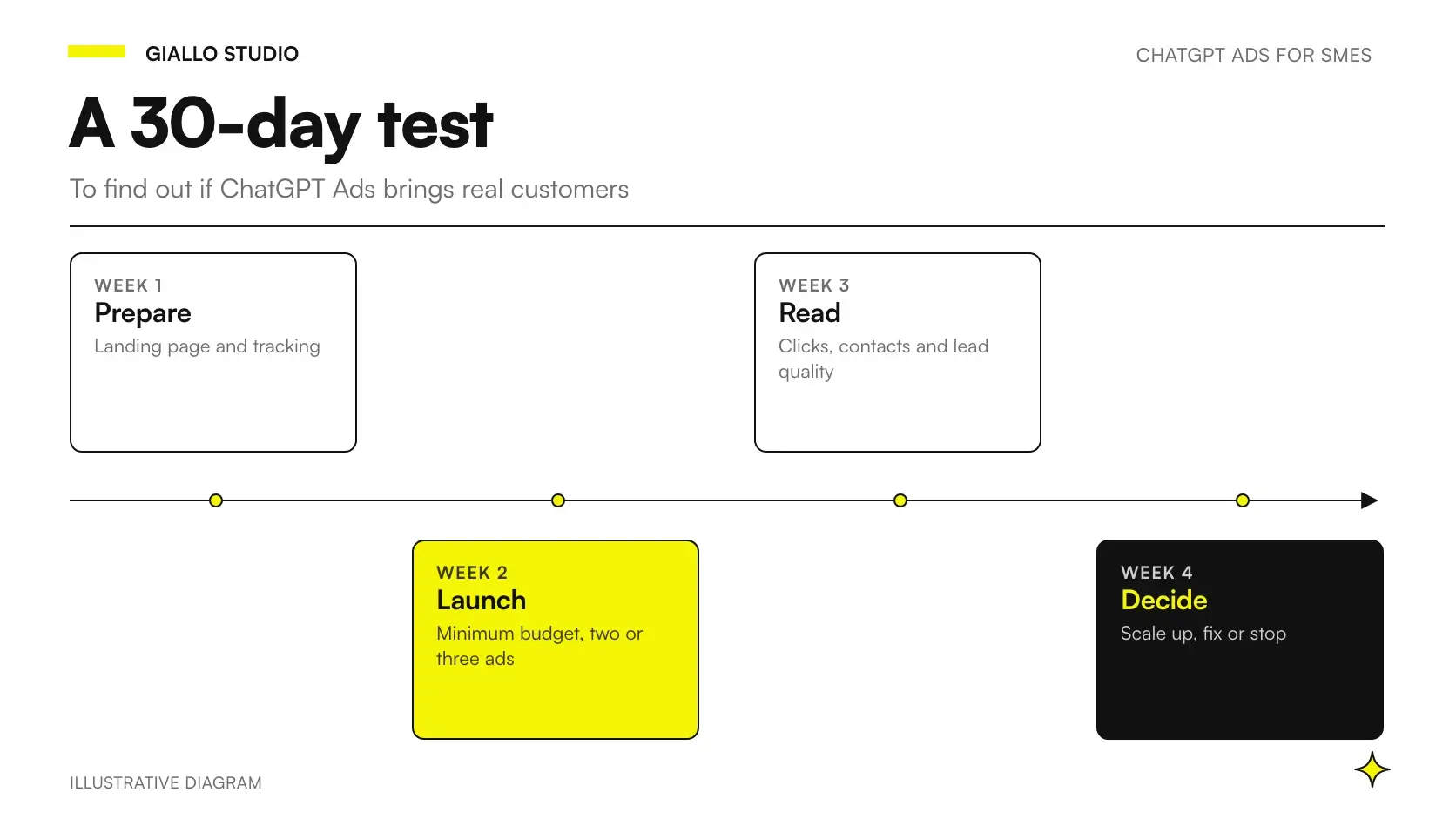
The Italian OpenAI Ads page, accessed on 19 October 2026, offers new advertisers €500 in credit in return for €500 spent. For spending caps and indicators, see the guides on how to set an AI budget in a small business and on KPIs to set before an AI project; a 30-day test calendar is in the guide to ChatGPT Ads for SMEs.
Mistakes to avoid when you bring the Google Ads method to ChatGPT Ads
- Pasting keywords into context hints. A list of bare terms wastes the main signal: the description of the conversation.
- Comparing CPC without looking at the lead. A click from a long conversation can be worth much more or much less than one from a search: the CRM tells you which.
- Reusing URLs with dynamic macros. On ChatGPT Ads every ad must be tagged with static UTMs.
- Promising ads in Google's AI answers in Italy. Today you cannot buy space in Italian inside AI Overviews.
The sequence for opening an account, ad groups and tracking is in the guide to ChatGPT Ads Manager and your first campaign.
The practical choice for an Italian small business in autumn 2026
Google Ads intercepts people who search, Meta Ads people who discover, ChatGPT Ads people who compare. Start with the channels that already measure well; then, if the customer decides after a comparison and the category is allowed, run a test on ChatGPT Ads. Alongside it there is the organic route, getting cited without paying, described in the guide to ChatGPT for SEO; for marketing-team tools, there is the overview of the best AI tools for marketing.
In the projects we follow, the first question is always the same: at what moment does your customer realize they need you? To answer for your business, AI consulting by Giallo Studio lines up active channels, tracking and category, and tells you whether the ChatGPT Ads test is worth the first euro.
Giallo Studio guides: methodology and sources
How we apply it in the company
Related resources
 ChatGPT Ads: what it is and how advertising on ChatGPT works in Italy
 ChatGPT Ads cost: CPC, CPM, minimum budget and welcome credit
 ChatGPT Ads targeting: context, audiences and privacy in Europe
 ChatGPT Ads for small business: is it worth it? Best-fit sectors and a 30-day test
 ChatGPT Ads: new formats, lead measurement and availability in Italy
 Perplexity vs Google: response with sources or link list
 ChatGPT for SEO
 Best AI for Marketing: Tools and Platforms
Other direct comparisons
The same criteria applied to other model pairs.
- DIY AI or agency: how to decide
- Free ChatGPT vs ChatGPT Plus
- Subscription or custom AI: which makes sense?
- ChatGPT Plus vs Claude Pro: which subscription to choose
- Voice AI or chatbot: which channel to choose
- ChatGPT vs Claude: which one to choose
- RPA vs AI automation: differences, costs and when to use which
- ChatGPT vs Copilot: which to use in business?
- Custom business PWA: when it makes sense over off-the-shelf software
- ChatGPT vs DeepSeek: Which to Choose
- Perplexity vs Google: response with sources or link list
- ChatGPT vs Gemini: practical differences
FAQ
Is ChatGPT Ads better than Google Ads?
Not across the board: it depends on the buying moment. Google Ads remains better suited to people searching for a specific or urgent service, while ChatGPT Ads reaches people who are still comparing options in a conversation. For an Italian small business, today, ChatGPT Ads is a test to run alongside Google, not a replacement.
Can you buy keywords on ChatGPT Ads like on Google Ads?
No. Instead of keywords, you write context hints: descriptions of the conversations and topics where the offer is relevant. OpenAI states that they are not exact-match and do not guarantee that the ad will appear in a specific conversation.
Can you show ads inside Google's AI answers in Italy?
Not yet. According to Google's guide, accessed on 19 October 2026, ads inside AI Overviews are available only in English and in 12 countries, and Italy is not one of them. Above and below AI Overviews, however, ads can appear in all the markets where AI Overviews are available.
Can ChatGPT Ads replace Meta Ads for an ecommerce store?
No. Meta Ads works on visual discovery in feeds, Stories and Reels, with audiences defined by age, location and interests. ChatGPT Ads reaches people who ask for advice before they buy: for an ecommerce store it makes sense as a test on the product feed, alongside Meta.
How much budget should I take from Google Ads to try ChatGPT Ads?
None, if Google is already delivering measurable results. Fund the test with a separate budget, decided in advance. In Europe the minimum is €15 per day per campaign, as a seven-day average.
Can a law firm or a doctor move from Google Ads to ChatGPT Ads?
Not today. Outside the United States, OpenAI's policies generally prohibit ads for financial and healthcare services and, for now, for legal services. For these sectors, Google and Meta remain the options, with their own sector rules.
Does ChatGPT Ads have performance benchmarks like Google Ads?
No. OpenAI writes that the platform does not yet have benchmarks for advertisers, industries or campaign types. Early results should be compared with your own data on Google and Meta, using the same definitions of lead and sale.