
ChatGPT Ads targeting: context, audiences and privacy in Europe
ChatGPT Ads targeting explained: the signals that pick the ad, customer-list audiences, what applies in the EEA, and what to do about GDPR, Pixel and cookies.
Reading time: 12 min
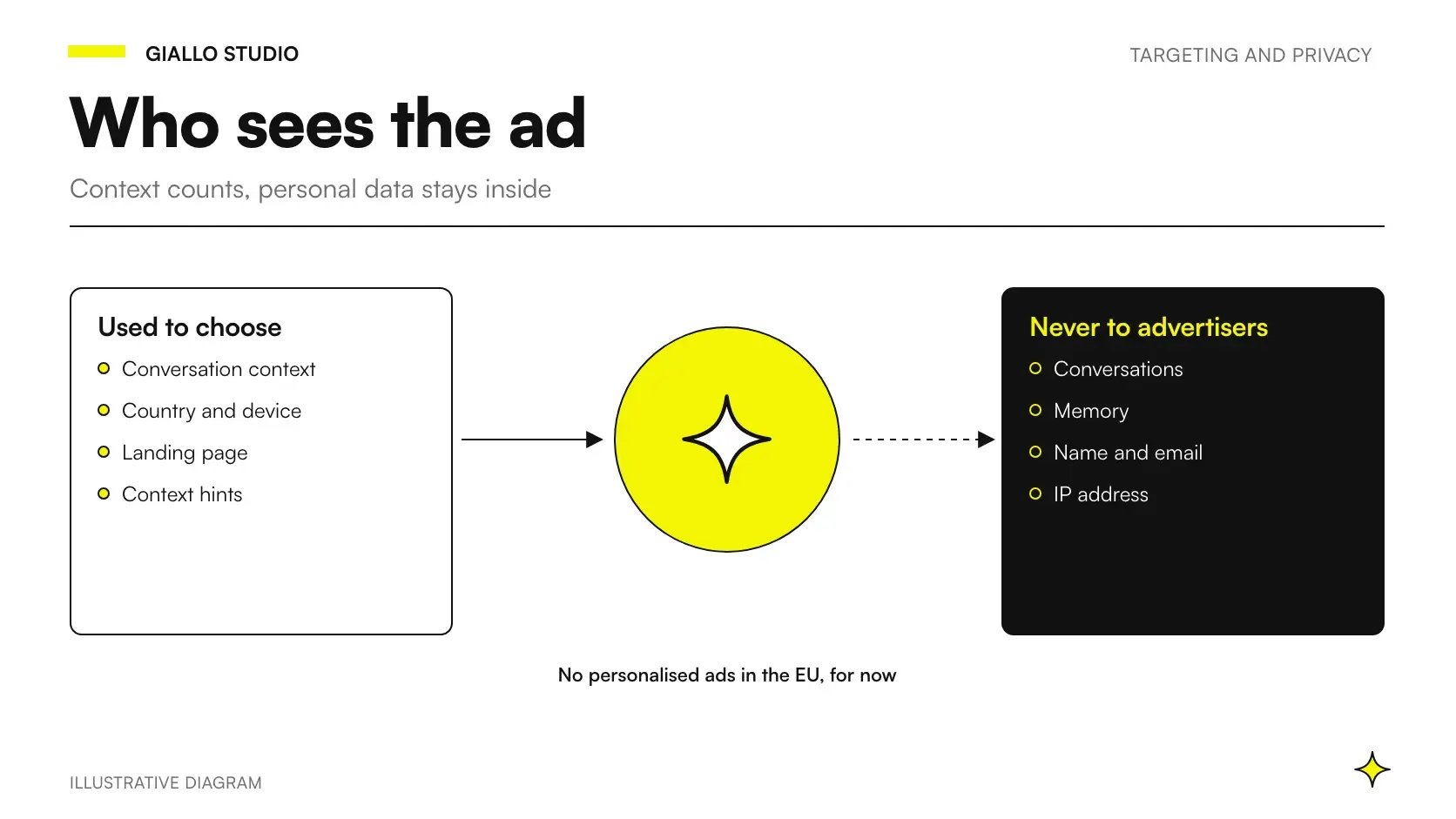
The ChatGPT Ads targeting system starts with the conversation, not the person. OpenAI chooses the ad by reading the context and intent of the current chat, together with the landing page, headline, text and the context hints written by the advertiser; the business adds country, device and any audiences built from its own customer lists. In Italy, as across the whole European Economic Area (EEA), personalized ads based on past chats and memory are not initially available, according to the “Ads in ChatGPT” Help Center page accessed on 19 October 2026.
Privacy has two sides. For users: the advertiser receives only aggregated numbers and never sees conversations, names, emails or IP addresses. For the business that advertises: when it uploads a customer list or installs the OpenAI Pixel, it is responsible for the privacy notice, legal basis and cookie consent, as with any advertising platform. Plans, formats and availability are covered in the complete guide to ChatGPT Ads.
In summary
- ChatGPT Ads targeting is based on the context of the current conversation and on context hints, which are not exact-match keywords.
- In the European Economic Area and Switzerland, personalized ads based on past chats and memory are not initially available, according to OpenAI as of 19 October 2026.
- A custom audience built from an email or phone list can be used only if it reaches at least 25,000 matched users.
- Advertisers receive only aggregated reports: never chats, memories, name, email, precise location or IP address.
- For data sent through the Pixel and Conversions API, the business and OpenAI are independent controllers: the privacy notice and consent are the business's responsibility.
- Since 31 August 2026, ChatGPT has been designated a very large online search engine under the Digital Services Act (DSA), with additional obligations due by January 2027.
How does ChatGPT Ads targeting work?
ChatGPT Ads chooses the ad based on its expected relevance to what the person is trying to do. The basic guide for advertisers lists the signals: conversation context and intent, landing page, headline, text, context hints and targeting choices. If several ads are eligible, relevance and bid decide together.
General location and language also count. The ad's language may differ from the chat's, because the system also considers location and settings: if you are targeting an Italian audience, prepare the copy and landing page in Italian.
Compared with Google and Meta, the method is different: no keywords or interests; you describe the conversations where the offer makes sense, and hints steer the matching without guaranteeing that the ad appears in a specific chat. How to write them is covered in the guide to your first campaign with ChatGPT Ads Manager; the difference from keywords is explained in the comparison ChatGPT Ads vs Google Ads.
Are ChatGPT ads personalized in Italy?
No, not with past chats and memory. The Help Center says personalized ads “are not initially available” in the European Economic Area and Switzerland, whereas elsewhere they can use previous conversations, memory and reactions to other ads.
The OpenAI EU privacy policy, updated on 24 August 2026, already describes both regimes. With the consent of the user, ads are personalized, to the extent the feature is available. Without consent, there are generic ads based on limited information, namely chat context, location, time of day and device type, on the basis of the legitimate interest of OpenAI and third parties, advertisers included. The two pages do not contradict each other: the policy sets the rules, while the Help Center says personalization has not launched in Europe. No launch date appears to have been published as of 19 October 2026.
In practice, in Italy targeting comes down to relevance to the conversation: precise hints, a consistent landing page, a clear offer.
What data does OpenAI use, and what reaches the advertiser?
The table summarizes what the page “Ads in ChatGPT” and the EU privacy policy state for an Italian user on the Free and Go plans.
| Data | Used to choose the ad? | Reaches the advertiser? |
|---|---|---|
| Context and intent of the current chat | Yes, it is the main signal | No, the conversation is never shared |
| General location, language, time, device type | Yes, also for generic ads | No; precise location and IP address never |
| Past chats and memory | Not initially in the EEA | No, never |
| Ads seen, hidden or clicked | Only with personalization on | Only as totals of impressions and clicks |
| Customer lists uploaded by the business | To include, exclude or adjust bids | Ads Manager does not show individual matched users |
| Conversions from Pixel and Conversions API | Yes, to measure and optimize campaigns | As totals in the report, not per person |
| User name and email | Not among the declared signals, except for list matching | No, never |
| Sensitive topics: health, mental health, politics | No, ads do not appear there | No, never |
In Ads Manager the business sees impressions, clicks, spend, average CTR, CPC and CPM, and conversions, which can be exported as CSV (report guide). The OpenAI advertising terms add a constraint that is often overlooked: report data may be used only to measure frequency, reach and effectiveness, and may not be combined to identify people or build segments on OpenAI users.
What happens to the text employees type into ChatGPT, by contrast, is explained in the guide on what happens to company data in AI tools.
What can you set in Ads Manager? Country, device, areas and exclusions
An advertiser has few levers. The campaign creation guide lists:
- Country, always set at campaign level.
- Platform: iOS app, Android app or web, desktop and mobile together.
- Areas below country level: in the United States state, DMA and ZIP code; elsewhere regions, cities and postal codes “where available”, with an offering that varies from country to country.
- Custom audiences to include or exclude, plus bid multipliers in ad groups.
OpenAI does not say which Italian locations can be selected in the pages accessed on 19 October 2026: check the location selector in Ads Manager.
Then there are the exclusions decided by OpenAI. The advertising policies, updated on 10 September 2026, keep ads away from conversations about personal and mental health, politics, self-harm, hate and emotional dependence on the model. For brand placement needs, since 5 October 2026 eligible advertisers can use Negative Phrases (OpenAI). The sectors allowed in Italy are the topic of the guide to OpenAI ads and policies.
ChatGPT Ads custom audiences: how does the 25,000-user threshold work?
A custom audience is a list of customers or prospects uploaded as emails or phone numbers, in plain text or as SHA-256 hashes. The custom audiences guide describes three uses:
- Inclusion: the campaign is eligible only for people on the list.
- Exclusion: the campaign runs for everyone except people on the list, for example recent customers.
- Bid multiplier: the ad group's maximum bid goes up or down, from 0.1x to 10x, when the user belongs to the audience, without deciding who can see the ad. The effect on spend is explained in the guide on CPC, CPM and budgets in ChatGPT Ads.
The rule that stops many small businesses is the threshold: to show ads to an audience or adjust bids on it you need at least 25,000 matched users, and OpenAI recommends at least 100,000. Invalid values, duplicates and contacts with no match do not count. Below that threshold the list is still useful, but only for exclusion: in Ads Manager it appears as ready with the note “Exclusion only” (custom audiences guide, accessed on 19 October 2026).
An audience cannot be edited: to update it, you create a new one. The uploaded file is deleted after processing, usually within 24 hours.
The Ad Tools Terms, published on 24 August 2026, set three conditions. The data must be first-party, not bought from data brokers or marketplaces. The business must have provided the privacy notices and have the legal bases to share the data. And sensitive data is prohibited, such as health, sexual orientation, political opinions or financial hardship, as is using audiences to re-identify users.
Example: a pet supplies online store and its customer list
Example. An online store selling food and accessories for dogs and cats has 60,000 customers, with emails collected through orders. It wants to avoid paying for clicks from people who bought in the last month, and to bid higher when it reaches a food subscriber.
The first step is not technical: check that the privacy notice covers using contacts for ads on third-party platforms and that a valid legal basis exists, to be chosen together with whoever handles your privacy. Then the export: a file of emails only, optionally as SHA-256 hashes.
Here the limits come in. Last month's buyers number 9,000: too few for a dedicated bid, but enough to exclude them, so the test does not spend on people who have just bought. The uploaded subscribers number 30,000, but they might match below 25,000 and remain useful only as an exclusion. To adjust bids you need an audience above the threshold: the one with all 60,000 customers has more headroom, and a multiplier below 1, for example 0.5x, spends less on people who already buy if the test is looking for new customers. Audience and event names stay neutral: OpenAI's agreements prohibit labels that reveal sensitive information about people.
ChatGPT Ads and GDPR: who is the data controller, and what falls to your business?
For European users, the controller of the data processed by ChatGPT, ads included, is OpenAI Ireland Ltd. The lead supervisory authority is the Irish Data Protection Commission, but you can also contact the Italian Data Protection Authority (Garante). The advertising contract of a business in the EEA is also with OpenAI Ireland.
When the business sends data to OpenAI, the roles are set by the Ad Tools DPA, in force since 19 August 2026.
| Data flow | Company | OpenAI | What the business must do |
|---|---|---|---|
| Pixel and Conversions API events | Independent controller | Independent controller | Privacy notice, consent where required, handling of objections and withdrawals |
| Audience list matching | Data controller | Processor | Legal basis for uploading the list and privacy notice to customers |
| ChatGPT conversations and usage data | No role | Controller (OpenAI Ireland) | None: the business does not receive them |
Being independent controllers means that each is responsible for its own processing: the business guarantees privacy notices and consents and, if a customer withdraws consent or objects, stops sending that customer's data.
No Garante guidance specific to ChatGPT ads appears in the sources accessed on 19 October 2026. Legal basis, privacy notice and transfers remain the usual topics, covered in the guides on legal basis and privacy notices when using AI and on GDPR applied to artificial intelligence in business.
OpenAI Pixel and cookie banners: what changes on an advertiser's website?
The OpenAI Pixel records the actions taken on the site after the click: purchase, inquiry, sign-up. As the conversion measurement guide explains, it saves the click reference in a first-party cookie called oppref, and with automatic advanced matching it reads identifiable data in forms, hashes it with SHA-256 in the browser and attaches it to the event. OpenAI asks advertisers to send conversions only after informing users and obtaining the consents required by law.
In Italy the reference is the Garante guidelines on cookies and other tracking tools of 10 June 2021. Without consent only technical tools may be used; closing the banner with the X means browsing without the non-technical ones; scrolling the page does not count as consent. A Pixel that sends events to a third-party advertising platform, which is an independent controller of the data, is not a technical tool: it must be activated only after the visitor says yes.
Three steps are needed: the Pixel loaded by the consent management platform only with marketing consent, OpenAI named in the privacy notice and cookie policy as an independent controller, and a map of the forms that automatic matching can read. People who decline remain in the Ads Manager clicks but not in conversions, apart from the modeled estimate that OpenAI applies where available. How to connect conversions to leads and your CRM is explained in the article on measuring leads in ChatGPT Ads.
Example: a cooking school in Bologna looking for students in the city
Example. A cooking school in Bologna sells evening fresh-pasta courses and gift packages, to people who live in the city or arrive for a weekend. Before starting, it checks in the location selector whether Bologna or Emilia-Romagna are available. If they are not, it sets Italy as the country and leaves the local part to context hints: what to do in Bologna at the weekend, an experience gift in Emilia, how to learn to fold tortellini.
The landing page shows the address, calendar and prices, because the page is also a signal for matching. The Pixel fires only after consent in the banner, the conversion is the completed enrollment, and static UTM parameters make the traffic recognizable in the school's analytics tools, always within the limits of consent. The privacy notice adds OpenAI among the recipients of data for advertising purposes.
In the report the school reads clicks and enrollments without knowing who the people are: to find out where its students come from, it can add an optional “how did you hear about us” field to the form.
What will the Digital Services Act change from 2027?
On 31 August 2026 the European Commission designated ChatGPT as a very large online search engine, after the service reported at least 45 million average monthly users in the EU. The additional obligations must be met by January 2027.
For advertisers, the most concrete one is the ad repository under Article 39 of the DSA: a public, searchable archive with the content of each ad, on whose behalf it was presented and who paid for it, the period it ran, whether it targeted specific groups and with which main parameters, exclusion ones included, and the number of people reached. It stays online until one year after the last time the ad was displayed. An OpenAI repository does not appear to have been published as of 19 October 2026, but it is worth setting up ads and audiences already knowing that competitors will be able to consult them.
Which targeting and privacy mistakes cost a small business the most?
- Building the test on a customer list without checking the threshold and whether it applies in Italy. Below 25,000 matched users, the audience can only be used to exclude.
- Installing the Pixel outside the consent management platform. The numbers look more complete, but the site is not compliant.
- Uploading lists that were bought or enriched by third parties. The Ad Tools Terms allow only first-party data.
- Taking city targeting for granted. Without available areas, local targeting runs through hints and the landing page.
Privacy checklist before your first ChatGPT Ads campaign
- Updated privacy notice. OpenAI named as a recipient and independent controller for the Pixel and Conversions API.
- Pixel behind consent. Activation only after the yes in the banner, checked in debug mode before launch.
- First-party lists only. Contacts collected by the business, with a documented legal basis.
- Threshold checked. At least 25,000 matched users to include an audience or adjust bids; below the threshold, exclusions only.
- Neutral names. Events, audiences and parameters that do not reveal sensitive data.
- Locations verified. Italian areas checked in Ads Manager before a local test.
On ChatGPT Ads, OpenAI handles most of your users' privacy; the privacy of your site and your lists remains yours. Whether your business is a good fit for the channel is covered in the guide to ChatGPT Ads for small business. To fix the banner, privacy notice and customer lists before launch, get help from AI consulting by Giallo Studio to set them up, so the test measures the channel and not configuration errors.
Giallo Studio guides: methodology and sources
How we apply it in the company
Related resources
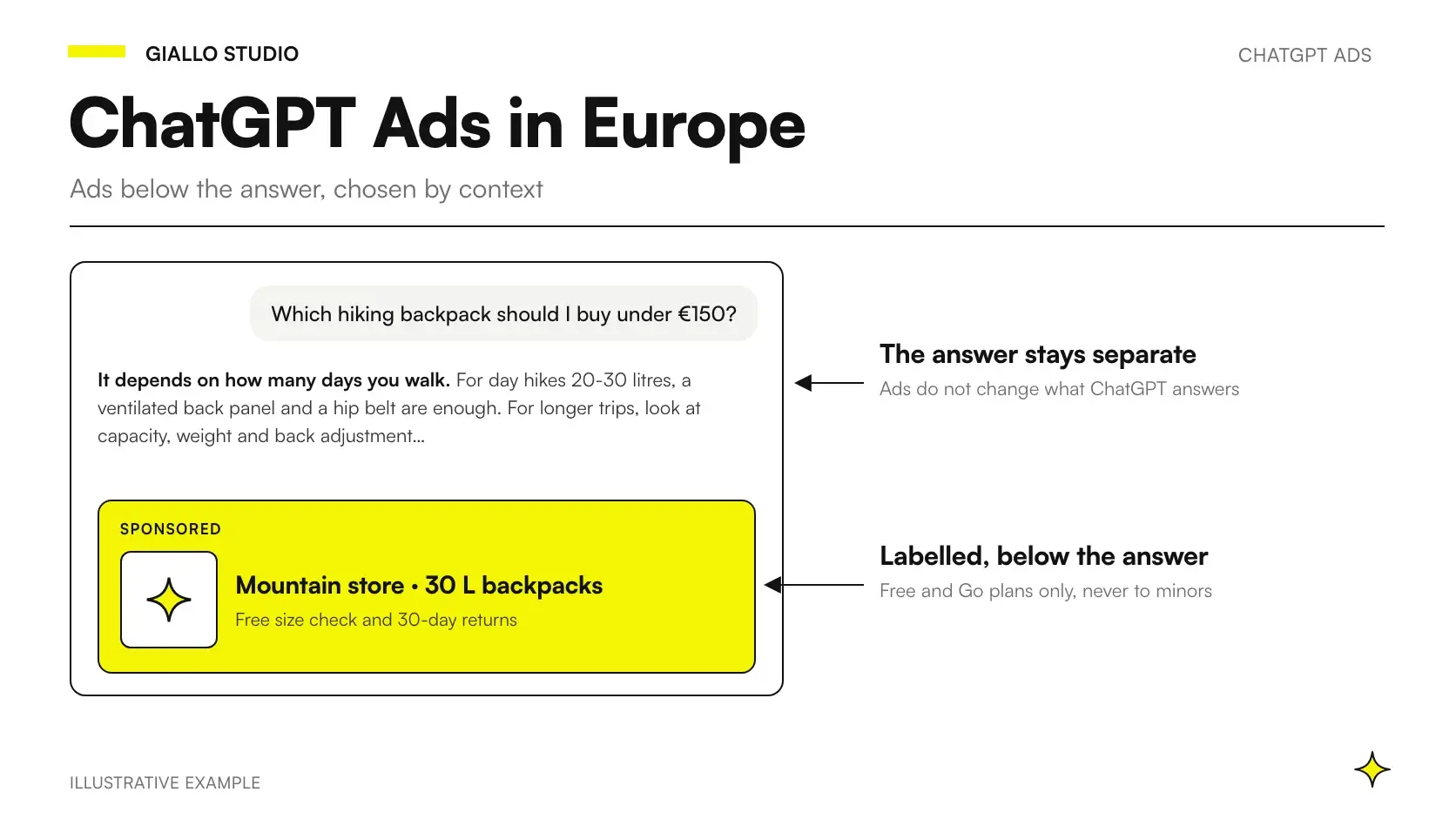 ChatGPT Ads: what it is and how advertising on ChatGPT works in Italy
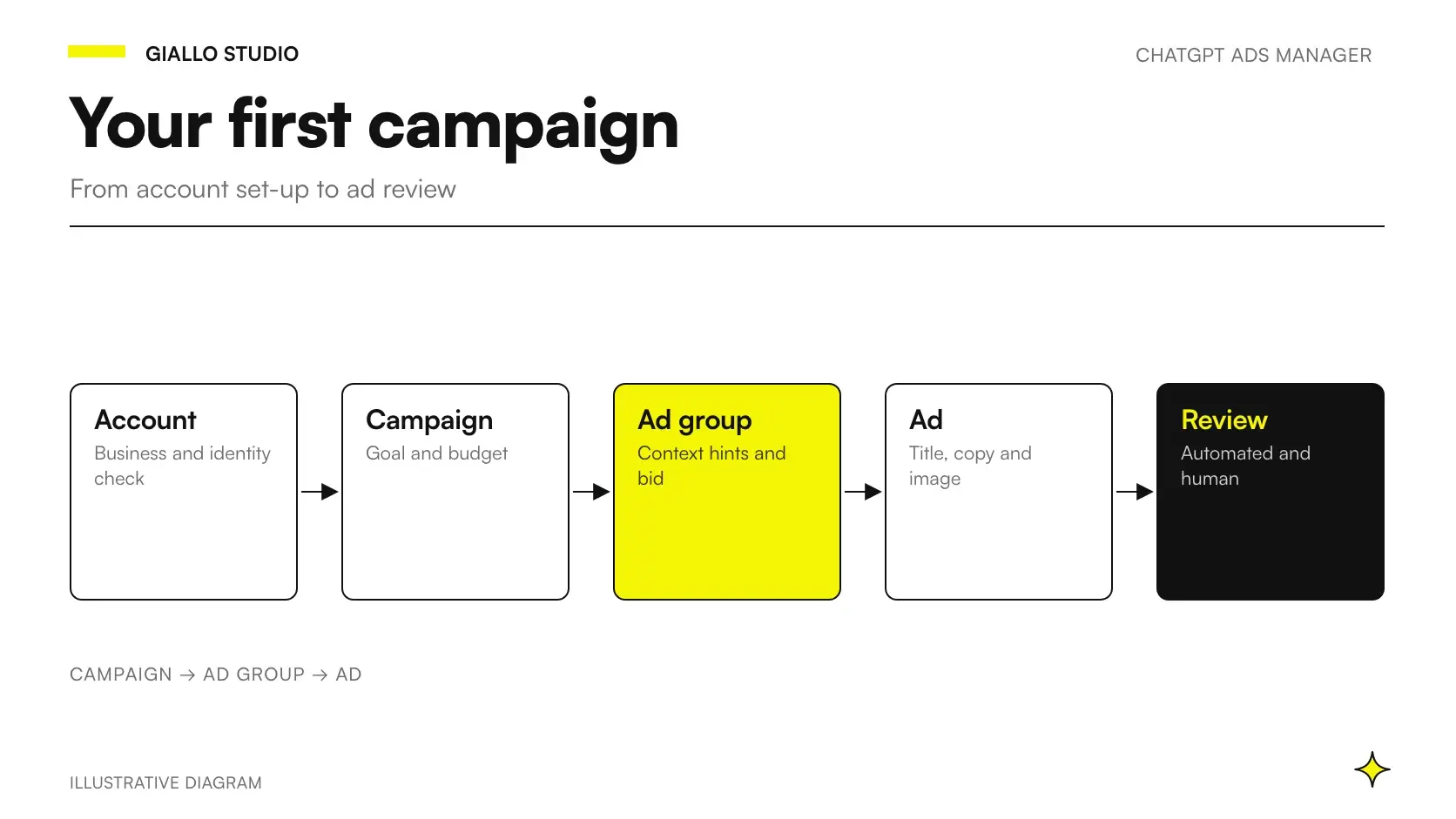 ChatGPT Ads Manager: how to create your first campaign, step by step
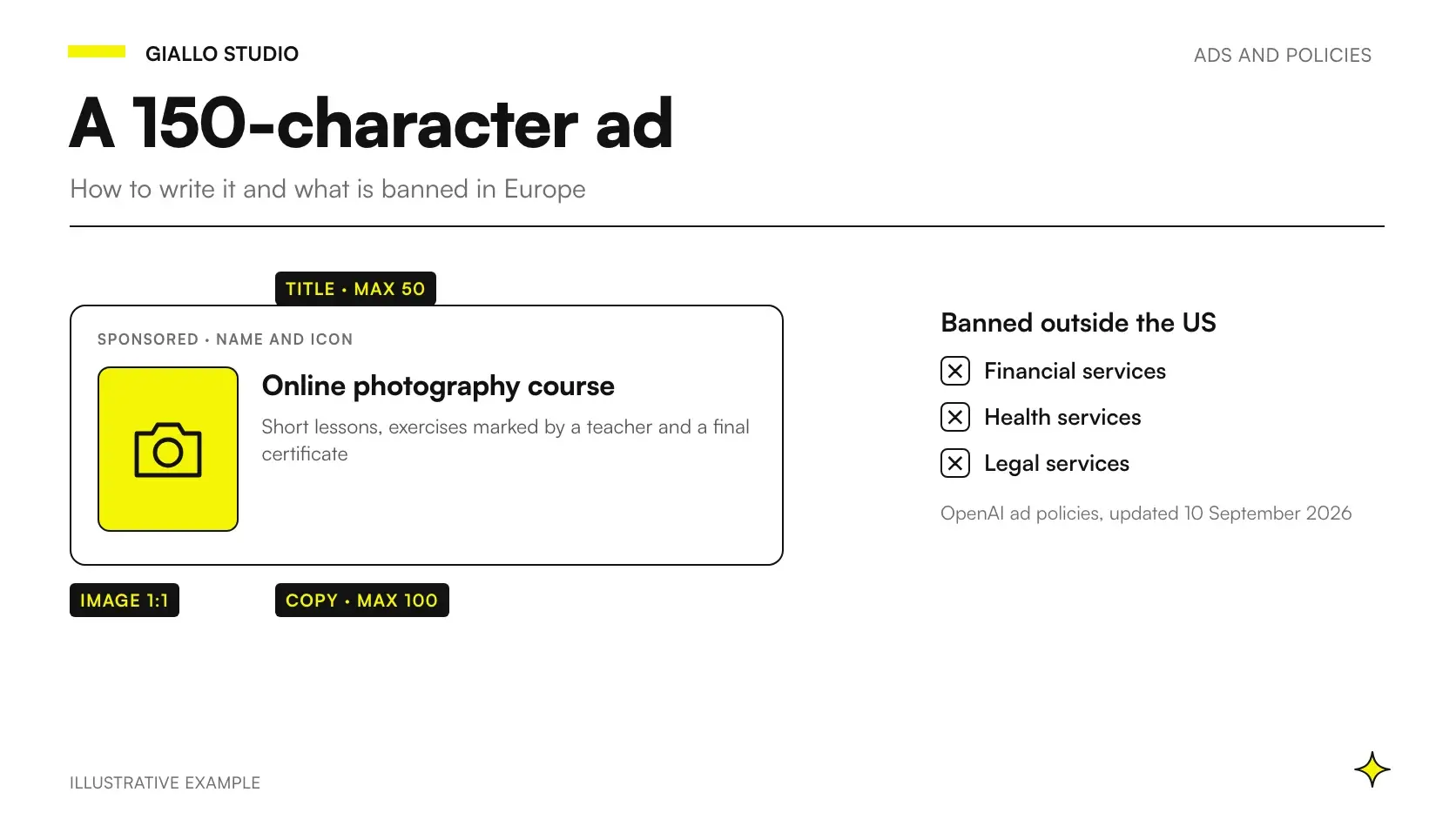 ChatGPT Ads creative: how to write your ads and what OpenAI's policies prohibit
 ChatGPT Ads: new formats, lead measurement and availability in Italy
 ChatGPT Ads for small business: is it worth it? Best-fit sectors and a 30-day test
 AI and GDPR: What a company needs to know before using AI
 GDPR and artificial intelligence in the company
 Business Data and AI: What Happens to What You Write
FAQ
Does ChatGPT Ads use my conversations to choose ads?
Yes, but in Italy only the current conversation is used. In the European Economic Area and Switzerland, personalized ads based on past chats and memory are not initially available, according to the OpenAI Help Center accessed on 19 October 2026. Conversations are never shared with advertisers.
Can you target an Italian city or region on ChatGPT Ads?
Not confirmed. Ads Manager offers targeting by country and, in the United States, by state, market area (DMA) and ZIP code; for other countries OpenAI mentions regions, cities and postal codes where available. Before planning a local campaign, check the location selector to see which Italian areas appear.
What is a custom audience on ChatGPT Ads?
A custom audience is a list of customers or prospects, uploaded as emails or phone numbers, used to include, exclude or adjust bids for the people on it. You can use it only if it holds at least 25,000 matched users, and OpenAI recommends at least 100,000. The data must be first-party, never bought from third parties.
Can advertisers see who clicked their ad on ChatGPT?
No. Ads Manager shows aggregated data such as impressions, clicks, spend and conversions, with no names, emails, IP addresses or precise location. Even with custom audiences, advertisers cannot see the individual matched users.
Do you need cookie consent to install the OpenAI Pixel?
Yes, as a rule. The guidelines of the Italian Data Protection Authority (Garante) require prior consent for tracking tools other than technical ones, and OpenAI asks advertisers to send conversion data only after informing users and collecting the consents required by law. Connect the Pixel to your cookie banner and activate it only after the visitor says yes.
Who is the data controller for ChatGPT ad data in Italy?
For European users it is OpenAI Ireland Ltd. For data a business sends through the Pixel and Conversions API, the business and OpenAI are independent controllers; for matching custom audience lists, the business is the controller and OpenAI is the processor.
Do ChatGPT ads appear in chats about health or politics?
No. OpenAI excludes ads from conversations about personal health, mental health and politics. The ad policies also keep out other sensitive contexts, such as self-harm, hate and harassment.