
ChatGPT Ads for small business: is it worth it? Best-fit sectors and a 30-day test
ChatGPT Ads for small business: see which Italian companies can already advertise on ChatGPT, who should wait and how to set up a measurable 30-day test.
Reading time: 11 min
ChatGPT Ads for small business makes sense today in Italy for small and medium-sized businesses that sell home and lifestyle products, local services, travel and experiences, digital products or training, and that can measure what happens after the click. Companies that offer financial, healthcare or legal services, on the other hand, cannot in practice buy ads for now: outside the United States, advertising policies exclude them. For businesses in the allowed categories, the prudent choice is a 30-day test with a single offer, a budget set in advance and a written rule for deciding whether to continue.
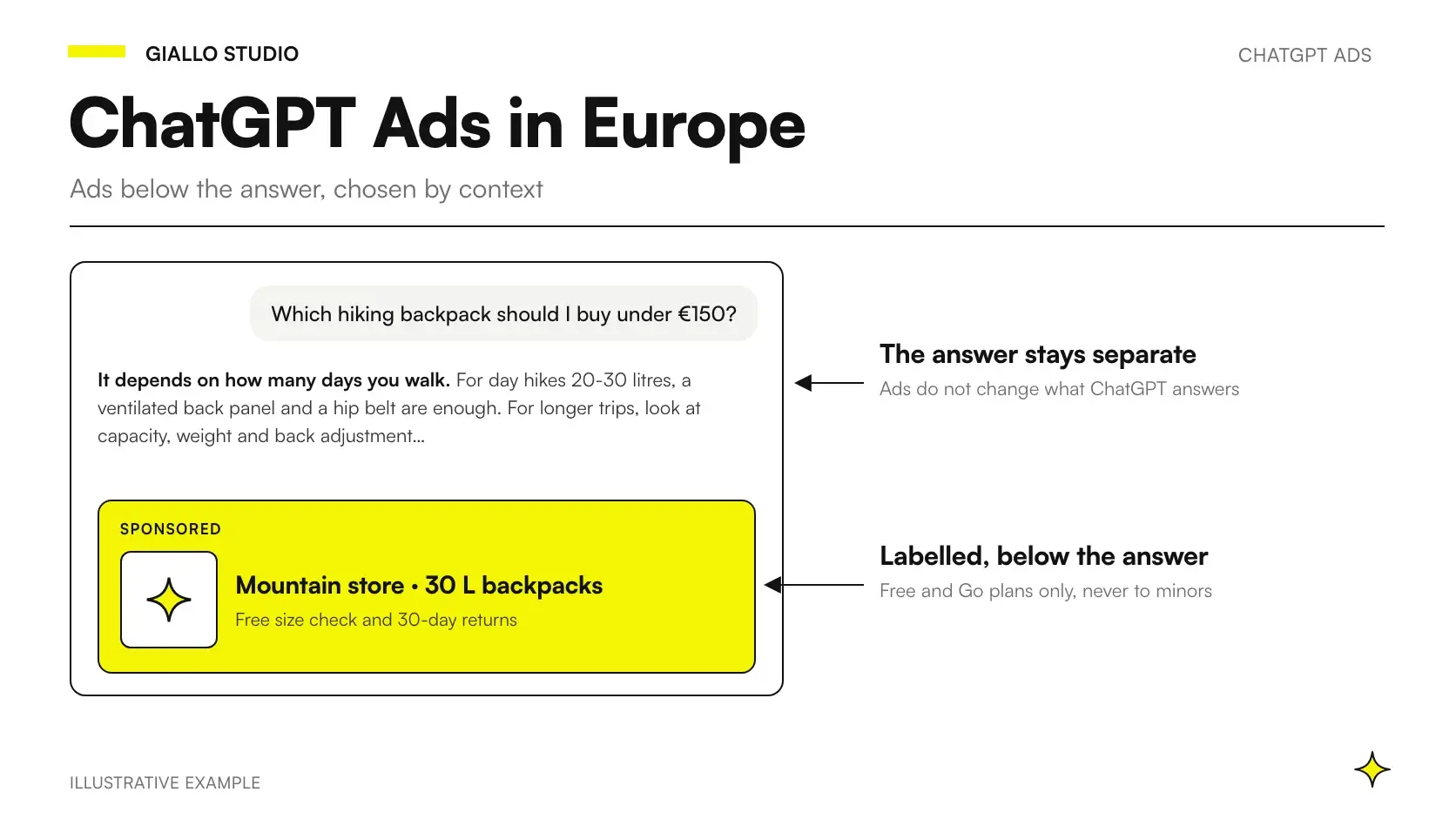
ChatGPT Ads shows ads below ChatGPT's answers to users on the Free and Go plans, and in Italy it has been available to buy through Ads Manager since 31 August 2026. Dates, formats and general rules are in the complete guide to ChatGPT Ads; here you will find the decision-making part, with facts verified on OpenAI's official pages as of 19 October 2026.
In summary
- ChatGPT Ads for small business is suitable today for ecommerce, local services, tourism, training and digital products: these are the categories on which OpenAI's policies focus the initial phase.
- Outside the United States, the policies define financial and healthcare services as “generally prohibited” and legal services as “currently prohibited”.
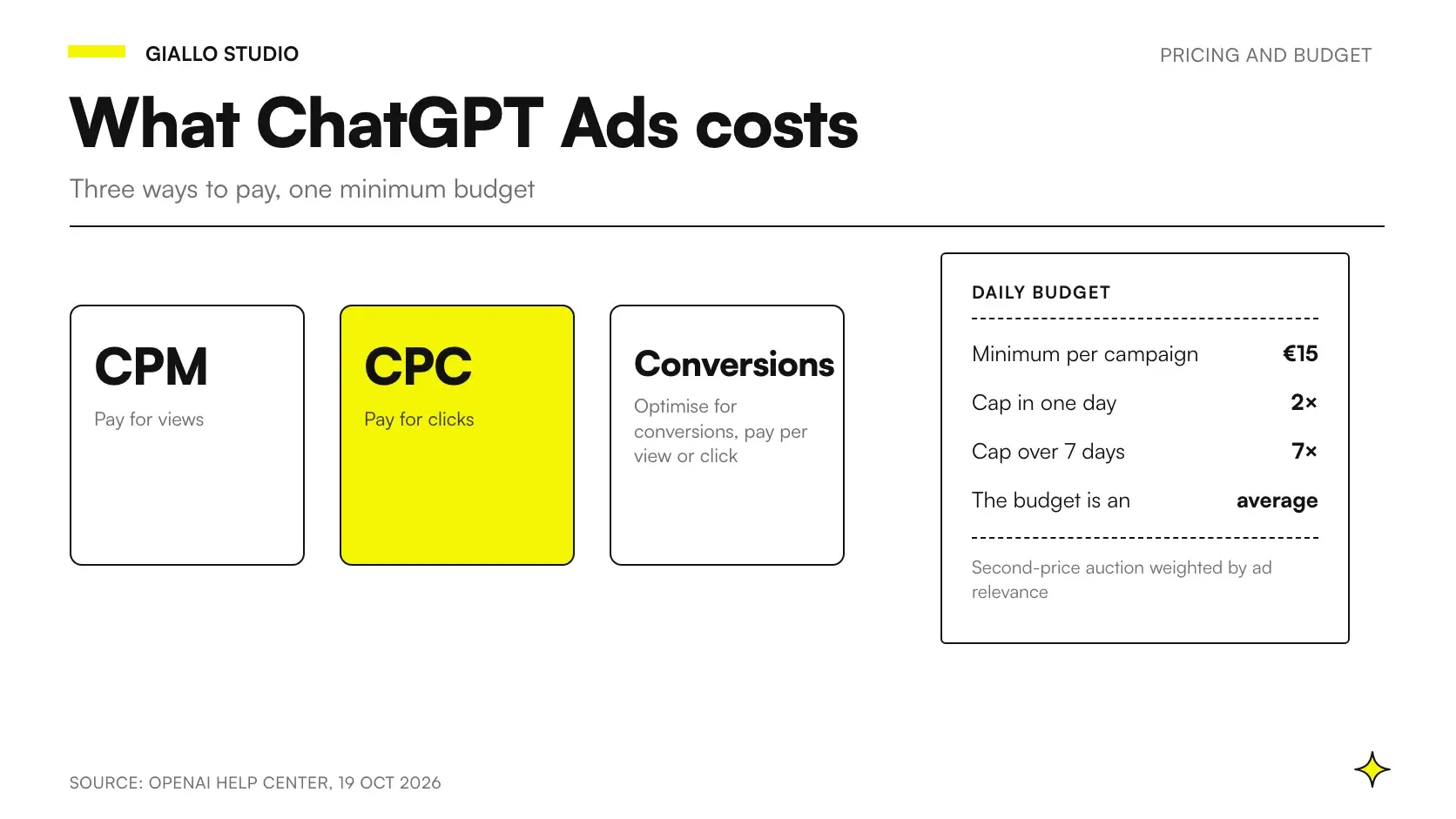
- In Europe, the minimum budget is €15 per day per campaign, so a test campaign at the minimum comes to about €450 over 30 days (campaign guide).
- OpenAI states that it does not yet have performance benchmarks by industry: a small business has to compare results against its own channels.
- The published cases, such as Newegg or WeightWatchers, are results reported by OpenAI or its measurement partners, with no independent verification.
- Buying ads does not get a business into ChatGPT's answers: organic visibility is built separately.
Is ChatGPT Ads worth it for small businesses in Italy?
Yes, on three conditions: work in an allowed category, sell something the customer chooses after comparing options, and have your landing page and tracking ready before you spend.
The channel is open to small companies too: according to OpenAI's announcement of 31 August 2026, small and medium-sized businesses have become a significant share of the business with Ads Manager. The pages we reviewed show no minimum total spend commitment, only a minimum daily budget per campaign.
The limit is maturity. The platform is in beta, delivery can fluctuate, and OpenAI writes that it does not yet have performance benchmarks for industries or campaign types (Official FAQs). Those who start now are mainly buying information: they find out whether their audience is there and how much it costs to reach it. When an urgent request still favors classic search, see the article ChatGPT Ads vs Google Ads.
Which small businesses can advertise on ChatGPT in Italy today?
The policies, updated on 10 September 2026, focus the initial phase on home and lifestyle products, local services, travel and experiences, digital products or training, and plan to widen the categories over time. The table translates these rules for the most common types of small business.
| Type of business | Status in Italy | Best-fit format | First check |
|---|---|---|---|
| Ecommerce for home and lifestyle products | Allowed | Product feed ads | Catalog updated automatically: feed items expire after two weeks (feed guide) |
| Local services for consumers | Allowed | Standard ads linking to a contact page | Service area: besides the country, regions and cities only where available (creating campaigns) |
| Tourism, hospitality and experiences | Allowed | Ads linking to the booking page | One campaign per source market |
| Training and digital products | Allowed | Ads with the Conversions objective | Enrollment event already tracked |
| Financial services | “Generally prohibited” outside the US | None, for now | Budgeting tools and courses without financial services may be allowed |
| Healthcare and medical services | “Generally prohibited” outside the US | None, for now | Organic content |
| Legal services | “Currently prohibited” outside the US | None, for now | Organic content |
Two details matter. During account verification, OpenAI checks whether products and services are allowed (account setup), so check your category before you sign up. And an allowed ad cannot lead to a page that introduces prohibited content. Headlines, copy and reasons for rejection are covered in the guide on how to write ChatGPT ads that comply with the policies.
What signs show that a business is ready for ChatGPT Ads?
OpenAI describes ChatGPT as the place where people explain what they want to achieve, what matters to them and what constraints they have (OpenAI, 18 August 2026). So the first sign is an offer that the customer chooses after comparing alternatives. The others are operational.
- Considered purchase. The customer compares materials, sizes, dates or programs. An impulse purchase or an emergency finds an answer faster elsewhere.
- Readable landing page. The page responds to OAI-AdsBot, the review crawler, without firewall blocks, CAPTCHAs or logins (crawler guide).
- Tracked conversions. OpenAI Pixel or Conversions API installed, with users' consent where required, and static UTMs on URLs.
- Legal entity based in Italy. The business that advertises and receives the invoice must be based in an available country. For sole proprietorships, the pages we reviewed do not make clear whether they qualify as the required “legal entity”.
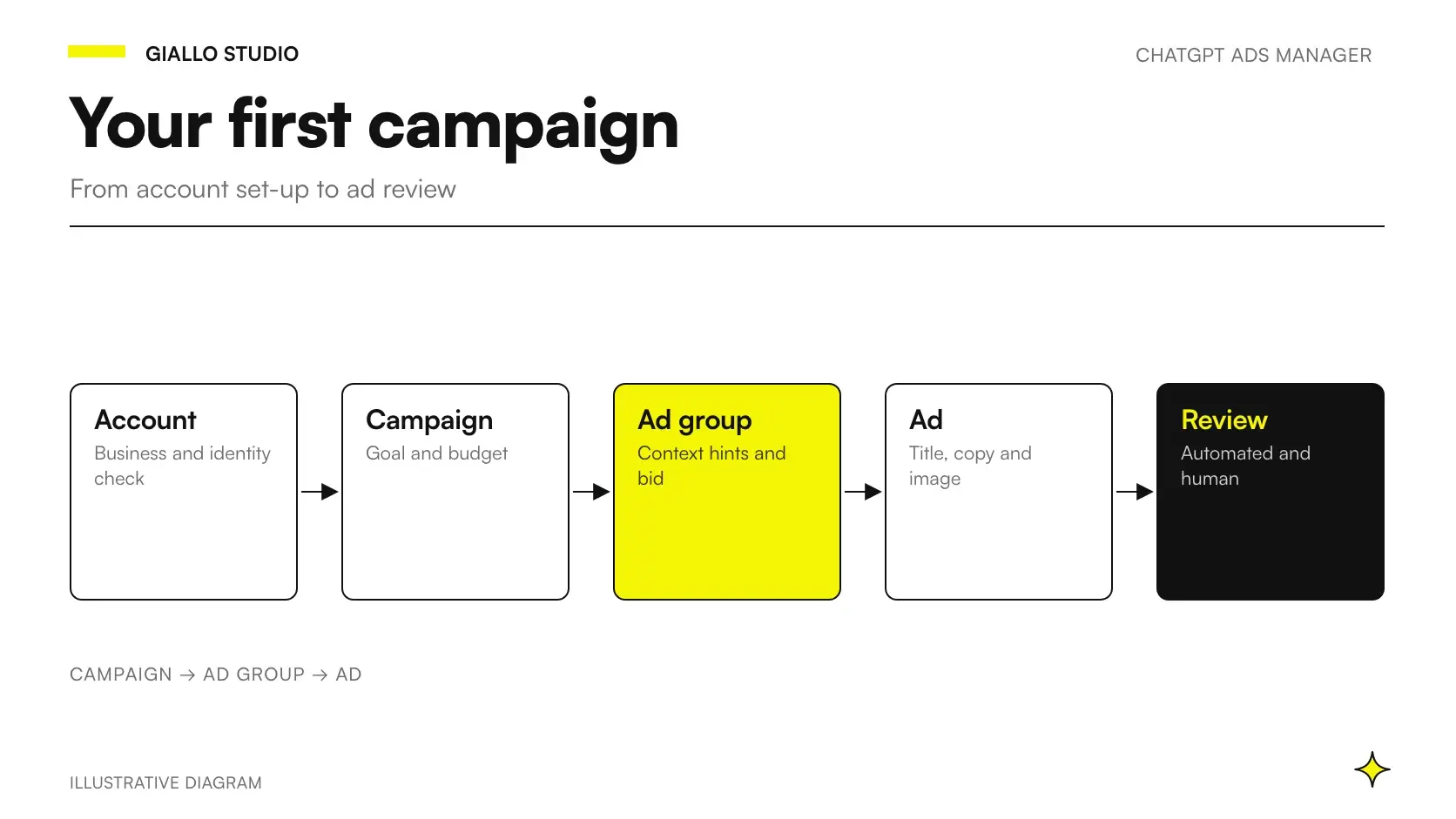
If the landing page and tracking are missing, that work comes before the campaign: the sequence is in the guide to ChatGPT Ads Manager and your first campaign. Consent and Pixel are covered in the guide to ChatGPT Ads targeting and privacy.
Three small business profiles: ceramics, farm stay, digital academy
The three cases are examples built around typical Italian businesses, not clients.
Handmade ceramics workshop selling online
The workshop sells handmade plates, cups and vases from its own ecommerce store: they fall under home products. The natural format is product feed ads, with the image, price and reviews of each piece. Feed items expire after two weeks, so it is best to connect the catalog through a hosted URL. If the store is on Shopify, the ChatGPT Ads app has been available since 23 September 2026, outside the United States too (OpenAI announcement of 16 September).
Sample context hints: “handmade wedding gift”, “stoneware dinner set for six people”. To measure: orders, share of new customers, average cart value. An idea taken from the published cases: run a seasonal campaign before Christmas alongside the always-on feed. For product pages and AI-managed reviews, see the guide to AI for e-commerce.
Farm stay (agriturismo) in Tuscany
The farm stay sells overnight stays and, from its cellar, wine. The stay falls under travel and experiences. The wine does not: the policies prohibit ads promoting alcohol in all markets, so the ad leads to the rooms page, not to the cellar shop.
Many guests come from abroad. The country is chosen per campaign, and OpenAI recommends separate campaigns for different regions (campaign best practices): for example one for Italy and one for Germany, each with copy and a page in the language of the market. Sample context hints: “country holiday with children in Tuscany”, “where to stay to visit the Val d'Orcia”. To measure: confirmed bookings, not clicks. For guest questions, see the guide to AI for hotels and accommodation businesses; if there is a kitchen open to the public, bookings and allergens are covered in the guide to AI for restaurants.
Digital training academy
The academy sells online courses in digital marketing and data analysis: it falls under digital products and training. Here the value is the enrollment, or the request that reaches the CRM. The right objective is Conversions: the system optimizes toward a standard event, such as a lead submission, and you pay per impression or per click, as you prefer. The event must be decided beforehand, because it cannot be changed once the campaign is created (guide to conversion-optimized campaigns).
Sample context hints: “change career and become a data analyst”, “evening online digital marketing course”. Watch the promises: the policies prohibit unfounded claims about results, so no “get a job in three months”. To follow a contact through to enrollment, you need the tools described in the article on measuring leads from ChatGPT Ads and an automated lead generation flow into the CRM.
How do you set up a 30-day ChatGPT Ads test?
Before day 1 there is one step you cannot speed up: account verification, handled in a queue, which OpenAI says it cannot expedite. Country, currency and time zone chosen at sign-up cannot be changed later, so decide them with your admin team.
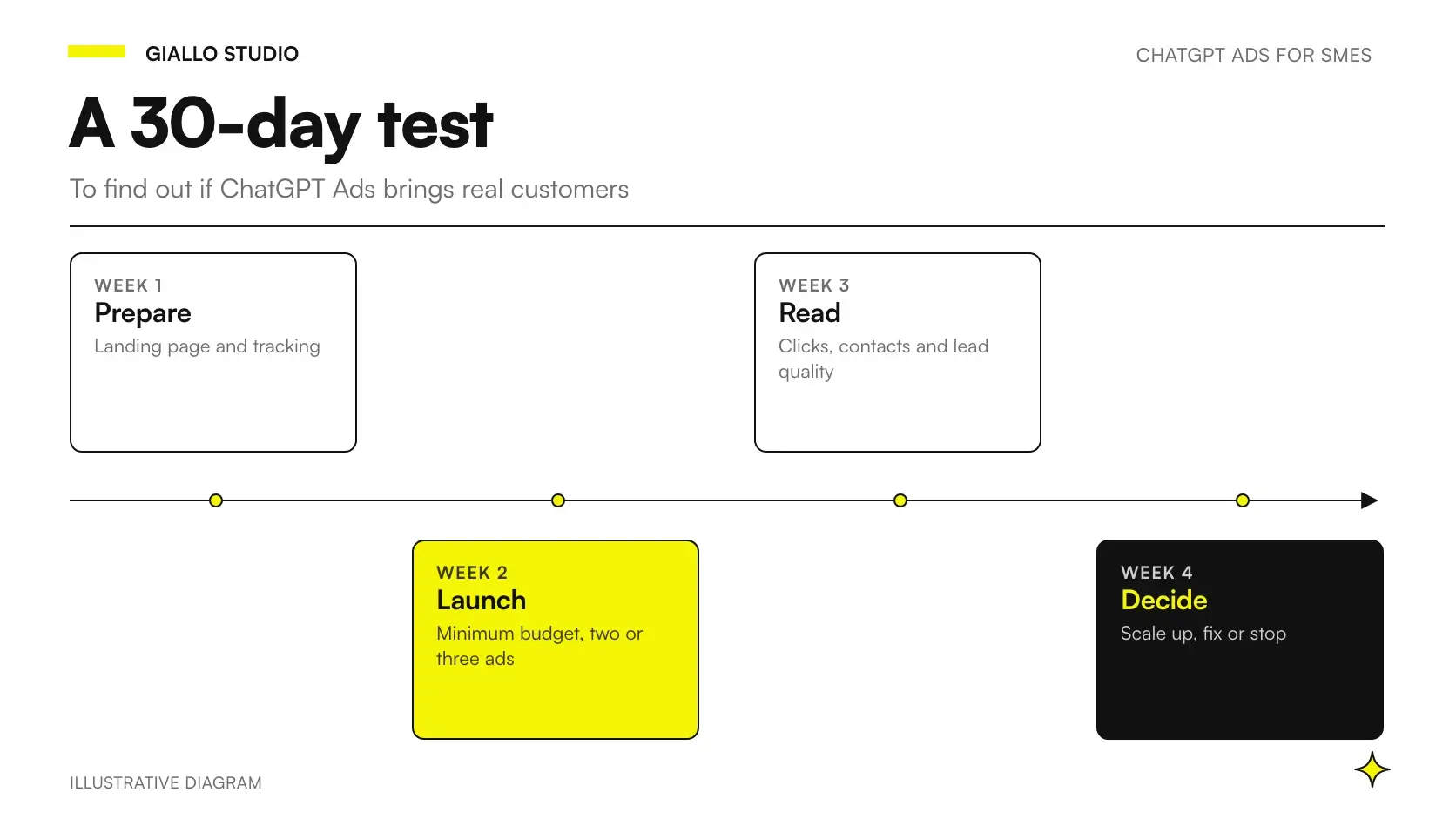
- Days 1-7: preparation. One offer only, one main metric. Write the decision rule before you see the data, for example the acceptable cost per acquisition compared with your other channels. Check the landing page, install the Pixel or Conversions API and add static UTMs: dynamic macros are not supported.
- Days 8-10: launch. One campaign, two ad groups with different context hints, two or three variants per group. Within 24 hours, active ads should receive their first impressions (launch guide); conversions can appear up to 48 hours later.
- Days 11-24: reading. Check the data once a week and change one thing at a time. OpenAI itself recommends waiting for enough volume before making big changes to bids, budget or creatives.
- Days 25-30: decision. Compare cost per conversion, share of new customers and margin against your other channels. There are three paths: a second cycle with more budget, a second cycle with one specific correction, or stop.
On budget there is one constraint: in Europe you need at least €15 per day per campaign, calculated as a seven-day average (OpenAI campaign guide). A campaign at the minimum for 30 days comes to a maximum spend of about €450.
The Italian page of OpenAI Ads, viewed on 19 October 2026, offers new advertisers €500 in credit once they have spent €500, and according to the ad credit terms, unless different conditions apply, the credit expires after 90 days. At the minimum budget, the first cycle stays below the threshold: anyone aiming for the credit needs to plan somewhat higher spend. CPC and budget calculations are covered in the guide on how much advertising on ChatGPT costs.
Mistakes that skew a 30-day test
- Judging by clicks alone. Without tracked conversions, you cannot tell whether a click turned into an order.
- Touching everything every day. In beta, delivery and spend can fluctuate: daily changes make the test unreadable.
- Opening too many fronts. Three products, four countries and two objectives in one month split a small budget into pieces that tell you nothing.
How do you read the first results without industry benchmarks?
Without benchmarks published by OpenAI, the point of comparison is your own business: the same metrics measured on your other channels over the same period. In Ads Manager you find impressions, clicks, spend, CTR, average CPC, average CPM and conversions (advertiser basics guide). Cost per conversion is spend divided by conversions. New customers, margin and lead quality are read in your back-office system or CRM: the guide to KPI of an AI project helps you choose them before you start.
| What you see after 30 days | What it may mean | What you do |
|---|---|---|
| Few impressions | Context hints too narrow or a low maximum bid | Broaden the topics and check any bid strength indicator in Ads Manager |
| Clicks but no conversions | Landing page not consistent with the ad, or broken tracking | Check the Pixel, events and page before raising the budget |
| Spend below budget with the Conversions objective | It can be normal: for OpenAI the goal is to improve conversions, not to use up the budget | Do not force spend; look at cost per conversion |
| Numbers that differ from Google Analytics | Different attribution, consent and time zones | Compare the same period and the same time zone: a difference is not necessarily an error |
| Cost per conversion in line with your other channels | The channel works for that offer | A second cycle with one more ad group or product |
The guidance in the table comes from the FAQ and the conversion measurement guide published by OpenAI.
What do the case studies published by OpenAI teach?
The available cases are reported by OpenAI or its measurement partners. As of 19 October 2026, we found no independent verification.
- Newegg, an online electronics retailer, reports a return on ad spend of 3x in 28 days and 7x in a two-week promotion, with always-on feeds and seasonal campaigns (Newegg case study).
- WeightWatchers, according to DV Rockerbox, had an attributed cost per acquisition 15.3% lower than its combined paid search baseline (OpenAI, 5 October 2026).
- Dose and Portland Leather: according to WorkMagic, 67% of Dose's incremental purchases come from new customers; according to Triple Whale, 93% of Portland Leather's visitors who arrived from the ads are new (same OpenAI announcement).
These numbers are not a forecast: they concern individual brands, measured with different methods and partners. What you can take from them is the method: all of them measure something beyond the click, such as new customers. And according to OpenAI, product feed ads have so far been among the most effective, a hint for anyone selling online.
Can you get cited by ChatGPT without paying? The organic side
Ads and answers run on separate tracks. OpenAI states that ads do not influence answers (Help Center, “Ads in ChatGPT”), and for now feed products do not appear in organic conversations. Buying ads does not put a business inside the answers.
Organic presence is built with clear, verifiable content, pages that answer specific questions and consistent structured data. One technical step costs little: OpenAI recommends also allowing OAI-SearchBot, because it can help OpenAI understand the site's public content. The method is in the guide to GEO and using ChatGPT for SEO. For businesses excluded from ads, this is the main route today.
When is it better to wait? The case of a private medical clinic
Take a private medical clinic offering specialist consultations and physiotherapy. Outside the United States, the policies define healthcare services as “generally prohibited”. Changing the subject of the ad is not enough: a business whose core business model sits in a restricted category, and the policies name healthcare explicitly, may not be eligible as an advertiser. On top of that, ads do not appear next to conversations about personal health, which is exactly where the clinic would want to be found.
The sensible choice is to wait and invest in organic content. The advertising policies have a change log that moved from version 1.0 in March to version 1.6 in September 2026: it is worth checking it again every quarter.
Start with a test
- Your category is allowed outside the United States.
- Customers compare options before buying or booking.
- Landing page and conversions are already measured.
- You can sustain 30 days of spend without taking budget away from other channels.
Wait
- You work in healthcare, finance or legal services.
- Your demand is urgent or impulse-driven.
- You do not yet know which sales come from which channel.
- You are a sole proprietorship and have not checked whether the account would be accepted.
What is the first step for a small business that wants to try ChatGPT Ads?
The shortest path has three moves: check your category against the policies, prepare your landing page and tracking, then open the account under the right entity and put budget, duration and decision rule in writing.
If you want to set up the 30-day test without starting from scratch, with AI consulting by Giallo Studio we start from choosing the offer and go all the way to reading the results. If you sell online, the work begins with the catalog and product feeds, through our service for e-commerce.
Giallo Studio guides: methodology and sources
How we apply it in the company
Related resources
 ChatGPT Ads: what it is and how advertising on ChatGPT works in Italy
 ChatGPT Ads cost: CPC, CPM, minimum budget and welcome credit
 ChatGPT Ads Manager: how to create your first campaign, step by step
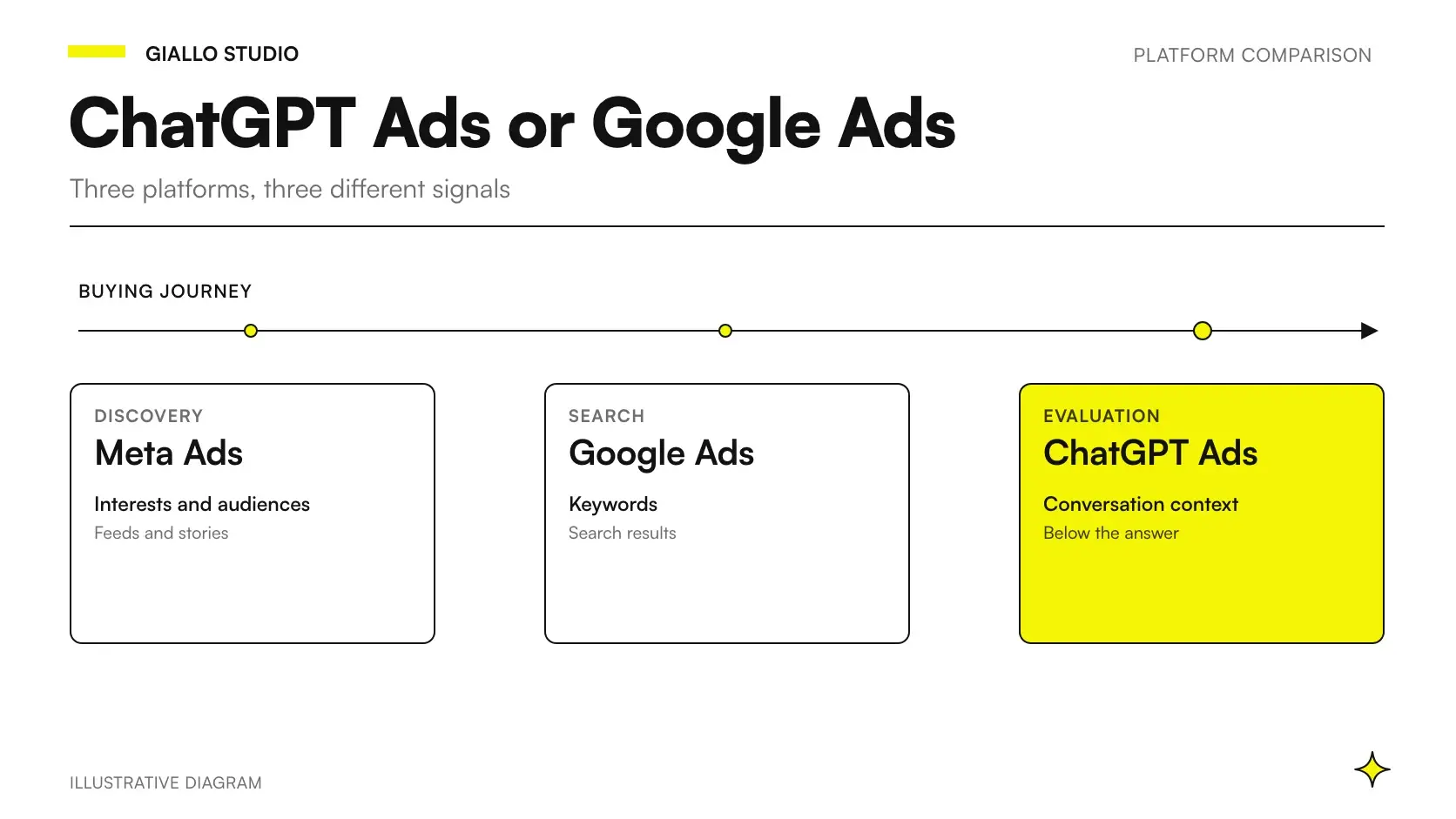 ChatGPT Ads vs Google Ads (and Meta Ads): differences and when to use each
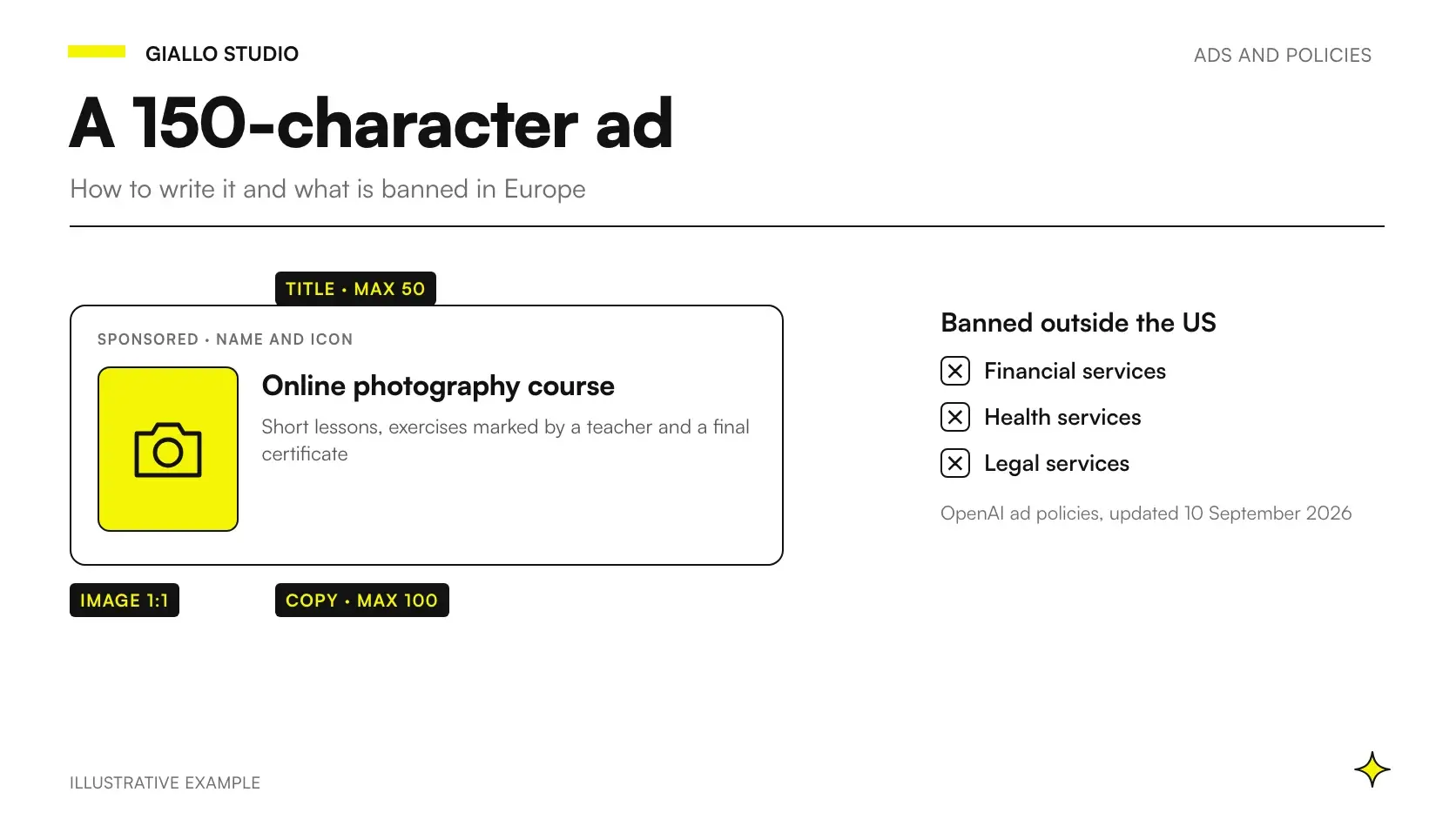 ChatGPT Ads creative: how to write your ads and what OpenAI's policies prohibit
 ChatGPT Ads: new formats, lead measurement and availability in Italy
 AI for e-commerce: compliant returns, product descriptions, discounted prices and reviews
 AI project KPIs: what to measure
FAQ
Is ChatGPT Ads worth it for a small business?
Yes, if it sells in an allowed category and can measure sales. In Italy today, ecommerce stores, local services, tourism businesses, schools and sellers of digital products can advertise on ChatGPT. The prudent way to start is a 30-day test with a single offer and a decision rule written before launch.
How much budget do you need to test ChatGPT Ads for a month?
In Europe, the minimum budget is €15 per day per campaign, calculated as a seven-day average. A single campaign at the minimum comes to a maximum spend of about €450 over 30 days. OpenAI does not publish average cost-per-click figures in euros.
Can a medical clinic or a law firm advertise on ChatGPT?
No, not in Italy for now. Outside the United States, OpenAI's policies generally prohibit ads for healthcare and financial services and, at the moment, for legal services. It makes sense to work on organic visibility and recheck the policies every few months.
Can a sole proprietorship open a ChatGPT Ads account?
It is not clear. OpenAI requires the legal entity that advertises and receives the invoice to be based in an available country, and Italy is one. However, the pages we reviewed on 19 October 2026 do not specify which legal forms are accepted.
Are there benchmarks to tell whether a ChatGPT Ads campaign is doing well?
No. OpenAI states that it does not yet have performance benchmarks for advertisers, industries or campaign types. Compare results against your own channels, using the same metrics over the same period.
Does advertising on ChatGPT help you appear in its answers?
No. According to OpenAI, ads run on separate systems and do not influence answers, and for now products uploaded to the ad feed do not appear in organic conversations. Presence in answers is built with clear, verifiable content.
Can a Shopify store use ChatGPT Ads from Italy?
Yes. OpenAI has announced that the ChatGPT Ads app for Shopify has been available since 23 September 2026 in the markets where ChatGPT Ads is live, and Italy is one of them. Before you plan, check in the Shopify App Store that the app can be installed for your store.