
Cheap AI Models Compared
Compare low-cost AI models from Anthropic, OpenAI and Google: official prices, limitations and when they are sufficient.
Reading time: 10 min
The Cheap AI Models are the least told and most used band. The ads talk about the top models, but in real business systems most traffic passes through here — and that's where you decide if a project stands economically.
This guide compares the official price lists of the three main suppliers and explains when this tier really is sufficient. Data verified on August 19, 2026 for Anthropic and OpenAI, the 3 September 2026 for Google.
In summary
- The cheapest verified is GPT-5.6 Luna: 0,20/1,20 $.
- Among the economic models is up to five times of a gap.
- Compared to the top band you get to fifty times.
- That's enough for Simple Recognition and Transformation.
- Not enough when you need it handle exceptions.
- The lowest price does not guarantee the Lower spending.
The price lists in comparison
Prices in dollars per million tokens. For Google the plan is indicated Standard.
| Model | Supplier | Input | Output |
|---|---|---|---|
| GPT-5.6 Luna | OpenAI | 0,20 $ | 1,20 $ |
| Gemini 3.1 Flash-Lite | $0.25 (text, images, video) ) $0.50 (audio) | 1,50 $ | |
| Gemini 3.5 Flash-Lite | 0,30 $ | 2,50 $ | |
| Claude Haiku 4.5 | Anthropic | 1 $ | 5 $ |
The gap within the band is wide: between the first and the last there are five times in input and over four times in output. On high volumes is a difference that weighs as much as that between different bands in other comparisons.
What changes with respect to the upper bands
It is worth being precise about what you lose by going down, because the economic belt is not a depowered version: on a precise class of tasks it does exactly the same job.
That class is the Simple Recognition and Transformation: understand what a message is about, locate a field in a structured document, decide who to route a request to, rephrase a short text, verify the presence of an information.
The gap opens when the task requires you to hold several items together: cross-reference information from different sources, handle an exception not provided for in the instructions, recognize that the request contains a wrong assumption, concatenate deductions where an intermediate error spoils the result.
The economic belt is enough
- Classification of messages and tickets
- Extraction from structured documents
- Routing and sorting
- Short responses from predefined templates
- Presence and consistency checks
- Very high volumes, critical latency
We need to go up
- Badly formed or ambiguous documents
- Synthesis crossing multiple sources
- Exceptions not provided
- Multi-step reasoning
- Long Outputs to Generate
- Knowledge of the Recent World
The technical limits to be verified first
Before any consideration on quality, there are constraints that can exclude an upstream model. They should be checked immediately because they are absolute.
The context window. Documentation indicates for Haiku 4.5 a 200,000-token window, while GPT-5.6 Luna declares about 1.05 million as the rest of his family. Two hundred thousand tokens remain many —a few hundred pages —but if your case passes entire archives the threshold meets.
The maximum output. Haiku 4.5 declares 64K tokens against the 128K of the GPT-5.6 family. If your system generates long documents, it is a limit that you encounter before the window.
The limit date of knowledge. Here the gap is wide: February 2025 for Haiku 4.5 versus February 16, 2026 for GPT-5.6 Luna. One year difference, relevant only for tasks that depend on internal knowledge of the model.
How much you really save
We take 200,000 requests a month with 1,500 input tokens and 300 outputs each.
| Model | Input (300M) | Output (60M) | Monthly Total |
|---|---|---|---|
| GPT-5.6 Luna | 60 $ | 72 $ | 132 $ |
| Gemini 3.1 Flash-Lite | 75 $ | 90 $ | 165 $ |
| Gemini 3.5 Flash-Lite | 90 $ | 150 $ | 240 $ |
| Claude Haiku 4.5 | 300 $ | 300 $ | 600 $ |
For reference, the same volume on a top model at $10 and $50 would cost $6,000 a month: over forty-five times the first line.
It is this gap that makes possible automations that with the high end would not stand. A process that processes hundreds of thousands of documents per month is only sustainable if the unit cost is in the order of cents.
Why the lowest price doesn't always win
There is, however, a tipping that needs to be taken into account, and that is why the choice is not made on the table.
If a low-cost model requires an average of two attempts where another needs one, the gap halves. If fifteen per cent of outcomes then need manual correction, the cost of people’s time quickly exceeds the entire saving.
- Count the attempts necessary to close each case
- Measure the percentage of outcomes to be corrected
- Estimate the review time by chance
- Verify that the model admit you don't know
- Look How it's wrong, not just how many times
- Calculate the cost per task completed
The fourth point is the most important property of an economic model, more than its average accuracy. A lightweight model that safely closes cases that it has not understood is dangerous precisely because it seems reliable — and makes mixed strategy impossible, because those cases never get to the second level.
The Mixed Strategy, in brief
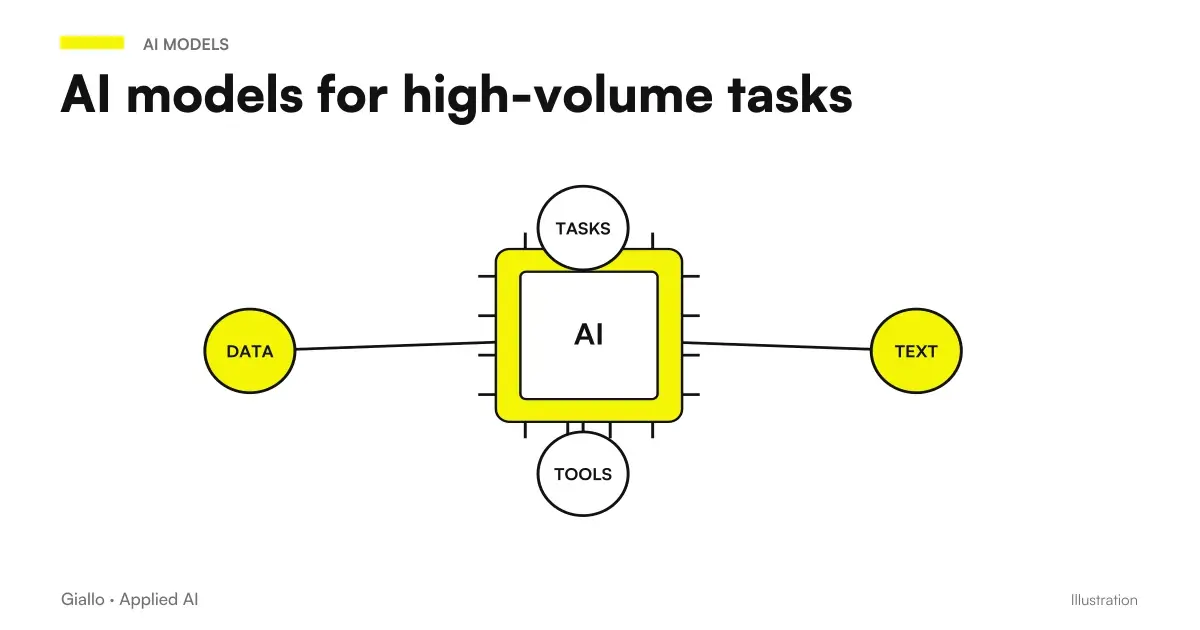
In most processes the difficulty of cases is not evenly distributed: the great majority is ordinary, a minority is complex. Paying the same rate for both is the most common waste in AI projects.
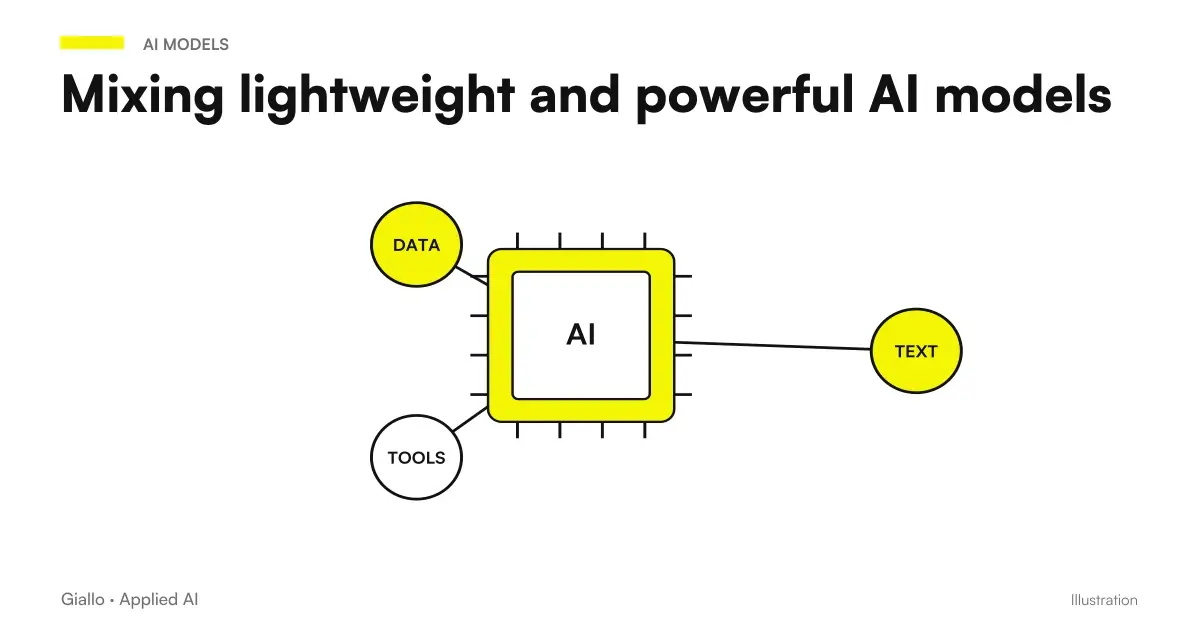
The low-cost model receives all traffic and closes the cases it handles confidently; cases it recognises as uncertain are escalated to the more capable model. If difficult cases account for ten per cent, you pay for the high-end tier on one tenth of the volume.
The setting detail, with the passing criteria and verifications to be done, is in Mixed Model Strategy.
Practical examples
E-commerce, sorting customer requests. Thousands of messages a day traceable to about ten recurring intents: shipments, returns, availability, billing. It is the ideal use case for this band. The task is to recognize intent and route, and speed matters because the customer waits. Out-of-the-box cases rise to the second level.
Accounting firm, extracting from supplier invoices. High volumes, structured documents, predictable fields. The economic belt handles most documents; those scanned badly or with missing fields must be switched to a more capable model. The condition for this to work is that the light model declares ‘field not readable’ instead of guessing.
Manufacturing company, enrichment of a product catalog. Hundreds of thousands of cards to be normalized once, without urgency. Here the economic belt is not only sufficient: it is the only one that makes the project sustainable. With a top model the same work would cost tens of thousands of euros instead of a few hundred.
The task that seems simple and is not
There is a category of jobs that at first glance belongs to the economic belt and instead puts it in crisis: extraction from Badly Done Documents.
Extracting eight fields from a well-formatted invoice is pure recognition. Extracting the same eight fields from a crooked scan, with a stamp over the number and a line of description that wraps up in the middle of an amount, is quite another task: it requires understanding what is missing, what is ambiguous and what needs to be reported.
What to Measure Before Choosing
| Metrica | How do you get | Why It Counts |
|---|---|---|
| Success rate on first attempt | Counting on the ten cases | Determine Real Attempts |
| Percentage of outcomes to be corrected | Human review | It is the highest cost item |
| Recognition of own limits | Test on difficult cases | Enable Mixed Strategy |
| Average latency | Direct measurement | Count in interactive scenarios |
| Tokens actually consumed | Reading Consumption | The price list underestimates |
The third line is the one that is often not measured and which determines whether the entire two-level setting is possible. It must be explicitly proven: you give the model a document that lacks the required information and you look at what it does. The correct answer is to declare absence; anything else is a problem.
Mistakes to Avoid
- Excluding the economic belt on principle. On many tasks he does the same job.
- Choose it without checking the technical limits context, output, and date limit.
- Not testing whether it admits when it does not know. It is the property that matters most.
- Testing only on clean documents. The difference is on the worst cases.
- Comparing Gemini prices without declaring the service plan.
- Ignoring review time in the calculation of savings.
The first mistake is more common than it seems, and arises from a wrong intuition: that a model that costs one fiftieth must be fifty times worse. It doesn't work that way. On recognition tasks the difference is often imperceptible, and on reasoning tasks it is enormous. The jump is not gradual, it is by task category.
How to apply it in the company
The decision that really matters is not which economic model to choose, but if your task belongs to this band. The difference between the two questions is one order of magnitude.
The criterion is simple: if the answer is contained in the material and must be recognized, the economic belt is enough. If it is to be built by crossing sources or handling exceptions, it needs to go up. The complete reasoning is in when an economic model is enough.
Check the band, check the three technical limits before any consideration on quality: input length, output length, and knowledge limit date. They are absolute constraints and are controlled in ten minutes.
Then proof, which must include the worst documents you have and a case that lacks the required information. The latter separates a usable model from a dangerous one, and must be done before production.
The setting that gives the best results uses this band as the top level and a top as a reserve on doubtful cases, according to the pattern described in Mixed Model Strategy. If the difficult cases are ten percent, spending remains close to economic and quality on complex cases rises.
Finally, remember that at these rates Optimizing the price per token is almost always the wrong thing. The system prompt, the context selection and the percentage of outcomes to be reviewed by hand count more, according to the calculation of cost per task or price per token.
If you want to design sustainable automation on your volumes, Giallo Studio helps SMEs and teams to build concrete, measurable and sustainable automations.
Three readings to close the picture. If you are still choosing the band, the operating criterion is in how to read AI benchmarks. For the calculation of real expenditure —the one that includes repeated context, failed attempts and human review —the reference is when it is best to change the AI model. And when traffic is uneven, the setting that gives the best relationship between quality and cost is described in because vendor benchmarks are not comparable.
How to Start a High Volume Project Without Risking
On this band the volumes are the very reason for the project, but it is not advisable to start from full traffic. Three stages, and the first two are the cheapest insurance you can buy.
One hundred cases with total review. Every outcome controlled by a person. It serves to measure real accuracy and —most importantly.find out where errors are concentrated. In practice it almost always emerges that they are not randomly distributed but grouped on a few identifiable formats or categories.
A thousand cases with confidence threshold. You set the threshold of passage to the second level and you measure how many cases go up and how many reach a person. It is the phase where you find out if the estimated percentages were realistic.
Full volume with continuous controls. Weekly sample, automatic consistency checks, monitoring percentages over time.
The deterministic controls, the forgotten ally
On structured data you can do automatic verifications that do not require AI and that intercept just the most dangerous category of error: the plausible but wrong value.
- The sums must come back: taxable plus tax equals total
- The dates must be plausible and consistent with the period
- The references must exist in the registry
- The amounts must be within a reasonable interval
- The identifiers must not be already present
They are trivial controls to implement and capture what no model guarantees. An invented amount passes the format control but almost never the arithmetic one.
It is why a well-done project on this band does not rely only on the model: it combines AI to read and deterministic rules to verify. Each makes the part where it is strong, and the result is more reliable than it would be with a much more expensive model without controls.
What Changes on Volumes
| Monthly Volume | Weight of band choice |
|---|---|
| Under a Thousand Cases | Minimum: choose quality |
| One thousand to ten thousand | Relevant: worth the test |
| Ten thousand to one hundred thousand | High: Optimization pays off |
| Over one hundred thousand | Decisive: Determines feasibility |
The last line describes the projects that exist only thanks to this band. Normalize a catalog of half a million cards, classify years of archive, enrich a database: with a top model these jobs would cost tens of thousands of euros and would not be done.
Conclusion
The economic belt covers an interval of five times within itself and comes to cost one fiftieth of the peak one. It is the band that makes high-volume automation possible, and on recognition tasks it does the same job as the upper bands.
But the lowest price does not guarantee the lowest expense. The number that decides is the cost per task completed, and is only obtained by measuring on real cases — including difficult ones.
If you want to design sustainable automation on your volumes, Giallo Studio It builds AI agents and automations tailored to SMEs.
Giallo Studio guides: methodology and sources
How we apply it in the company
Related resources
FAQ
What are the cheapest AI models?
On the verified official price lists: GPT-5.6 Luna at $0.20 for input and $1.20 for output per million tokens; Gemini 3.1 Flash-Lite from $0.25 and $1.50; Gemini 3.5 Flash-Lite at $0.30 and $2.50; Claude Haiku 4.5 at $1 and $5.
How much is saved compared to a top model?
A great deal: input costs differ by a factor of fifty between the cheapest low-cost model and the flagship model. At high volumes, the difference determines whether a project is sustainable.
For which tasks are they sufficient?
Simple recognition and transformation: classifying messages, extracting fields from structured documents, routing requests, checking for the presence of information and generating short responses.
When are they insufficient?
When the task requires cross-referencing different sources, handling unforeseen exceptions or chaining multiple deductions. In those cases, savings are lost to manual corrections.
Can they be combined with more capable models?
Yes, and it is often the best choice. The low-cost model handles most traffic and passes only cases it flags as uncertain to the more capable model.
Does the lowest price guarantee the lowest spending?
No. If a low-cost model needs more attempts or produces results requiring manual correction, its total cost may exceed that of a more expensive model completing the task on the first attempt.