
AI Model Temperature Explained in Plain Language
What temperature means in an AI model, why it changes the answers, and when to lower or raise it in the day-to-day work of an SME.
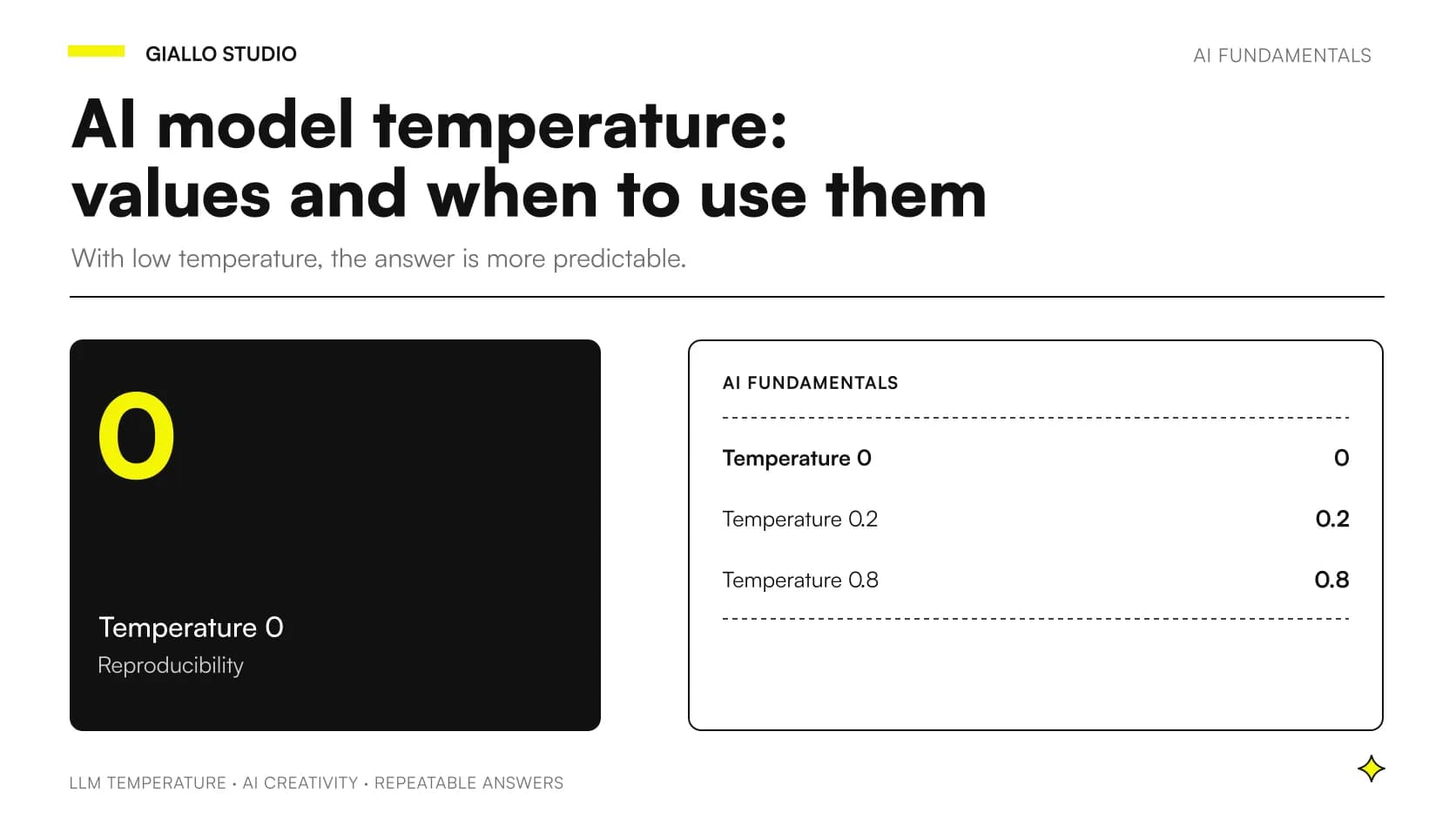
Temperature is a parameter that controls how much the responses of an AI model can vary. According to the Mistral glossary, it is a value between 0.0 and 1.0 that controls the randomness of the output: with low values the result is more focused and deterministic, with high values it is more varied and creative (Mistral AI Glossary).
In practice it is a knob. It does not make the model smarter or more accurate: it changes the way the model chooses, among the possibilities it has, the one it writes. That is why the same question asked twice can get two different answers, and why it helps to know when to keep the knob low and when to turn it up.
In this guide we explain the idea first, then the mechanism, then what to do in a business. We will use only what the Mistral and Google glossaries say, and we will state where the sources do not say enough.
In summary
- Temperature controls the randomness of a model's output: the lower it is, the more focused and predictable the response.
- High values produce more varied and creative texts, useful for finding ideas but less suited to procedures and documents.
- For tasks where consistency and reproducibility matter, the Mistral glossary says to set it to 0.
- Temperature does not guarantee that an answer is true: content must always be verified before use.
- The sources provided do not say where temperature can be adjusted in chat apps or how it affects costs.
What does temperature mean in an AI model?
The Mistral glossary describes it as a parameter from 0.0 to 1.0 that controls the randomness of the output. Low values, with the example of 0.2, give a focused and deterministic result; high values, with the example of 0.8, give a more varied and creative result (Mistral AI Glossary).
The name is a metaphor borrowed from physics, but you do not need to know the physics. Just remember the direction: toward the low end the model is sober and repetitive, toward the high end it is freer. The glossary classifies it among API-related concepts, that is, among the settings you pass when you call the model from a program.
One honest caveat: the range from 0.0 to 1.0 is the one given by this glossary. Other providers may use different scales, and the sources we read do not report the default value. Before copying a number from one guide to another, check the documentation of the tool you use.
Why can the same question get different answers?
To understand it you need the mechanism. A language model generates text one piece at a time: the Google glossary explains that an auto-regressive model predicts the next token based on the tokens it has already predicted, and that all Transformer-based large language models are auto-regressive (Google Machine Learning Glossary).
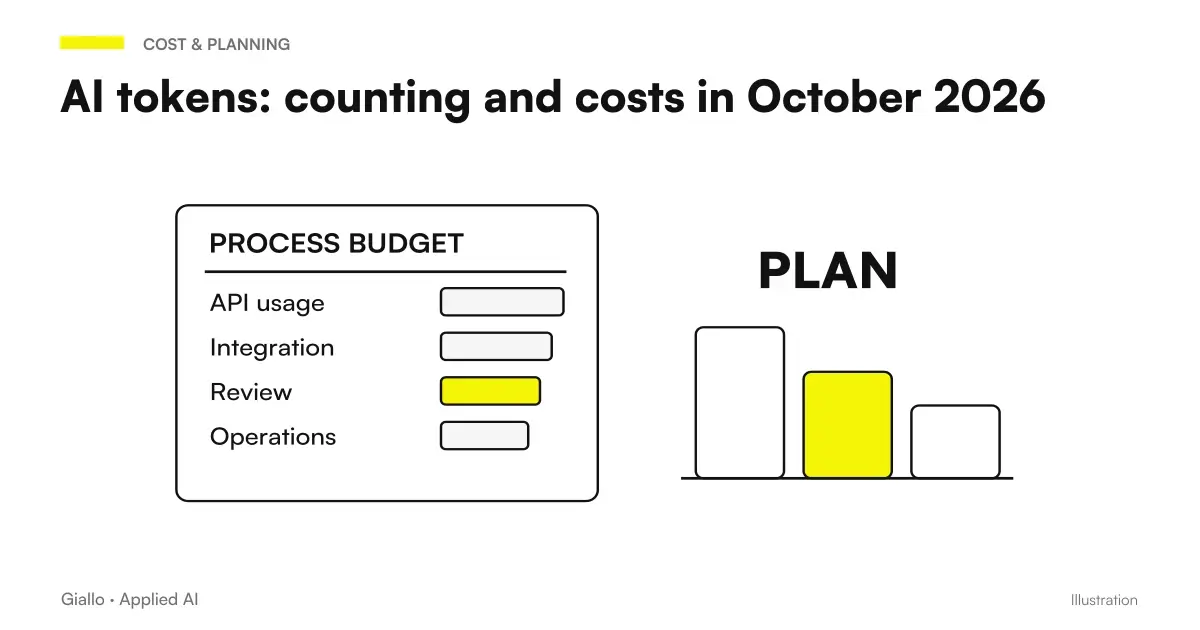
A token, according to Mistral, is the basic unit of text that models process: word fragments, not whole words (Mistral AI Glossary). If you want to explore the concept, we explained what tokens are and how they are counted in a dedicated article.
At each step the model has several possible candidates for the next fragment. This is where temperature comes in: it decides how closely the model sticks to the most probable candidate and how much room it leaves for the others. This is our own explanation of the parameter's role, consistent with the definition of output randomness, not a quotation.
An analogy, declared as such: imagine a person completing a sentence. With a low temperature they almost always pick the most obvious word; with a high temperature they occasionally pick a less predictable one. The analogy simplifies, but it conveys why two answers can differ.
Then there is the moment when all this happens. The Mistral glossary calls inference the running of a trained model to generate a response: calling the API means performing inference, which is distinct from training, which modifies the model's weights (Mistral AI Glossary). Temperature therefore acts when the model answers, not when it learns.
To put these models in context, you can read What are LLMs and how they relate to deep learning explained simply.
How does behavior change with different values?
The table summarizes what the sources say about the values given as examples. They are not universal thresholds: they are the values cited by the glossary.
| Value | What it produces | When it makes sense | Source |
|---|---|---|---|
| 0 | Consistency and reproducibility | Tasks that always need similar results | Mistral |
| 0.2 | Focused and deterministic output | Procedures, standard answers, documents | Mistral |
| 0.8 | More varied and creative output | Looking for ideas, text variants | Mistral |
The “When it makes sense” column is our own practical reading of the facts, not a recommendation from the glossaries. The Mistral glossary expressly says to set 0 for tasks where consistency and reproducibility are critical (Mistral AI Glossary).
Warning. A low temperature makes the response more repeatable, not more correct. A model can consistently repeat an error too: that is why verification remains necessary, as we explain in a checklist for checking AI answers before using them.
When is it worth lowering the temperature?
When the result must be predictable. The Mistral glossary says it clearly: for tasks where consistency and reproducibility are essential, the value should be set to 0 (Mistral AI Glossary).
In day-to-day work, these are the cases where the reader always expects the same form and the same content: an answer to a recurring question, the summary of a procedure, the filling in of a form with fixed fields. Here variety is not a virtue, it is a risk, because two customers could receive different wordings of the same rule.
Another advantage is practical. If the result is reproducible, it is easier to test a change to the prompt and tell whether the change altered the answer, rather than chance. This applies especially when you work on writing instructions: the Google glossary notes that prompt engineering is crucial for guiding models and includes methods such as zero-shot, one-shot and few-shot (Google Machine Learning Glossary). To practice, see our complete guide to prompts.
When does it make sense to raise it?
When you are looking for variety. According to the Mistral glossary, high values such as 0.8 produce more varied and creative output (Mistral AI Glossary).
The Google glossary goes in the same direction from a different angle: it observes that it is easy to assume all models should be grounded in factuality, but some prompts must push a generative model to optimize for creativity rather than factuality (Google Machine Learning Glossary). The same glossary defines factuality as the property of a model whose output is based on reality, specifying that it is a concept and not a metric.
For a business this means there is no single right value: it depends on the task. Coming up with ten names for a new product line is a different job from answering a question about the terms of a warranty. In the first case variety helps; in the second it does harm.
What concrete examples are there for an SME?
The two examples below are hypothetical and serve to illustrate the reasoning: they are not client cases and do not report measured results.
A professional firm preparing standard answers. Imagine a small firm that uses AI for draft emails to clients about deadlines and documents to send. The text must always be consistent with the firm's procedures. Here the reasonable choice is a low temperature, following the Mistral glossary's guidance on consistency and reproducibility (Mistral AI Glossary). Every draft must still be reread by a person before it is sent.
An online shop looking for ideas for descriptions. Imagine a small e-commerce business that wants to propose three or four title variants for a product page. Here a higher temperature makes sense, because the goal is variety: the same glossary associates high values with more creative output (Mistral AI Glossary). The variants are starting points, not texts to publish unchecked: prices, materials and features must be verified against real data.
In both cases the same technology is used with opposite settings. For other work scenarios, see the guide on AI for SMEs.
What mistakes should you avoid with temperature?
Thinking that a low temperature means true answers
It happens because “deterministic” sounds like “reliable”. In reality the parameter concerns randomness, not correctness. The Google glossary treats factuality as a distinct concept, which is not a metric (Google Machine Learning Glossary). You avoid it by always checking the content, and by remembering that the risk of invented errors is covered in AI Hallucinations: What They Are and How to Avoid Them.
Using a high temperature for texts that must be precise
It is done to make texts “less robotic”. The price is variability: two answers to the same question can contradict each other. You avoid it by reserving high values for creative phases and using low values for procedures, data and documents.
Changing several settings at once
It happens when you try to improve a result by touching temperature and instructions at the same time. You can no longer tell what worked. You avoid it by changing one thing at a time and noting the effect.
Assuming the number applies everywhere
The glossary gives the range from 0.0 to 1.0, but other providers may use different scales and the sources do not give the default value (Mistral AI Glossary). You avoid it by reading the tool's documentation and testing values on real examples.
How do you apply this in a business, step by step?
- List the tasks for which you use AI and divide them into two groups: those that always require the same result and those where you are looking for variety.
- For the first group start from a low temperature, down to 0 where consistency and reproducibility are critical, as the Mistral glossary.
- For the second group try higher values and treat the outputs as starting points to select, not as final texts.
- Run tests with the same real examples, changing only one parameter at a time, and keep the answers so you can compare them.
- Have a person check the content before using it with customers or in official documents.
One practical part falls outside the facts: the sources do not say in which chat apps temperature can be adjusted, because the Mistral glossary places it among API concepts. If you use a ready-made tool, check the settings or ask the provider. It is also not verified whether temperature affects costs or the length of responses: the glossary links API pricing to the number of tokens, but says nothing about the role of temperature (Mistral AI Glossary).
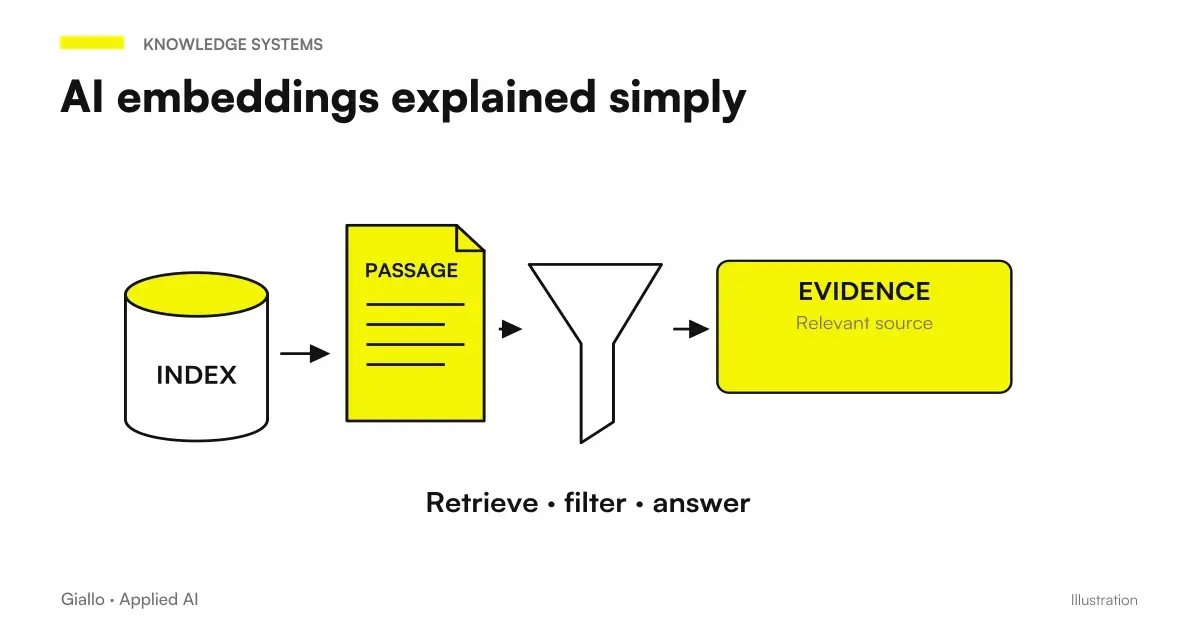
If you then work with long documents, remember the limit of the context window: for Mistral it is the maximum number of tokens a model processes in a single request, across input and output, and when it is exceeded the earlier content is discarded (Mistral AI Glossary). To understand how models represent the meaning of texts, you can also read AI embeddings: what they are.
What can a business do with all this?
Temperature is one of the simplest levers to understand and most useful to manage. An SME can use it to make repetitive activities predictable and to keep a controlled creative space where needed, without changing tools. The next step is deciding which tasks to entrust to AI and with what controls.
If you want to think through where AI makes sense in your business and with which settings, you can start from our AI consulting.
Giallo Studio guides: methodology and sources
Want to apply this to your business?In 30 minutes, free of charge: the first process to automate and its estimated return, in writing.
Book the free auditHow we apply it in the company
Related resources
FAQ
What is temperature in an AI model?
It is a parameter that controls the randomness of the output. With low values the answers are more focused and deterministic; with high values they become more varied and creative. It does not change what the model knows, but how it chooses what to write.
Why do ChatGPT and other assistants give different answers to the same question?
Models generate text one piece at a time, predicting the next token from the ones already produced. When there is randomness in the choice, the answers can differ. The sources provided do not say which settings each app uses.
Does a low temperature eliminate errors?
No. It makes the result more consistent and repeatable, but not true. Factuality is a different concept from randomness, so the content must be checked anyway before it is used.
What temperature suits creative texts?
To look for variety and ideas, higher values are indicated, as they produce more creative output. Treat the outputs as starting points to select and verify. The exact value depends on the tool and its scale.
Can I adjust the temperature in an ordinary AI chat?
The sources we read do not say: the glossary treats it as an API-related concept. In a ready-made chat the setting may not be available or may have a different name. It is best to check the tool's settings or its documentation.
Does temperature change usage costs?
The sources provided do not say, so we cannot claim it. We only know that the number of tokens determines the API price and the use of the context window. For actual costs, check the provider's price list.