
Best AI Model for Agents
Choose a model for an AI agent handling multi-step tasks: which benchmarks matter and what to measure in practice.
Reading time: 9 min
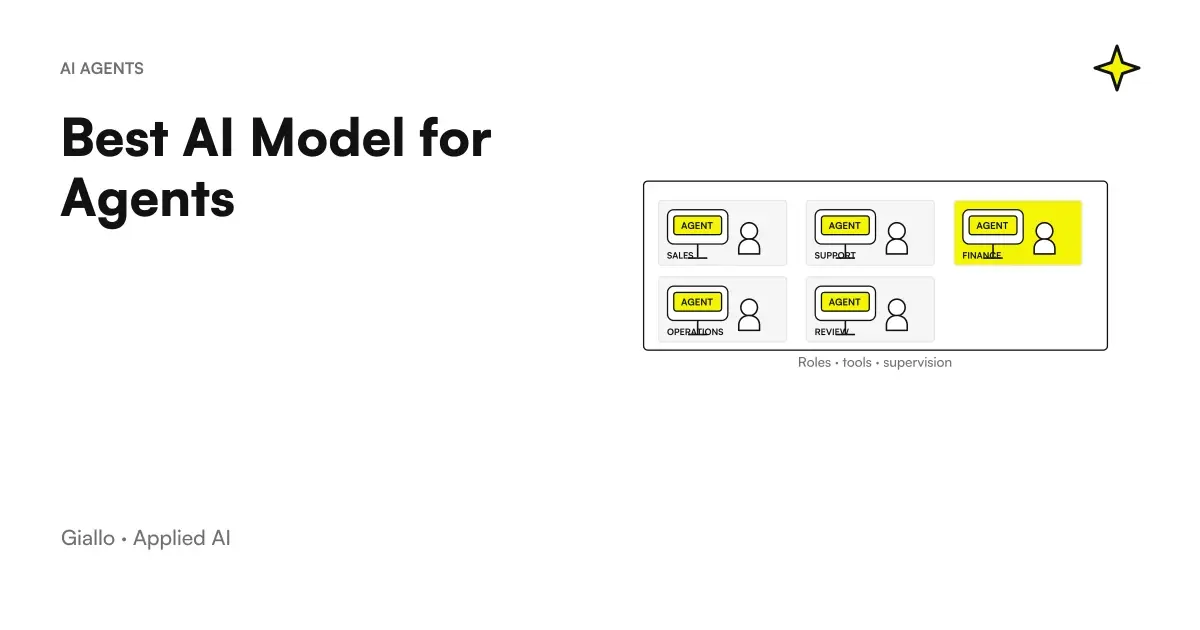
A AI Agent does not answer: executes. reads, verifies, uses tools, decides and completes. It is a category of tasks different from all others, and requires different choice criteria.
The main one is that here the errors they propagate: a mistake on the second step ruins the next ten. Which is why the model band counts more than anywhere else.
In summary
- Errors they propagate along the chain of steps.
- Agent benchmarks measure us agent + model, not the model.
- The metric that counts is tasks completed without intervention.
- The latency multiplies by the number of steps.
- An agent who It stops when it doesn't know It's worth more than one.
- You almost always need a human level in the flow.
Because agents are a separate case
In a single-step task, an error is an error: you see, you correct, you end there. In a twelve-step task, an error on the second step contaminate everything that follows può and the end result may seem consistent while being built on a wrong premise.
Hence a counter-intuitive consequence: the difference between a good model and an excellent one, which on a simple task is imperceptible, on a long chain becomes enormous. Not because the best model misses much less at every step, but because the probability of getting to the bottom without incident is the product of the probabilities of each step.
Relevant benchmarks
Agentici benchmark Frontier-Bench and similar benchmarks measure multi-step tasks performed in an isolated environment, with a verifiable success criterion. They are the right family to look at, with an important warning.
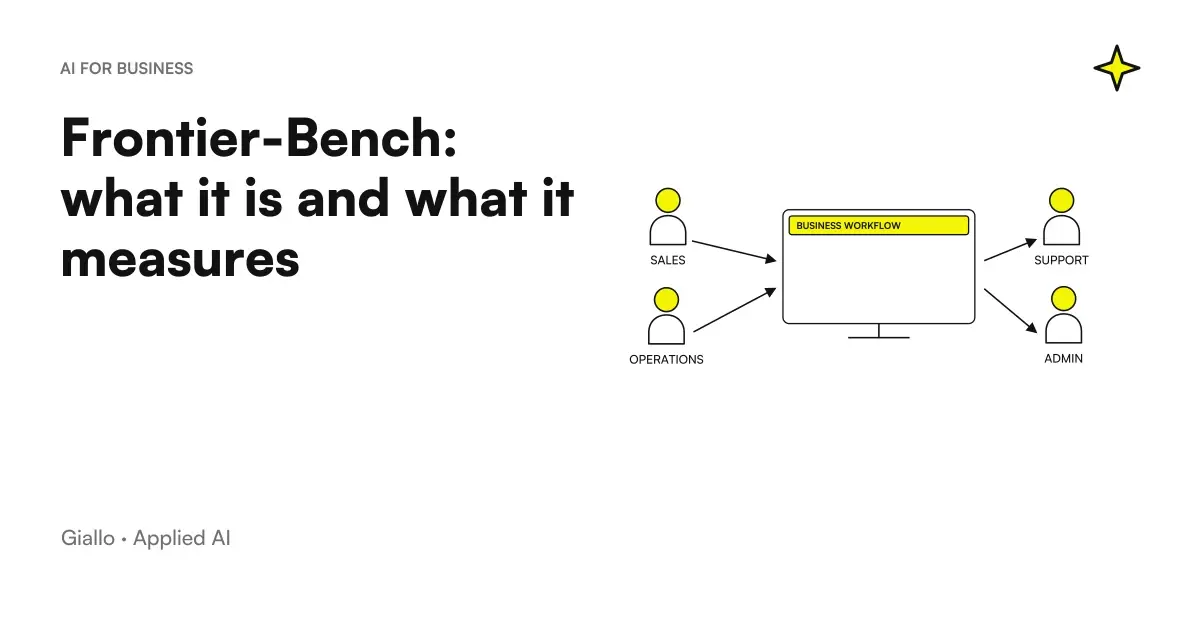
They measure the torque Agent Plus Model, not the isolated model. Documentation of these projects requires specifying both, and one result describes that combination in that configuration. Changing the scaffolding changes the result. The detail is in Frontier-Bench: what it is and what it measures.
In Claude Opus 5's announcement of July 24, 2026, Anthropic states state-of-the-art results on Frontier-Bench v0.1, with a result more than double that of Opus 4.8 at a lower cost per task, and cites a pass rate on Zapier AutomationBench about one and a half times the runner-up at the same cost per task. They are self-reported data from the manufacturer, useful for orienting and not for deciding.
What to Really Measure
| Metrica | Why It Counts |
|---|---|
| Tasks concluded without intervention | It's the real value of the agent |
| Cost per task completed | Includes failed attempts |
| Percentage of cases where it stops | Whether it recognizes its own limits |
| Full run time | Multiply by steps |
| Error Type When Wrong | Visible or silent |
The third line is the one that hardly anyone measures and is the most important for a business use. An agent who in the face of an ambiguous situation stops and asks is usable; one who guesses and proceeds is dangerous, because he has just made a decision that no one has seen.
Which band is needed
Serves the high end
- Long chains of passages
- Unsupervised execution
- Using multiple different tools
- Decisions with real consequences
- Situations not provided for in the instructions
Less may be enough
- Chains of two or three steps
- Very structured tasks
- Always the same path
- Automatically verifiable outcome
- Human confirming every step
The right column deserves attention: many processes that are described as ‘agents’ are actually fixed sequences of two or three operations. Those don't need the high end, and calling them agents makes them spend more than they need to.
Latency, which here multiplies
An agent who makes twelve passes pays for the response time twelve times. An execution that with a fast model lasts three minutes can reach ten with a slow one.
The paradox is that the patterns indicated for long agent flows are often the slowest in one's family. It's not a reason to rule them out, but it changes a design decision: does the agent work while someone is watching, or during the night?
If he works under someone's gaze, showing the steps as they take place completely changes the perception of waiting — often more than would change the pattern. The reasoning is in AI models latency by comparison.
The Human Level
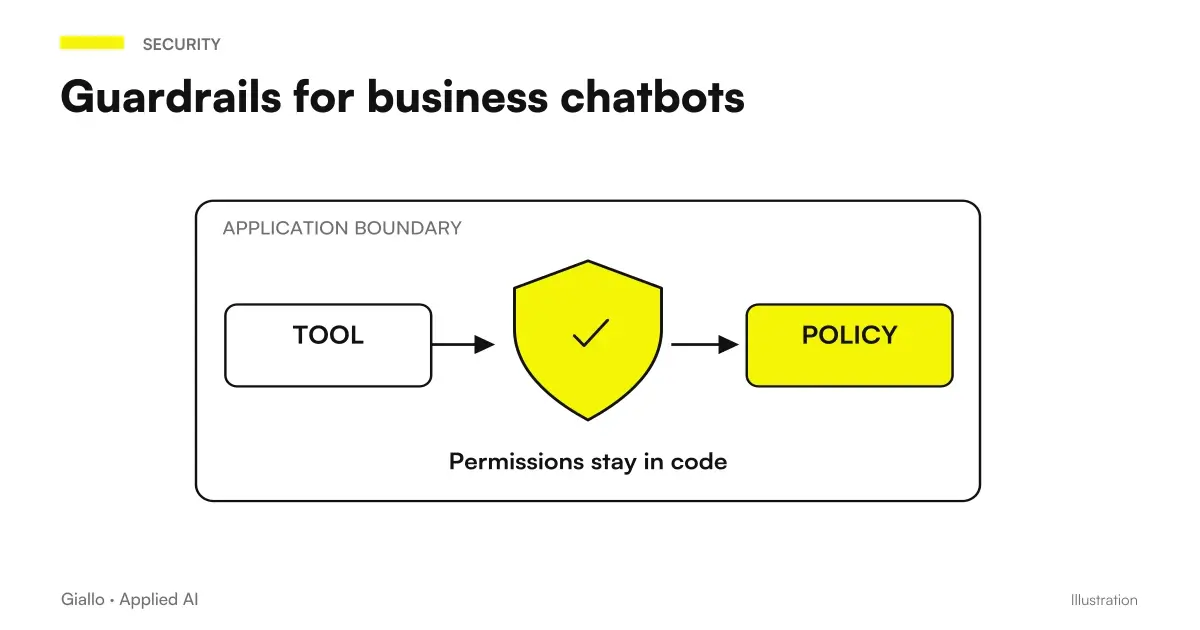
In almost all business processes a part of cases should not be closed automatically. Designing it from the start costs less than adding it after an accident.
- Define in advance what categories They always come to a person
- Bring in cases with the context already prepared
- Indica what is doubtful, not only that the case is firm
- Put them on inside the instrument that people already use
- Check the cases by sample automatically closed
The last point is the security check of the entire system: it serves to notice if the agent is safely closing cases that should have passed.
How to Try an Agent Before Adopting It
The proof of an agent is different from that of a model that answers: it is not enough to look at the outcome, you have to look at How it got there.
- Take ten real tasks of your process, complete
- Include three abnormal cases: missing data, unexpected condition, document out of format
- Record each step, not just the end result
- Count how many come to an end without intervention
- Look what the agent does. when something does not add up
- Measure the complete execution time
The fifth point is proof that it matters most of all. An anomalous case puts the agent before a choice: stop and declare the problem, or proceed with an undeclared assumption. The first response makes the agent usable in the company; the second does not, at no success rate.
| Behavior in the face of an anomaly | Verdict |
|---|---|
| It stops and describes the problem | Great, the case comes to a person |
| Proceeds but reports intake | Acceptable, downstream verifiable |
| Proceeds in silence | Not suitable for business processes |
The Real Cost of an Agent
The agents have a different cost structure than anything else, and the quotes almost always miss it.
A twelve-step task does not cost twelve times a single request: it costs more, because with each step the context grows — the model also receives what happened in the previous steps. Input consumption therefore grows more than linearly with respect to the number of steps.
To this are added the failed attempts: a task that does not come to a conclusion has consumed all its steps without producing value, and it is paid entirely.
Practical examples
Passive cycle agent. It reads the invoice, checks the correspondence with the order, checks the agreed conditions, proposes registration and reports anomalies. Five steps with real accounting consequences: high end, with explicit threshold under which the case goes to a person.
Document Research Agent. He receives a question, searches documents, crosses sources, produces an answer with quotations. Three or four steps, verifiable outcome because every statement is traceable. Here the intermediate fascia may suffice, as long as the agent declares when he does not find.
Data Preparation Agent. It takes raw data, normalizes it, enriches it, loads it. Fixed path, automatically verifiable outcome with consistency checks. It is the case where a lower band is often sufficient, because the task is structured and errors are interceptable.
Mistakes to Avoid
- Calling Agent a fixed sequence of two operations, and pay it off as such.
- Comparing Scores obtained with different scaffolding.
- Measuring only success rate Ignoring if the officer stops.
- Estimating the cost multiplying the steps, without the growing context.
- Not planning for the human level in the flow.
- Ignoring latency multiplied by the steps.
The first mistake is more common than it seems and stems from the lexicon: "agent" has become the term for any automation that uses AI. But a fixed-path stream, with an automatically verifiable outcome, doesn't need the high end — and calling it an agent spends three times as much as needed on a capability that never comes into play.
How to apply it in the company
An agent should be evaluated differently from a model that responds: it is not enough to look at the outcome, it is necessary to look at How it got there.
Take ten complete real tasks of your process and include three anomalous — missing data, unexpected condition, out-of-format document. It records each step, not just the end result: it is in the steps that you see where the chain breaks.
The three anomalous cases are the decisive proof. They put the agent before a choice: stop and declare the problem, or proceed with an undeclared assumption. The first answer makes the agent usable in the company; the second does not, at any rate of success.
On the economic level, agents have a cost structure that quotes almost always miss: with each step the context grows, because the model also receives what happened before. Consumption increases more than linearly with respect to the number of steps, and unfinished tasks are paid for entirely. The estimate should be made on fifty complete tasks, using the method of cost per task or price per token.
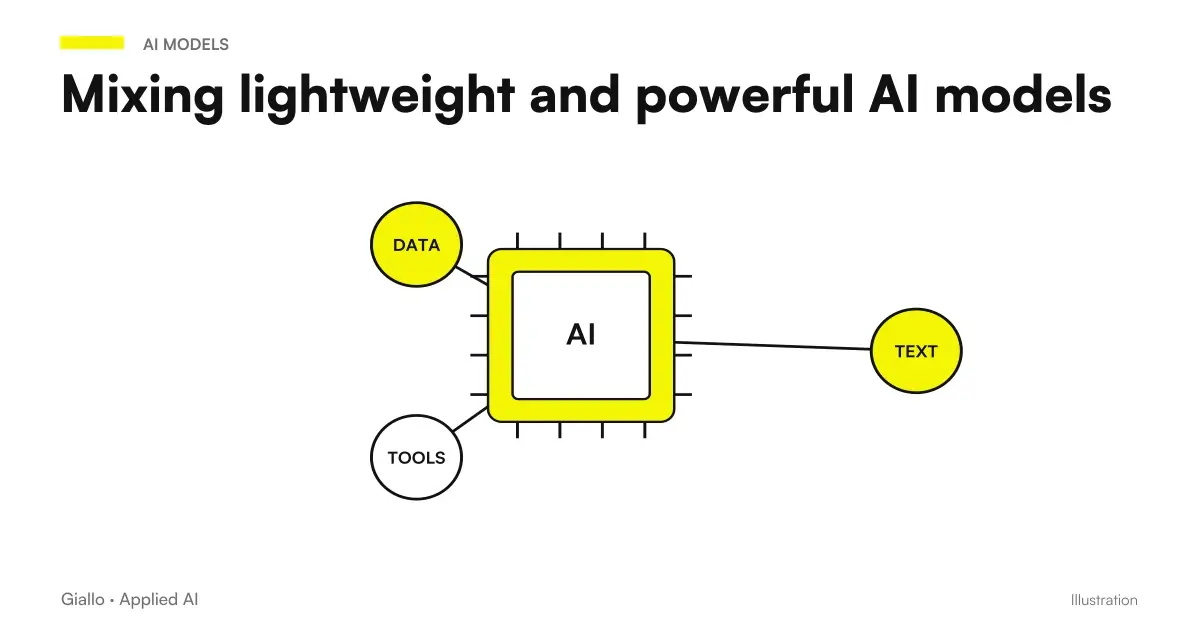
Finally, he designs the human level from the beginning: a small percentage of cases must arrive at a person, with the context already prepared, the indication of what is doubtful and inside the instrument that that person already uses. It is the same level setting as described in Mixed Model Strategy, applied to multi-step tasks.
One final check before you leave: verify that what you call an agent is really an agent. A fixed path stream with an automatically verifiable outcome does not need the high end, and calling it an agent spends three times as much as necessary.
If you want to design an AI agent that really works in your processes, Giallo Studio It builds agents and automations tailored to SMEs.
From here, three useful insights. To orient yourself among the price ranges, the complete picture is in when an economic model is enough. The correct way to read the numbers declared by the manufacturers is in how to read AI benchmarks. And to understand if your task really requires the band you are paying, verification is in when it is best to change the AI model.
Conclusion
For agents the pattern band counts more than anywhere else, because errors propagate along the chain and a small difference per pass becomes large on the final result.
But the metric that decides is not the success rate: it is the combination of tasks concluded without intervention and ability to stop when it can't proceed. An agent who never stops is not reliable, he is just silent.
If you want to design an AI agent that really works in your processes, Giallo Studio It builds agents and automations tailored to SMEs.
Giallo Studio guides: methodology and sources
How we apply it in the company
Related resources
FAQ
What model does an AI agent need?
In general, a high-end model, because agents chain multiple steps together and an intermediate error propagates. However, test this on your own real tasks, measuring how many reach completion without intervention.
Which benchmarks are relevant?
Agentic benchmarks such as Frontier-Bench, which measure multi-step tasks completed in an isolated environment. Interpret them knowing that they measure the combination of agent and model.
What should you actually measure for an agent?
The percentage of tasks completed correctly without human intervention, the cost per completed task and, above all, whether the agent stops when it does not know how to proceed.
Does latency matter for agents?
Yes, and it multiplies: an agent performing twelve steps incurs response time twelve times. Account for this when deciding whether execution is interactive or overnight.
Is an agent that makes fewer mistakes always better?
No. An agent that makes fewer mistakes silently is worse than one that makes more but flags uncertain cases. The ability to stop matters as much as the success rate.
Is human intervention needed in the workflow?
In almost all business processes yes, on a small percentage of cases. It must be designed from the beginning, with the context already prepared for those who have to decide.