
How much does an AI chatbot cost for companies
How much an AI chatbot costs: subscription versus custom solutions, pricing factors and when each makes sense.
Reading time: 10 min
Under the word "chatbot" fall two products with costs that differ by two orders of magnitude: a subscription solution from a few tens of euros per month, and a tailored system connected to your data that falls within the range 3.000 – 15.000 €.
They are not better or worse alternatives: they solve different problems. This article helps to understand which of the two you are really looking for, because it is the choice that determines everything else.
In summary
- Chatbot in subscription: a few tens of euros per month, configuration in hours, limited integrations.
- Chatbot custom made: 3,000 – 15,000 € of development, connected to your systems.
- Discriminant is not the quality of the answers but the need for real-time data.
- The preparation of the documentary basis is the most underrated voice.
- Many companies ask for a chatbot but describe a Agent, which costs more.
- Transparency towards the user is an obligation, simple but to be foreseen in the project.
The two categories, no turns of words
| By subscription | Tailored | |
|---|---|---|
| Initial cost | Null or Low | 3.000 – 15.000 € |
| Monthly cost | Canon for piano | API + hosting consumption |
| Timings | Hours or days | Weeks |
| Source of Responses | Content you upload | Your systems, in real time |
| Concrete actions | Limited or absent | Yes, with integrations |
| Customization | Within product limits | Full |
| When it makes sense | Frequently Asked Questions About Stable Content | You need to access live data or take action |
The line that decides is ‘source of answers’. If your customers' questions are answered in content that changes infrequently —product sheets, shipping conditions, schedules, FAQs — a ready solution works well and costs a fraction. If the answer is "depends on its order", we need a link to the management software, and we are in another project.
The Test in Three Questions
- Do the responses change from customer to customer? If so, integration is needed.
- Does the chatbot have to do something, not just say something? If yes, it is not a chatbot: it is an agent.
- Is the information already written somewhere in an orderly manner? If not, consider the preparation work.
Three ‘no’s’ mean that a subscription solution is probably enough. Even a single "yes" shifts to custom-made, and the quote changes accordingly. The technical distinction between the two families is explained in AI chatbots: what they are and in assistant, chatbot and agent: the differences.
The Voice That No One Preempts: Preparing Content
A chatbot responds well only if the information it draws from is ordered. In most companies they are not: the procedures are in email, the conditions in an old PDF, the exceptions in the head of two people.
- Duplicate documents in different versions, without knowing which one is good
- Contradictory information between site, price list and commercial material
- Content written for a human reader who already knows the context
- Answers that exist only in everyday practice and are not written anywhere
This work needs to be done, and it needs to be paid for. The good news is that it serves the company anyway: it is the same base that feeds the training of new hires and the knowledge base company. The mechanism by which the system draws on documents is explained in RAG: what is it.
What it costs each month
- API Consumption: proportional to the number and length of conversations. See cost of AI API.
- Hosting: content for most cases.
- Content Update: when changing products, conditions or procedures.
- Revision of conversations: look at a sample every month to figure out where it's wrong.
Point 4 is internal time, not invoice, and is the one that distinguishes a chatbot that improves from one that silently worsens. Real conversations say what customers really ask for, and it's information that's valuable regardless of the system.
Practical examples
Website showcase of a professional studio. Frequently asked questions: what do you do, how do you make an appointment, what documents are needed. Stable content, no need for real-time data. A subscription solution resolves, with a few hours of configuration. Spending thousands of euros here would be a waste.
Medium-sized e-commerce. «Where is my order?», «can I change size?», «when does it arrive?». The answers depend on the individual customer and are in the management software. Integration is needed: you enter the range of the tailored, low-central if the management software is accessible.
B2B company with complex technical catalogue. The questions concern compatibility, specifications and availability. The document collection is extensive and disorganised: PDF information sheets, multiple revisions and scattered information. Here the project’s dominant cost item is organising the content rather than the chatbot, and this must be stated when preparing the quote.
Why a chatbot responds poorly, and how much it costs to fix it
When a chatbot disappoints, the cause almost never is the model. It's four recurring problems, and knowing them helps you understand what you're really buying when someone offers you "a smart chatbot."
There is no information. The system can only work on what you gave it. If the answer to a frequent question is not written anywhere, the chatbot will invent or say they don't know. No model resolves an absence of content.
Information contradicts itself. It is the most insidious and most common case. The site says one thing, the price list another, and an internal circular a third. The system fishes one or the other without criterion, and the result seems random. The reclamation of these contradictions is work of analysis, not development.
The context is too broad. Giving the system the whole company archive makes the answers worse instead of improving them: it increases the noise and the probability of fishing the wrong document. Selecting the right sources counts more than having many.
It is not expected what to do when he does not know. A chatbot who answers with certainty about what he does not know is worse than one who says "I put her in contact with a colleague on this". The phenomenon is explained in AI hallucinations: how to avoid them.
All four problems face each other at the project stage and come at a cost. Dealing with them later, when the chatbot is already online and customers complain, costs more — and meanwhile the system has produced reputational damage instead of savings.
The calculation that says whether it is convenient
Before deciding which way to go, it is worth doing an elementary bill that hardly anyone does.
Count how many requests you receive per month on the channels the chatbot should cover. It estimates how long it takes today to respond to each, including the disruption of ongoing work. Multiply by the real time cost of the responder.
The result is how much that service costs you today. At that point the question becomes concrete: if a system managed half of it autonomously, how much would it be worth in a year? And does that value justify a subscription, or even a custom-made project?
In most Italian SMEs the account leads to a precise conclusion: the demands are too few to justify a custom project, but enough to justify a subscription. It is an unexciting and very useful answer, and those who sell you solutions will hardly give it to you. The extended calculation method is in AI budget for SMEs.
Mistakes to Avoid
- Asking for a chatbot describing an agent. If it has to perform actions, the estimate changes — see how much does an AI agent cost.
- Underestimating the preparation of content. It is often the greatest voice.
- Switching to custom-made without having tried a ready solution. A month's subscription teaches what customers really want.
- Not planning for handoff to an operator. A dead end chatbot loses customers instead of serving them.
- Forgetting the statement of automatic nature. It is an obligation of transparency — see AI Act obligations for SMEs.
- Never reviewing conversations. It's the only way to notice that he's responding badly.
How to apply it in the company
The path that wastes the least money is gradual:
- Collect a hundred real questions of customers, taken from emails and chats of the last few months.
- Mark how many find answers in stable content and how many require customer-specific data.
- If the first category dominates, start from a solution in subscription.
- Measure for a couple of months: how many conversations, how many resolved, how many you spend with a person.
- Rate the custom made only if the numbers show that the limit is data access.
Step 1 costs an afternoon and completely changes the quality of the decision. Many companies find out here that 70% of the questions are recurring and no project needed, or the other way around — and in both cases they stopped guessing.
Conclusion
A chatbot can cost a few tens of euros per month or several thousand one-off, and the difference lies not in the quality but in the type of problem. Answering questions about stable content is one thing; answering about data that changes for each customer is another.
The practical rule: start from subscription, measure, and go to custom only when the numbers tell you the limit is access to your data. It's the only way not to pay a project for a problem you didn't have.
AI becomes useful when it enters processes. Giallo Studio helps SMEs and teams to build concrete, measurable and sustainable automations.
Giallo Studio guides: methodology and sources
How we apply it in the company
Related resources
 How much does a custom AI agent cost
 How much does AI cost in the company: a guide to real prices
 Subscription or custom AI: which makes sense?
 The hidden costs of AI projects
 How much does it cost to maintain an AI system
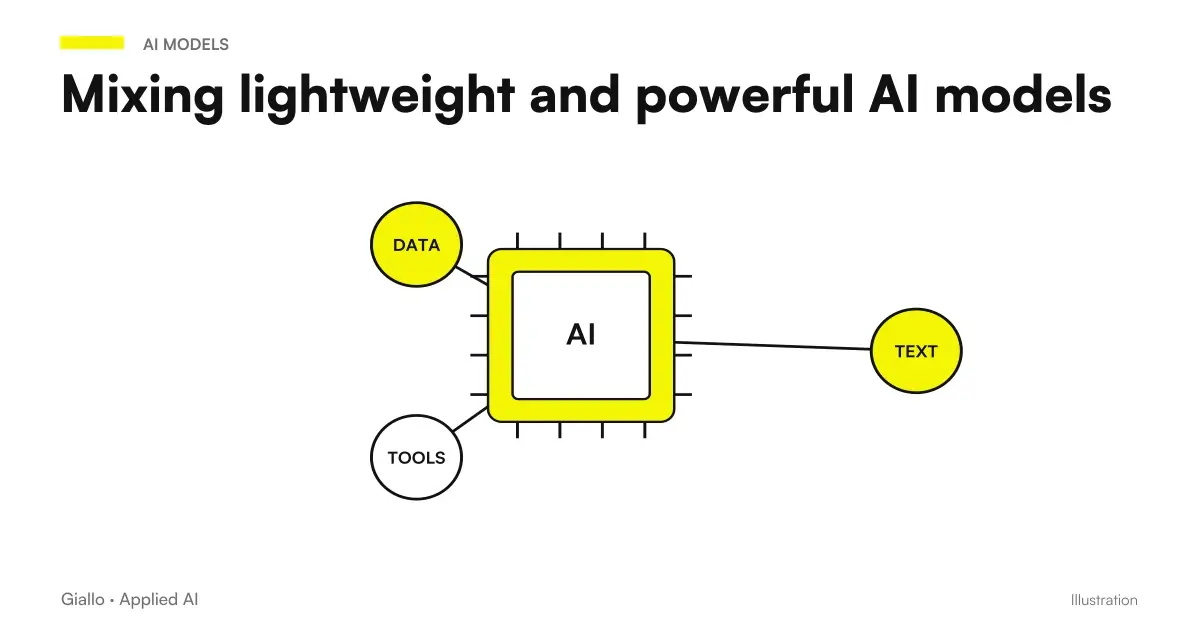 Mixed model strategy: light and powerful
 Microsoft Copilot: prices and licenses for an Italian SME
FAQ
How much does an AI chatbot cost for a business site?
There are two worlds. Subscription solutions start at a few tens of euros per month and are configured in a few hours, but respond only to what you feed them and integrate little. A tailored chatbot, connected to your data and systems, falls within the range of AI agents: 3,000 – 15,000 € of development.
Is a subscription chatbot enough?
For many businesses, yes, and that is the honest answer. If customers ask recurring questions and the answers are in a stable set of content, an off-the-shelf solution handles most cases at a much lower cost. A custom solution is needed for real-time data from your systems or concrete actions.
What drives up the price of a custom-made chatbot?
In order: the number of channels it must respond to, the integration with the systems that contain the answers, and the quality of the document base from which it draws. A messy archive requires preparation work that is often worth a significant share of the project.
How much does monthly maintenance cost?
The cost items are API usage, proportional to the number of conversations, hosting and content maintenance. For a site with average traffic, usage often costs a few tens of euros per month, but it must be estimated: a heavily used chatbot costs more than a lightly used one, and that is a good problem to have.
Does the chatbot have to disclose that it is automated?
Yes, this is part of the transparency obligations for systems that interact with people. It is a simple requirement — a clear line at the beginning of the conversation and a route to an operator — but must be included in project design rather than added afterwards.
Better a chatbot or an agent?
It depends on what it must do. If it only answers questions, a chatbot is sufficient and costs less. If it performs actions — checking an order, updating data or making a booking — an agent is needed, and the cost rises because integrations and checks are required. Many businesses ask for a chatbot while describing an agent.