
Logic Apps Automation: free quotas, AI costs and limits to check
Logic Apps Automation pricing and free allowances: what grants cover, which costs remain and what to check in Azure's new preview experience.
Reading time: 12 min
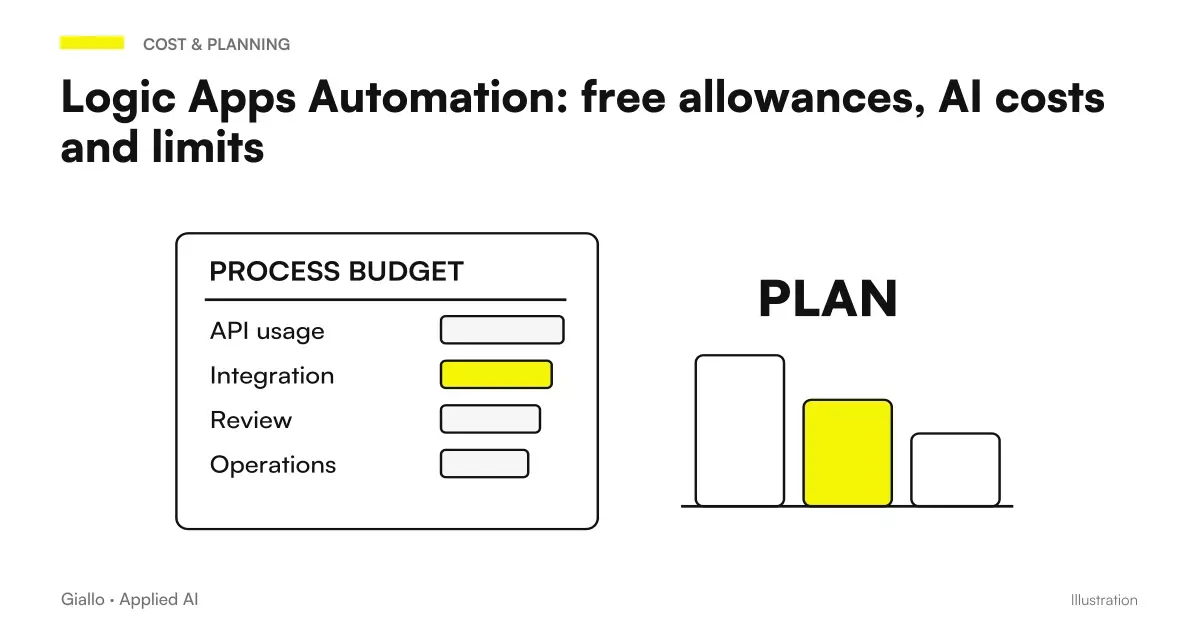
Logic Apps Automation grants are defined free quotas for specific service components, not an unlimited AI automation plan. The economic decision requires distinguishing what is included, what is consumed by the workflow and what belongs to the connected services.
Microsoft posted the announcement on quotas and prices on October 7, 2026. It concerns the new Logic Apps Automation experience in public preview, distinct from the already existing Logic Apps Consumption and Standards plans. That's why an old table found looking for «Logic Apps prices» might not describe the configuration you want to try. Microsoft official announcement.
In summary
- The news concerns quotas and pricing of the new Automation experience in public preview.
- Grants include different components and must be read with their scope.
- Recurring shares and initial concessions do not have the same duration.
- AI models, connectors, and related services can affect the cost of the process.
- For a quote you need live prices of the configuration and consumption observed in the workflow.
What does the new Microsoft announcement include?
The announcement describes monthly subscription fees covering execution, storage, connectors, knowledge, AI AAC credits and sandboxes. They are different categories, with measurements and conditions to verify. Reading them as a single availability of "free automations" makes it difficult to understand which component will be consumed by a concrete request. Microsoft announcement on grants and prices.
The ad reports these quantities per subscription. These are shares of the preview, to be reconfirmed before planning a service; they do not equal the number of practices completed by the workflow. Source of free allowances.
| Component | Share shown in the ad | Duration |
|---|---|---|
| Managed Environment | An Environment | First 60 days |
| Performing workflow | 108,000 seconds of execution | Monthly |
| Data retention | 1 GB | Monthly |
| Managed Connector Calls | 1,000 Standard and 500 Enterprise | Monthly |
| Knowledge Archive | 1 GB | Monthly |
| Using AI | 1,100 AAC | Monthly |
| Execution of isolated code | 18,000 seconds | Monthly |
AAC is the AI credit unit used by this experience: it should not be automatically equated to tokens or credits from another provider.
The question to ask is not just how many times the flow will be executed. You have to figure out what steps it goes through, what resources it uses, and what services it calls. A workflow that classifies a text has a different path from one that acquires attachments, extracts content, consults a source, and prepares a proposal. Both can be described as automations, but the label does not say how they consume quotas.
The ad is useful because it makes explicit components to include in the evaluation. However, it does not replace reading the current configuration. The new experience is in preview and should be treated as such in the choice of the test perimeter. Those who already have flows on Consumption or Standard must avoid automatically transferring prices and conditions from one experience to another.
What concessions are recurring and what initials?
The announcement distinguishes recurring grants from an initial concession for the managed environment, limited to first 60 days. This difference is important because a test might appear economically favorable while using a condition that does not continue in the same way. The duration should be verified in the Microsoft Ad Page, together with the conditions applicable to the subscription.
The choice of the environment has a concrete consequence: the announcement links the grants to the environment marked as free. By eliminating it you lose the ability to use them, without retrieving it simply by creating another environment. Before removing a test environment, check this constraint in the Microsoft section on free grants.
In the assessment sheet it is better to separate cost during the test and cost at full speed. It does not mean inventing a future estimate: it means marking which items are covered by an initial concession and which require recurring consumption. If the current price of a component is missing, that line must remain to be verified instead of being treated as free.
The scope by subscription also deserves attention. The team should know what environment the test takes place in and what other loads can share the economic context. Verification should be done on the actual configuration, without ideally assigning to each workflow all the announced availability. The Azure contact person and the process designer need to read quotas, duration, and expected usage together.
Why not indicate here a final rate in euros?
The tables observed in GitHub documentation and Azure pricing do not match in every row or region. Publishing an amount as a definitive rate would therefore suggest unsupported precision. For a quote, consult current sources, select the region and currency, and verify the components actually used. The references are the documentation Automation and the Azure Logic Apps official pricing.
This caution does not prevent a decision from being made. You can describe the path of the workflow, identify the necessary measures and build a test that collects consumption. The open part is the value of the lines to be confirmed, not the structure of the work. A well-prepared economic comparison makes it visible where the cost depends on the service and where it depends on the application choices.
It is also important to avoid calling the entire process invoice "Logic Apps". If the flow uses other services, these consumptions must be considered separately. The grant of a component does not prove that every connected call is included. The Guide to the automation of business processes helps start with real work instead of just the platform name.
How to read components without confusing them?
| Component to be examined | Application for project | Error to avoid |
|---|---|---|
| Performing the workflow | What steps does a request take? | Count only the starts and ignore the path |
| Connectors | What applications and operations are involved? | Presuming identical conditions for each link |
| AI and AAC credits | What processing does the task require? | Treat every AI request as equivalent |
| Knowledge | What sources are being prepared and consulted? | Forgetting the documentary part of the process |
| Conservation | What information should be kept? | Store everything without operational motivation |
| Environment and sandbox | What resources does the configuration require? | Confusing an initial concession with a permanent fee |
| Connected Services | What consumption remains outside the grant? | Read the grant as a cover for the entire architecture |
Categories are derived from Microsoft announcement and documentation; the question column is a design criterion, not a price list. Conditions must be confirmed on Official Grant Sources. The next step is to link each category to a workflow step that you can observe and explain.
How to estimate the consumption of a process before production?
The estimate starts from a map of the normal path and exceptions. For each step, entry, application involved, expected call and expected result are noted. They include missing attachments, unreadable documents, and temporarily unreachable services. An economically evaluated flow only on the favorable path leaves out some of the work that will still be managed.
Then a test is prepared with authorized materials and representative cases. We observe which components are used and connect the consumption to the type of request. There is no need to deduce a business volume from the vendor's demonstration. Instead, the team needs to know which path has produced the observed consumption and what information is still missing to estimate the expected usage.
Repeated attempts deserve an explicit entry. A service that fails or an invalid response can generate additional steps, according to the built workflow. The event subscriptions Make for errors are about another platform, but show why observing operational events is part of management. The comparison serves to design the control, without transferring to Logic Apps the rates or the behavior of Make.
The test falls within the quotas: does this mean that the process will remain free?
No. Check which concessions were applied, which are initial and which path followed the test. It also considers related services and exceptions. Before estimating recurrent use, it associates observed consumption with the current configuration and official prices of the chosen region and currency.
An administrative company dealing with documents: hypothetical scenario
Let's imagine a company that receives documents via email and wants to classify them, extract information and prepare a card for staff. In this hypothetical scenario the process must distinguish readable files, incomplete attachments, and materials that require revision. The grant does not solve the definition of these rules: it makes it necessary to understand what resources each path uses.
The evidence would start from authorized documents and an expected result for each case. The team would note acquisition, eventual AI processing, saving, and switching to the person. An unrecognised document should go into a visible queue, with no indefinite attempts. The economic objective would be to understand the cost of completed labor and exceptions, not just the consumption of a simple request.
The comparison with Make it could relate to already used applications, team capabilities and maintenance modes. It would not be enough to compare a free fee with the price of a subscription, because the perimeters could be different. The choice should include necessary integrations, error handling, and information that staff receive when they need to intervene.
An e-commerce that sorts assistance: hypothetical scenario
Let's consider an e-commerce that wants to separate questions about products, requests about orders and problems that require an operator. In this second hypothetical scenario automation would prepare a routing and a summary, using only necessary and authorized data. The flow should not promise an autonomous response for each request: some cases must stop or be transferred.
The routes would be distinguished by the estimate. A generic question might require a classification; a request on an order might involve a different system; an ambiguous message might come to the revision. Observed consumption should be linked to these differences. It is not assumed that all requests have the same cost because they pass from the same entry point.
The alternative with n8n would require a consistent assessment of the perimeter, including the management of the chosen environment. Another decision could relate to the path of agents in an already used platform, such as in the Zapier Agents and AI migration by Zapier. The point is to compare the final process and responsibilities, without considering the equivalent products only because they automate tasks.
What to check on region and preview status?
Preview regions listed in sources include Sweden Central, but not an Italian region. It is information to be verified before designing the distribution, not an automatic conclusion about every requirement of an Italian customer. Region, connected services and data path must be read together. Announcement of availability and grants.
The word preview must also appear in the internal decision. The team should understand which conditions are applicable and which perimeter is reasonable for the test. You cannot transfer to the new experience what you know of previous Logic Apps plans. If the process is already critical, the evaluation must include an operational path that does not depend on features not yet verified in the chosen environment.
The regional verification must be repeated on the current pages when preparing the project, because availability and conditions may change. The useful result is a configuration tab: environment, region, components, prices to be confirmed and external services. This prevents a generic reference to Azure from becoming an implicit guarantee on where all parts of automation operate.
How do you manage budget, errors, and workflow growth?
The initial estimate is not enough if the flow changes. Adding a different source, AI step, or storage can change your consumption. The team should note these changes along with the version of the workflow, so as to explain why an entry has changed. Those who decide on the budget must be able to link consumption to work, without reconstructing every technical detail on their own.
It is also necessary to distinguish economic monitoring from control of execution. The project must check which warnings and limits are really available and how a problematic path is interrupted. It should not be assumed that a configured budget automatically equals a block of each expense. The procedure must indicate who receives the signal and what they can do to intervene.
If the stream calls an external API, its constraints also come into play. The News about OpenAI Build, Launch and Grow API limits They relate to the capabilities and conditions of another service, not Microsoft grants. The link is useful to distinguish platform cost, model cost and operating limits: none of the three items replace the others.
What result must justify the cost of the trial?
Before comparing prices it is best to define when a request is actually completed. A classified document but left without a referent could still generate manual work. A tab saved with uncertain fields may require longer verification than expected. Technical consumption must therefore be read along with the quality of delivery to the team.
The evidence should also record human interventions, cases left open and reasons for escalation. Not to automatically attribute an economic value to each step, but to understand what work remains and who carries it out. If automation moves a task from one department to another without making it clearer, a favorable grant alone does not prove that the process is convenient. The final decision can be to narrow the perimeter, simplify the flow or proceed with the verified configuration.
Mistakes that turn the grant into a misleading estimate
The first is to describe Logic Apps Automation as free without limits. The second is to mix tables from the new preview with those from Consumption or Standard. The third is to use an initial concession to estimate recurrent operation. The fourth is to publish a final tariff derived from non-aligned sources, without verifying region, currency and configuration.
A final mistake is choosing the platform before describing exceptions and responsibilities. A workflow is sustainable when the team knows what happens to incomplete cases, what data is used, and how consumption is observed. We can prepare a assessment of automation and its cost components starting from a concrete process. The grant then becomes a condition of the project to be verified, instead of an economic promise that the process has not yet demonstrated.
Giallo Studio guides: methodology and sources
How we apply it in the company
Related resources
 How to automate processes in an SME: the practical guide
 Automation with Make: what it is and how it is used for SMEs
 n8n explained: how it works and how to use it in business
 Document automation with AI: contracts, forms and PDFs automatically
 Zapier Agents becomes AI by Zapier: migration, approvals and sources still missing
 Make Event subscriptions: receive alerts when an automation fails
 OpenAI API limits: Build, Launch and Grow arrive, what changes for automations
 Import email and PDF orders into business software: AI, checks and confirmation
FAQ
Is Logic Apps Automation completely free?
No. The grants cover defined allowances and components, not unlimited use. Related services and consumption exceeding the grants must also be considered.
Is the new experience the same as Consumption and Standard?
No. The announcement is about Logic Apps Automation in public preview. It should not be confused with existing Logic Apps plans.
Are all grants recurring?
The documentation distinguishes recurring monthly allowances from an initial grant for the managed environment. Check the current terms in the official documentation.
Can a final rate be indicated in euros?
Not on the basis of the observed tables, which have differences between sources and regions. For a quote you need live prices, region, currency, models and expected consumption.
Is the preview available in an Italian region?
The preview regions listed in the sources include Sweden Central, but not an Italian region. This does not amount to a full assessment of the conditions for an Italian customer.
How do you estimate the cost of a workflow?
Describe normal path, exceptions, AI calls, connectors, storage and connected services. Then verify the applicable components and measure consumption in a controlled test.