
Zapier Agents becomes AI by Zapier: migration, approvals and sources still missing
Zapier Agents AI by Zapier: what moves to the AI step, which sources are missing and how to check approvals, results and costs in the new workflow.
Reading time: 11 min
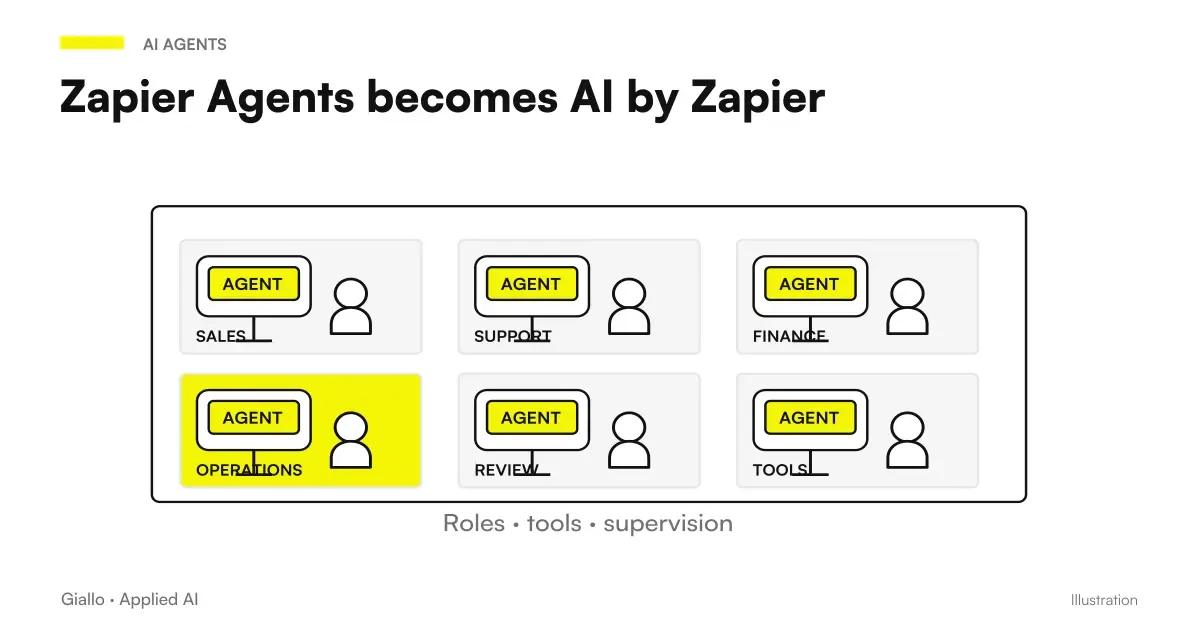
Zapier Agents is traced back to AI by Zapier, with the agent's reasoning inserted as a step in the Zap editor. For those who already use Agents, the point is to check what migrates, what sources remain available and where to apply approvals. The change is not to automatically turn every agent action into a normal separate step.
The product article published on 6 October 2026 describes this evolution. The migration guide was already updated on 1 October 2026: the new article therefore does not prove that the product or the migration process was born that day. Article Zapier and Migration Guide.
For an SME, the opportunity is to keep an AI part and predictable steps in the same stream: filters, paths, application updates and controls. The risk is to read "migration" as a guarantee of equivalence. A transferred agent must be tried again on the requests and sources he really uses.
In summary
- Prompt, reasoning, and tool usage enter an AI step of the Zap editor.
- The flow can combine AI parts with deterministic filters, paths, and steps.
- Approvals should be configured on operations that produce external effects.
- Some knowledge sources are not yet supported: check the current guide.
- Migration requires testing data, permissions, costs, and erratic behavior.
What changes in the Zap editor?
An agent can decide how to use tools to achieve a goal. A deterministic flow instead executes steps defined according to explicit rules. Bringing the AI step into the editor allows you to combine the two logics without entrusting every detail to the model. The ad also describes model choice, instrument approval, and charges expressed in tasks. Product description.
A sales enquiry, for example, can arrive through a form, be validated with ordinary rules, pass to the AI step for classification and finally reach a predefined path. AI must not decide whether an email address has a valid format when a rule is sufficient. Likewise, the rule must not invent a category when information is missing.
The Guide to Zapier for automations Explains the basics of flow. The novelty here is the placement of the agent within that job, not a promise that any procedure will become reliable with a prompt. Decisive steps must remain legible by the staff who maintain them.
Does migration automatically separate all tools?
No: according to the guide, the migrated agent remains in a single AI step. Actions are not automatically broken down into as many ordinary editor steps. This difference matters when the team wants to check the order, condition and result of each operation. Official guide.
It may be reasonable to keep a circumscribed exploratory sequence in the step, for example to look for information and prepare a summary. For critical writing, on the other hand, it is better to ask whether the model should only produce a proposal and leave execution to an explicit step. It is an architectural choice to be evaluated, not a guaranteed result of migration.
Before the transfer it is useful to inventory instructions, tools, sources, credentials and dependencies. You have to distinguish what the agent can read from what he can modify. If this map does not exist, it becomes difficult to tell whether a change in behavior depends on the model, the missing source, or a different authorization.
What knowledge sources require attention?
The documentation consulted indicates that knowledge sources are not yet supported HubSpot, Asana, Zendesk, Zoom and Jira, with planned support for the fourth quarter 2026. It is a prediction of the supplier, to be verified in the updated guide, not an already proven availability. Migration Limits.
A knowledge source is a source of knowledge used by the agent: it should not be confused with the normal integration of the application in Zapier. To say that a Zendesk source is not yet supported does not mean that any automation with Zendesk is impossible. The check must relate to the type of link actually used by its agent.
If a decisive source is missing, the company can maintain the existing process, restrict the pilot or design an approved alternative access. He should not compensate for the vacuum by asking the model to “do its best.” A plausible answer without the necessary document can make care worse precisely because it seems complete.
Where to put human approval?
| Operation | Possible role of AI | Recommended check |
|---|---|---|
| Read relevant data | Gathering Context | Limited permissions and recognizable source |
| Classify a request | Propose Category | Threshold and path for doubtful cases |
| Write a draft | Prepare content | Review whether information is sensitive |
| Send to customer | Perform an external action | Approval and verified recipient |
| Amend a commitment | Updating a system | Corporate rule and explicit confirmation |
The table is a control proposal, to be adapted to the risk of the process. The tool approval described by Zapier does not eliminate the need to show the person what they are approving. A button with no recipient, content, and consequences leaves too much work to the operator's memory. Approvals in the ad.
A dedicated service may also be useful for a fixed category classification: the OpenAI Decisions API they face this intent. The correct comparison concerns output, errors and integration, avoiding attributing to an agent a larger task than necessary.
Hypothetical example: a service company sorts contacts
Let's imagine an Italian technical services company receiving requests from the site. The AI step distinguishes assistance, new project and application, while ordinary filters check the mandatory fields. The flow prepares a tab in the CRM and leaves the commercial sending the response when the text contains commitments or prices.
Before migration, the team compares test requests against the existing agent. It includes mixed messages, missing attachments and cases outside the scope. A contact discussing support and a new purchase must not be forced into the most convenient category: it can follow a review path.
This scenario is hypothetical. It shows no major conversions or hours saved. The useful measure would be the correctness of the categories, the completeness of the cards and the absence of unapproved submissions. The Guide to AI Agents for Companies helps define these goals before choosing how much reasoning to leave in the step.
Hypothetical example: an assistance prepares answers from documents
Consider a distributor who uses an agent to read the customer's request and look for directions in the authorized documents. After migration, a previously used source may not be available in the same way. Testing must verify the answers on the documents concerned, not just on generic questions.
The stream could prepare a draft with references to sources and switch to an operator when the document is missing. Instructions must not push the model to complete the response anyway. Staff need to see the difference between recovered information and hypotheses. An active integration with the app does not prove by itself that the agent's knowledge source has been retained.
This is also a hypothetical case. The result to look for is a well-founded and controllable draft. The company maintains an alternative channel until the migration passes the relevant tests. A list of correct answers on easy requests is not enough: you also need cases where the correct choice is to stop, ask for a document or transfer the practice.
How to test an agent without interrupting work?
Open track for controlled migration
Preserve the existing configuration and prepare representative test requests. Check tools, sources, permissions, and approvals in the migrated step. Run tests without actual submissions, compare outcomes, and record differences. Define who can activate the new stream and how to return to the previous path if a problem arises.
The comparison should evaluate result and path. An identical final response may have been produced by reading too large data or by calling an unnecessary tool. On the contrary, a more prudent answer can be corrected because a source is missing. Therefore, understandable logs are needed, accessible only to authorized persons and proportionate to the data processed.
It is advisable to separate the changes. Migrating the agent, changing the model, and rewriting the instructions at the same time makes it difficult to attribute an error. You can define a work order that makes each step verifiable. The team should keep a note about what has changed, along with the test cases concerned, to facilitate subsequent maintenance.
How to estimate tasks and cost of new flow?
The ad presents a task-based cost logic. A universal price for a request is not indicated here, because configuration, pattern and flow actions must be verified in the current conditions of the account. Failed attempts and repetitions also deserve attention in estimation. Zapier Information.
Operational cost includes review time and maintenance of sources. A procedure that produces many drafts to be corrected may be of little use even if the technical consumption is contained. To compare different tools, the guide Make, Zapier and n8n proposes more extensive criteria than the canon alone.
The self-hosted choice also requires a license evaluation. The new clarification n8n Community Edition concerns control of workflows and permitted uses. It is not a shortcut to replacing a migration with a cost-free or liability-free infrastructure: they are different structures to design on the same process.
What mistakes to avoid after the transfer?
The first error is to publish the stream after only checking that the step exists. The second is to ignore missing knowledge sources. The third is to leave in the AI step actions that the team would rather govern with explicit conditions. The fourth is to think that an approval automatically configures the context needed to decide.
Operational errors also need to get to someone. The new monitoring Make Event subscriptions shows why an automatic flow requires an alarm path, while being a function of another platform. In the Zapier project you have to check the available mechanisms and the referent that intervenes: it is not enough to know that the execution has failed.
Finally, a migrated stream must have an owner. When changing a CRM field, document, or credential, someone needs to know which tests to repeat. An unmaintained agent can continue to produce text as it stops doing the expected work. Monitoring must also observe outcomes, not just the absence of technical errors.
How to distinguish a model problem from a data problem?
When an answer worsens after migration, the first question is about the available evidence. Did the step receive the same data? Is knowledge source still connected? Does the tool return the same content? Only after these checks does it make sense to attribute the difference to the model or instructions. Changing the prompt without understanding the cause can hide the problem.
A test case should retain the input, the expected result and why that result is correct. For a commercial request, the category depends on a team rule; for a documentary response, it depends on an approved source. Without this reference, comparison is reduced to the preference between well-written texts.
Doubtful answers deserve a separate category. If staff do not agree on the correct outcome, the flow may be too ambiguous for an automatic decision. You can then change the entry form, ask for clarification or better define the rule. Automation must not absorb any ambiguity that the process leaves unresolved.
It is also useful to observe repetitions. A step that keeps looking for an unavailable source can increase consumption and delay without improving the result. The path must recognize when to stop, what information is missing and who can retrieve it. A stated partial response may be more useful than an endless search.
Finally, the team should keep individual case corrections separate from general rules. Adding the text of each problematic request to the prompt makes it difficult to maintain the system. Better to identify the reason for the error, update the relevant rule and repeat the linked cases. Thus migration produces reusable operational knowledge instead of a long sequence of exceptions.
Before activation, a colleague should be able to reconstruct the flow from the documentation: input, sources, tools and approvals. If some steps depend only on the author's memory, delivery still requires work. Readability also facilitates recovery when a connected application changes.
Where to start with a concrete migration?
It starts with an agent with understandable perimeter, identifiable sources and a verifiable result. The inventory precedes the transfer; the test precedes the activation; the extension comes after understanding the errors. If a necessary function is missing, the limit is made explicit and the process maintains a viable path for the staff.
The useful deliverable is a flow map: input, rules, AI steps, tools, approvals, result, and problem management. This map allows those who maintain automation to figure out where to intervene when an application changes. The change of product name thus becomes an opportunity to make the process more readable.
If you have Agents already connected to sales or assistance, Giallo can accompany the business automation design starting from the correspondence between old and new path. The goal is to keep the useful work and verify the differences before they reach customers, data and business commitments.
Giallo Studio guides: methodology and sources
How we apply it in the company
Related resources
 Make Event subscriptions: receive alerts when an automation fails
 n8n Community Edition: the new clarification on business use, customers and SaaS
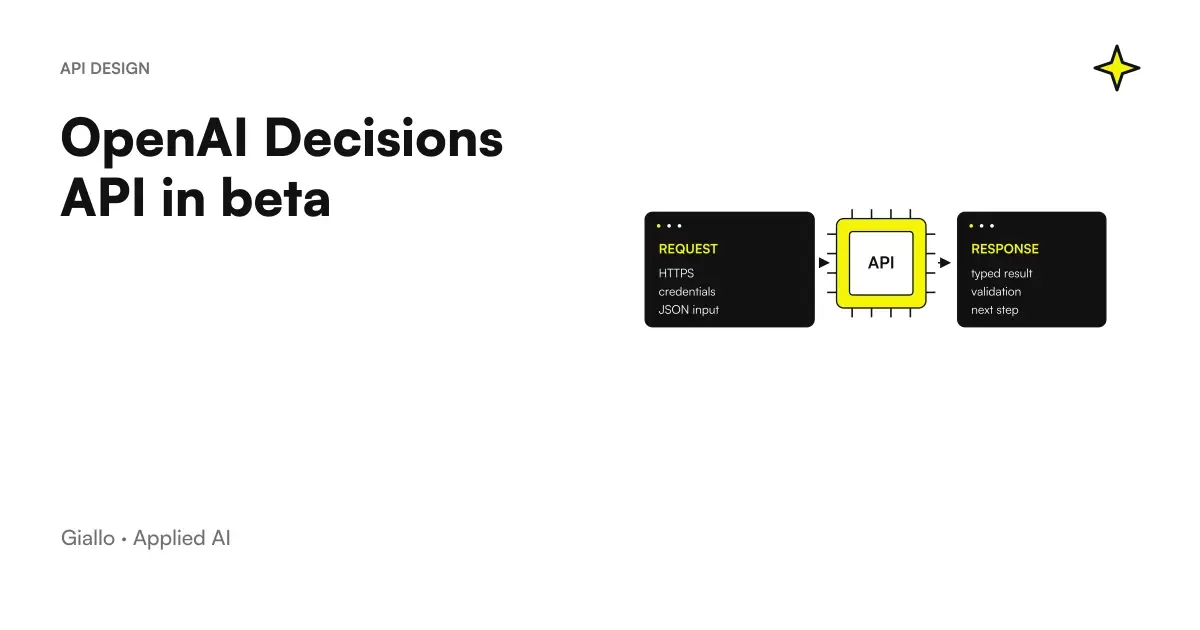 OpenAI Decisions API in beta: classify tickets and requests with controllable answers
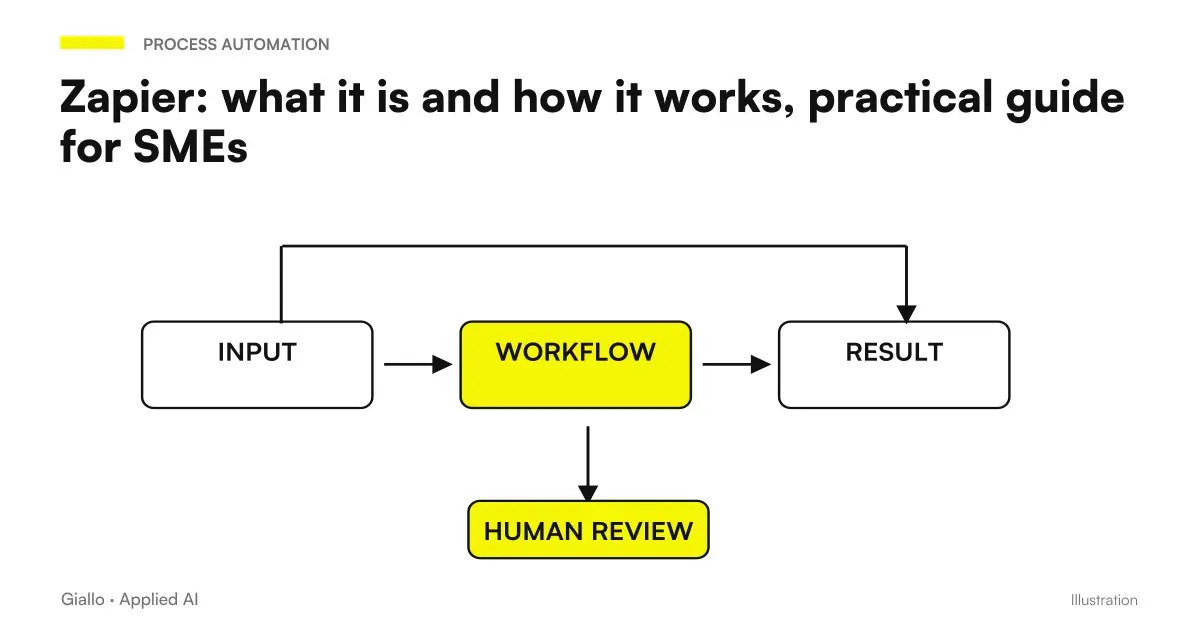 Zapier: what it is and how it works, practical guide for SMEs
 Make vs Zapier vs n8n: which one to choose for your company
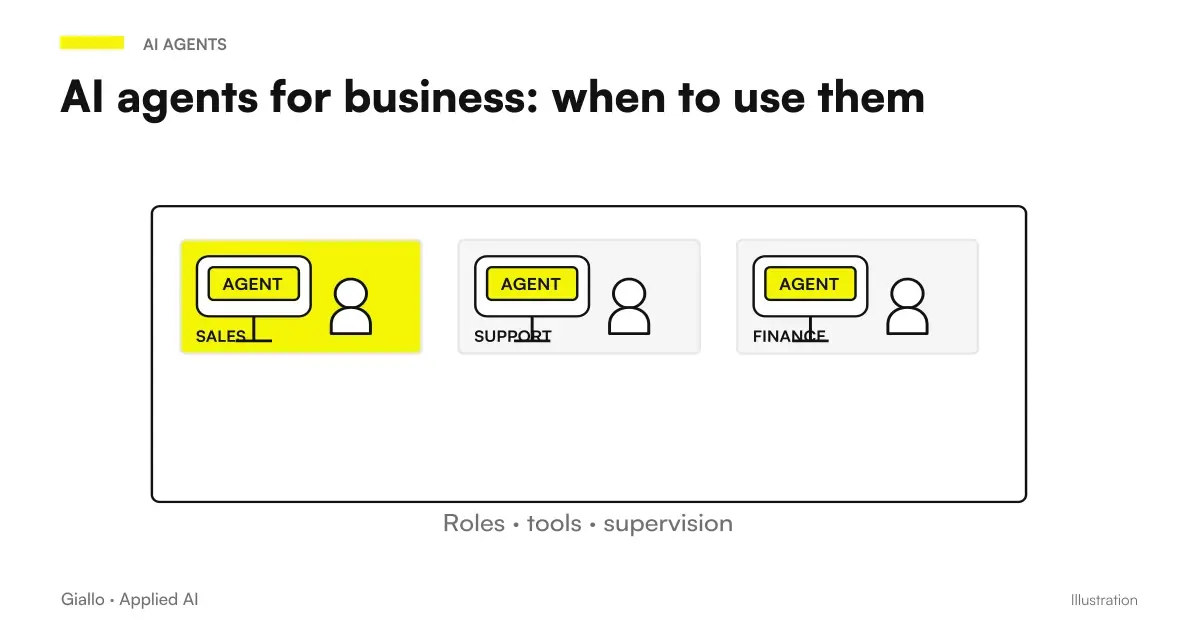 AI agents for business: when they are useful and how to adopt them
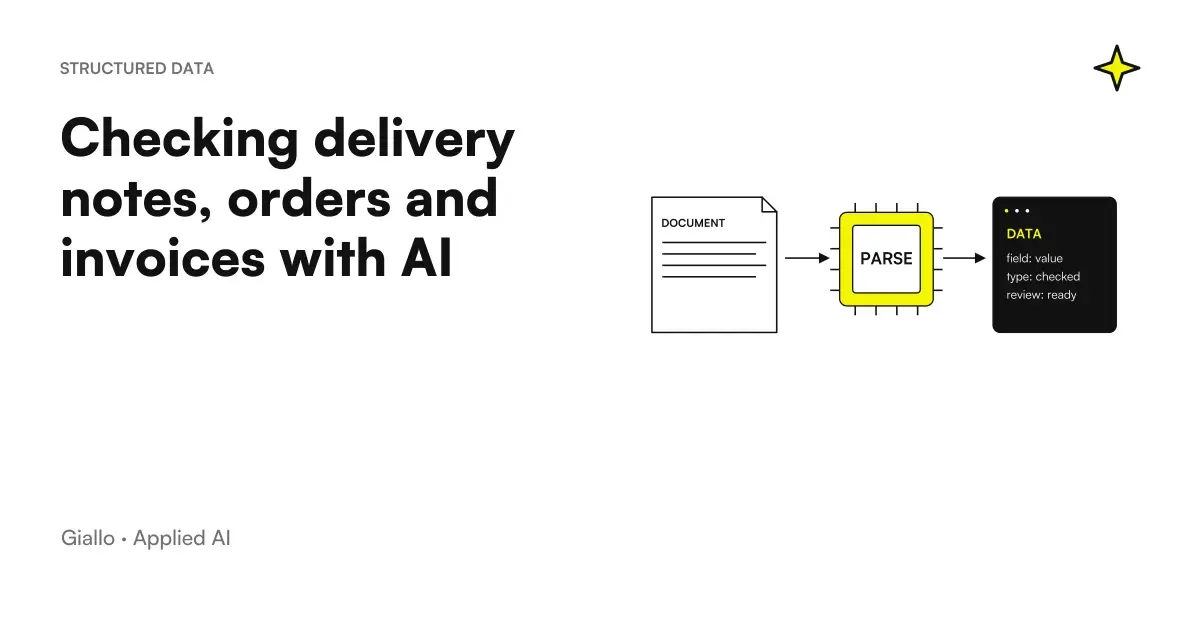 Check delivery notes, orders and invoices with AI before recording them
 AI expense reports: from receipts to approved reimbursement requests
FAQ
What changes for Zapier Agents?
Prompts, reasoning and tools are brought together in an AI step in the Zap editor. The workflow can combine them with filters and deterministic steps.
Did the migration begin with the October 6 article?
The article describes the evolution, but the guide was already updated before. It should not be presented as proof of the first launch of the product or the beginning of the migration.
Does each tool become a separate step?
No, the guide indicates that the migrated agent remains in a single AI step. A possible breakdown requires a design choice.
What knowledge sources require verification?
The guide consulted lists HubSpot, Asana, Zendesk, Zoom and Jira as not yet supported. This limitation applies to knowledge sources, rather than to every normal integration with those apps.
Are approvals enough to send automatically?
You need to configure the control and show content, recipient and effects. Staff need to understand what they are approving before the external action.
How to verify the transfer?
Use representative requests, compare with the previous workflow and test without actually sending messages. Check sources, permissions, tools, results and behaviour on errors.