
Copilot Studio: prices, credits and cost of agents
Copilot Studio pricing in Italy, credits and PAYG: estimate agent costs by separating harness, users, actions and actual usage.
Reading time: 12 min
The cost of a Copilot Studio agent depends on the capacity purchased, the technical experience used and the operations performed. To estimate this, it is necessary to distinguish the price of Microsoft Copilot user licenses from the consumption of agents. "We have twenty users" and "we handle a thousand requests" describe different sizes of the budget.
The 10 October 2026 the Italian page of Studio exposes a package of 25,000 Copilot Credits at €173.30 per month. The entry is tenant capacity, not a fee for each operator. VAT and contract conditions of the specific Studio purchase have not been verified in an authenticated checkout: they must be confirmed in the estimate. Source: Copilot Studio Italia prices.
The global guide also indicates a meter pay as you go of 0.01 USD for Copilot Credit. It is a commercial rate expressed in dollars, subject to published conditions; it should not be arbitrarily transformed into 0.01 euros. It does not describe how much Microsoft spends on the underlying APIs. Source: Microsoft Copilot Studio licensing guidance.
Before the price: what cost are we comparing?
A full quote may include Studio capabilities, any Copilot licenses of recipients, related services, design, maintenance and training. Some items are already present in the company; others are incremental. Keeping them separate allows you to understand what really changes when the project starts.
A Microsoft Copilot license of the operator is not a maker license for those who build and administer the agent. The external channel, an internal authenticated user, and automatic execution may also have different conditions. The recipient configuration must be written before multiplying a figure by the number of employees.
For user plans, see Microsoft Copilot: pricing and licensing for SMEs. This guide focuses on agent consumption and the operational cost of the project. Mixing Microsoft 365 add-ons and Studio capabilities can produce a seemingly simple, but unhelpful comparison to decide.
The economic sheet then indicates two columns: cost already incurred and new cost attributable to the use case. If the company already owns a license, it does not mean that each project is free; it means that that specific item may not increase. Implementation and management time remain to be assessed.
What do Copilot Credits measure in the standard path?
The following table concerns only the standard harness. Components can add up: a request does not always coincide with a single billable answer. Flow rate refers to actions performed, while Graph grounding is a distinct component from generation. Source: billing rates and management.
| Component in the standard path | Documented credits | Reading useful for estimating |
|---|---|---|
| Classical response | 1 | Default Content |
| Generative response | 2 | Generating the response |
| Agent's action | 5 | Action/Orchestration Passage |
| Message Grounding on the Graph Tenant | 10 | Additional context component |
| Agent flow actions | 13 per 100 actions | Counting the Path Run |
This selection does not include all meters. AI tools and reasoning models can introduce additional components; configurations with their own models have separate conditions. The table is not a universal tariff for any technology called ‘Copilot’.
To design an agent that is consistent with the goal, read Copilot Studio and Corporate AI Agents. Consumption also arises from delegation: an information response, a verification on current data and a sequence of updates do not require the same steps.
A Computable Example: A Thousand Answers with Graph Grounding
Scenario entirely hypothetical, without B2E inclusions and without additional instruments or meters. Suppose a standard agent produces 1,000 responses per month, each with a generative response and a grounding tenant Graph. Consumption per response is 2 + 10 = 12 credits; the monthly one is 1,000 × 12 = 12,000 credits.
With the global meter published in USD, the demonstration cost of consumption alone is 12,000 × 0,01 = 120 USD. It is not an Italian quotation, it does not include taxes and does not convert currencies. For a local offer you need actual price, billing country and applicable terms.
If the available capacity consists of a 25,000-credit package, this example uses 12,000 ÷ 25.000 = 48% of package. 13,000 credits remain in the same reference period. The package is not purchased at 48% of the price: spending and consumption are different sizes.
Attribute proportionally 173,30 × 48% = 83,184 euros, show yourself as 83.18 euros, can serve for an internal account between projects. It's not the price actually billed for that agent alone. If no one else uses the remaining capacity, the cost of the purchased package remains 173,30 euros before the tax conditions to be confirmed.
| Hypothetical calculation, only two standard components | Result |
|---|---|
| Generation + Graph for response | 12 credits |
| 1,000 Responses × 12 | 12,000 credits |
| Share of a 25,000 pack | 48% |
| Consumption only with global rate USD | 120 USD |
| Proportional internal allocation of 173,30 euros | 83.18 euros |
| Package bought, if only purchased for the period | 173,30 euros, conditions to be confirmed |
The example specially separates currencies and methods. It does not prove which option is more convenient: a comparison requires rates in the same currency, homogeneous duration, usable capacity and equivalent contractual conditions.
Why not apply the same table to the GitHub Copilot harness
Microsoft documents for the GitHub Copilot harness a structure based on LLM tokens, tools, and harnesses; billing can already begin with creation, preview, testing, and evaluations. This rule is about that path, not all Studio agents. Source: overview of usage-based billing.
The project document then notes the experience used. If the team only copies the "two credits to answer" count from a standard table, it risks underestimating an architecture that uses different meters. The trial budget must also be consistent with the path actually taken.
For a first test, it records initial consumption, consumption after construction and consumption after a defined set of tests. The aim is to make visible the expense attributable to the different activities. Without this separation, changes to the prototype could be mistaken for the cost of ordinary use.
Do not infer from the name ‘GitHub’ that the case is identical to a developer’s subscription to GitHub Copilot. Here the reference is to the harness described in the Studio documentation. Product, technical experience and contract must remain identifiable in the estimate.
When B2E use is included and what conditions matter
In the standard path, documented inclusion concerns authenticated Microsoft Copilot licensed users in B2E scenarios. For agent flows the trigger is valid When an agent calls the flow; other triggers consume credits. Computer-Using Agents have a specific exclusion. They are conditions, not an exemption for the whole company. Source: Inclusion and Billing Conditions.
An assistant manually called by an operator and a process that starts upon receiving a request are not automatically equivalent. In the estimate sheet, add one line for each startup mode and specify which identity is used. This helps to avoid an economic promise based on a missing detail.
Don't buy licenses just by comparing "included" with theoretical consumption. The license can give other capabilities and can already be useful to the role; the automatic project can still have its own costs. The Guide to Copilot Chat and Microsoft 365 Copilot It clarifies the differences to be assessed on day-to-day work.
For flows, deepen the relationship between Copilot Studio and Power Automate. Before using an alleged inclusion as a business topic, check the trigger and licensing path of the real flow, along with the tenant manager.
Build three scenarios instead of a seemingly precise figure
A useful estimate includes low, central, and high scenery. Various volume, average number of passes and quota of requests requiring a correction or a new attempt. Instead, keep the required quality clear: lowering the quality to reduce consumption is not an equivalent comparison.
For example, in the hypothetical project ordinary requests could use few sources, while exceptional ones require more verification. Before the test we don't know what the real distribution is. Separating the two groups makes it possible to quickly replace a hypothesis with an observed data, without redoing the whole account.
Loops deserve specific attention. A ten-line practice could perform a check for each line; a user fix could cause part of the path to be repeated. It counts the operations actually performed, not just the shapes drawn in the workflow.
Open fields of a playable estimate card
Identifies agent, harness, environment, channel, audience, and identity used. Note available capacity, method of purchase, currency, period and conditions to be confirmed. Distinguish existing costs and incremental costs.
For each type of request, it records expected volume, generative response, grounding, actions, flow, any tools and repetitions. Write the components excluded from the first example, so the reader does not interpret the total as a full quote.
After the test, compare expected and detected consumption. Add review time, percentage of successfully concluded practices, and reasons for escalation. It updates hypotheses with observable evidence before extending the audience.
Cost per correct practice is more useful than cost per chat
Imagine, again hypothetically, 500 conversations producing 300 ready practices and 200 suspended requests. Splitting the cost per 500 may be useful for reading traffic, but it does not represent the cost of the desired result. The definition of the denominator changes the economic interpretation.
A correct practice should have explicit criteria: mandatory fields present, applicable source, no unauthorized update and result usable by the operator. Suspended cases are not always mistakes: sometimes stopping is the right behavior. Expected suspension, defect and completed practice should be distinguished.
The Copilot integration with CRM and management software can make the task more useful but introduce external costs. The availability of a connector does not mean that each operation is included in the same rate or that the provider of the management software does not have its own limits.
The Guide to the ROI of an AI project helps link expense and benefit. Freed hours are only valuable if the quality remains acceptable and the organization is able to use them. A low cost per practice is not enough to demonstrate an overall economic return.
Light unused capacity and cost of waiting
The purchased package and the credits used can diverge even when the agent works well. A service used only at the end of the month could leave a lot of capacity unused in the other periods. When comparing purchases, it is therefore useful to observe the distribution of traffic, not just the annual total of requests.
Licensing guidance distinguishes monthly packages and pre-purchase forms; unused monthly package credits do not pass to the following month. Do not assume that all modes have the same duration or recovery of residual capacity. Source: purchasing mode and capacity.
For internal allocation, choose a criterion before the test. It can be proportional to consumption or include a fixed fee for the reserved service. The criterion must be explicit: otherwise a department that uses little the agent might seem very cheap while another supports all the capacity purchased.
The cost of the interruption deserves a separate account. If a practice is to return to ordinary management, recovery time may be more important than the difference between two tariffs. Record what work remains available during the block and how much it costs to complete the practice manually. This data helps to choose capacity and alternative without promising absolute continuity.
Finally, avoid saving by eliminating the control that makes the output usable. If a source or verification step is necessary to achieve the agreed quality, its removal changes the product compared. Useful economic optimization eliminates redundant operations, keeping requirement and result recognizable.
Prepare a budget that will stand for real use
In addition to consumption, it assigns responsibility to sources, integrations and measurement. A procedure that changes every week requires a different job from a stable catalog. The Business Data Privacy in Copilot it must be evaluated together with the actual route, without using the cost as the sole criterion.
Define a limit of expense for the test and a moment of review. If the volume grows, the team needs to know which choice is ready: reduce delegation, correct unnecessary repetitions or buy additional capacity. "We'll think about it when it's over" leaves just the moment when the process becomes service dependent.
Before extending use, it measures a sample of authorised actual practices or representative synthetic data. The Copilot pilot for SMEs link this test to net time, quality and cost. The best estimate is the one you can explain and update, without hiding the assumptions behind a precise total.
If you want to compare licenses, capabilities and integrations on your case, Giallo can help you with a AI Consulting. For an agent with custom workflows, the path Custom AI Agents starts with the process and the verifiable result: the budget is built on the delegation really useful to your company.
Giallo Studio guides: methodology and sources
How we apply it in the company
Related resources
 Microsoft Copilot: prices and licenses for an Italian SME
 Microsoft Copilot and Business Data: Privacy and Permissions
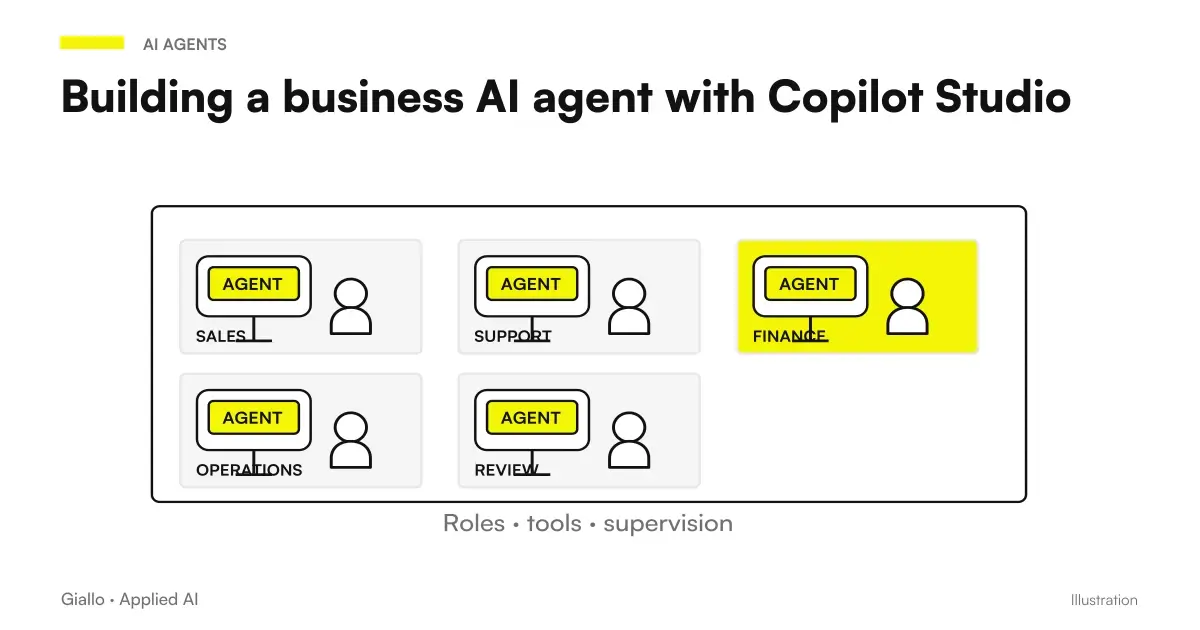 Copilot Studio: creating an AI agent for the company
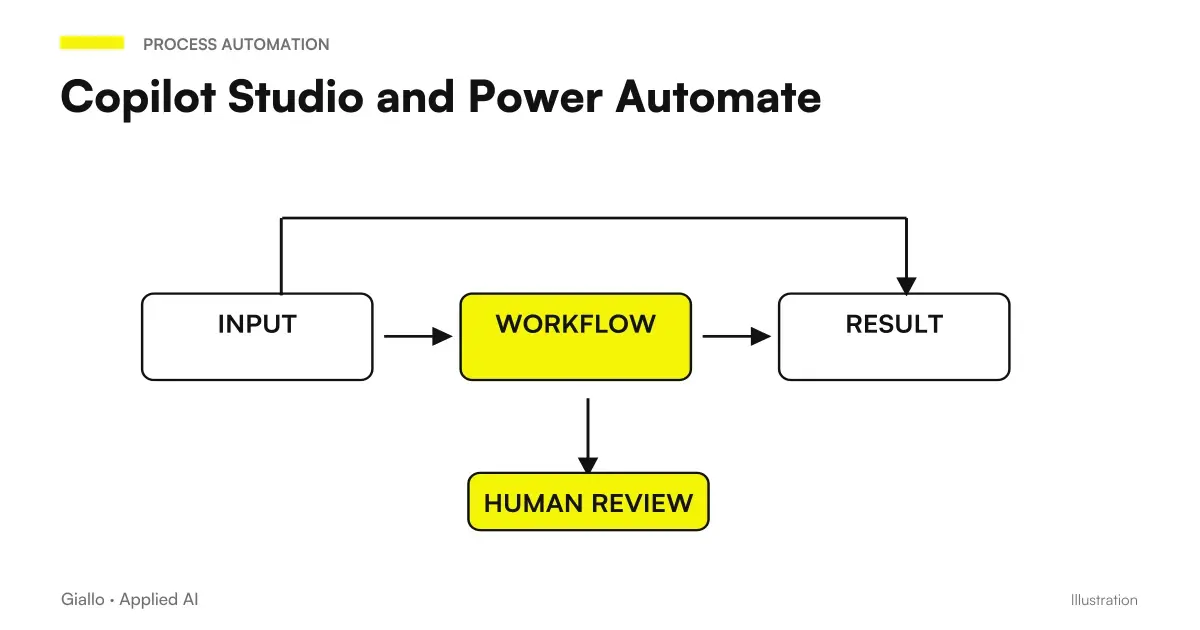 Copilot Studio and Power Automate: agents and workflows
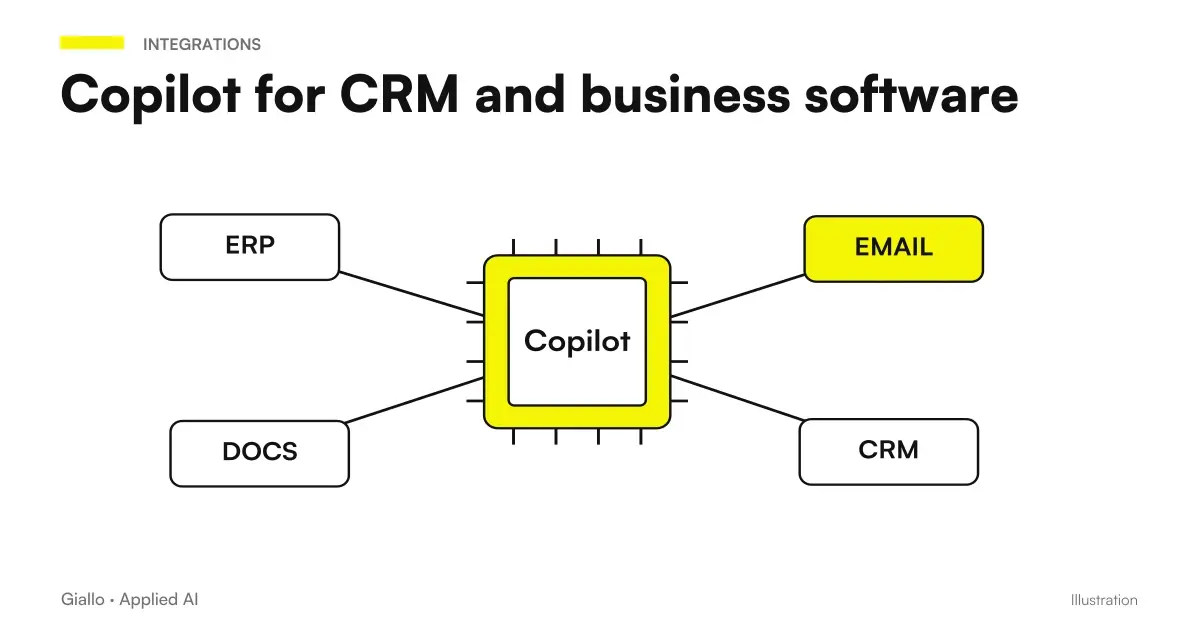 Copilot with CRM and business software: connectors and actions
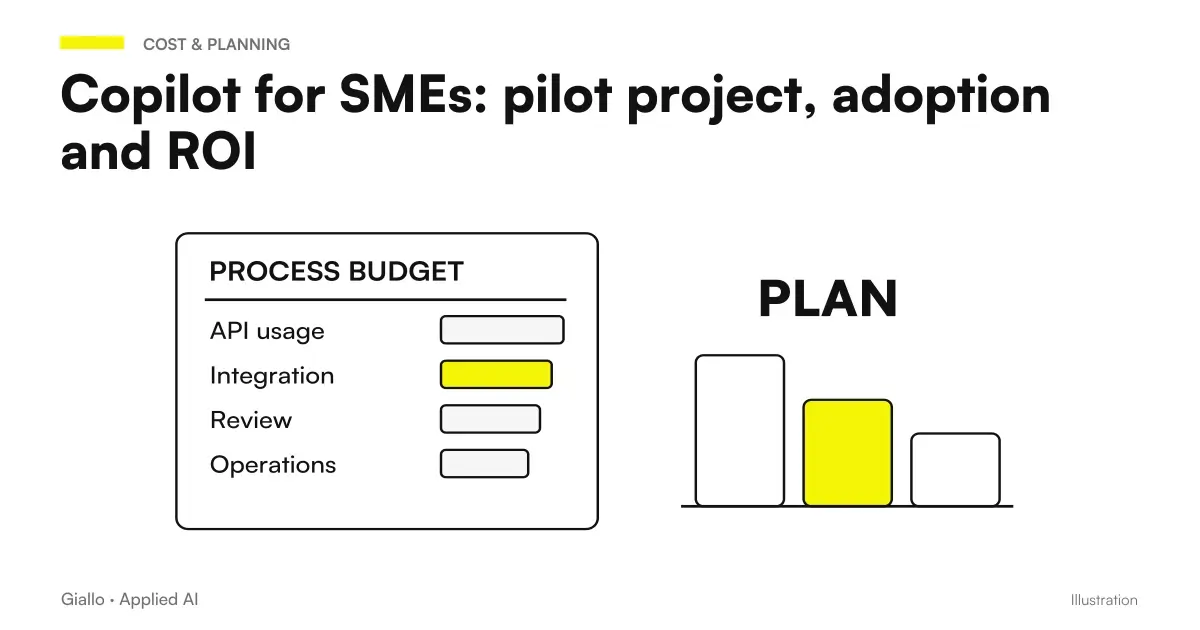 Copilot for SMEs: pilot project, adoption and ROI
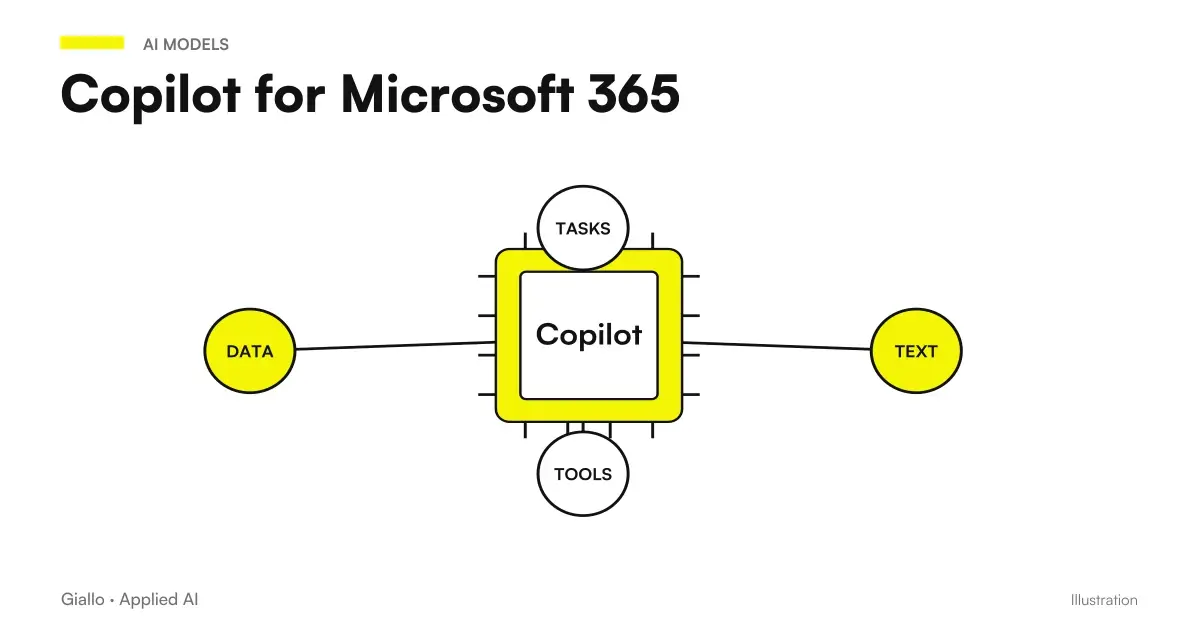 Copilot for Microsoft 365
 Copilot for companies
FAQ
How much does Copilot Studio cost in Italy?
On October 10, 2026, the Italian page lists a package of 25,000 Copilot Credits at 173.30 euros per month. Billing terms, commitment and VAT for the specific Studio purchase must be confirmed at checkout or in the quote.
Is the price pay as you go 0.01 euros per credit?
The public licensing guidance consulted indicates 0.01 US dollars for Copilot Credit. It is not a verified euro price nor the internal cost of APIs for Microsoft; the local price must be confirmed.
Does an agent's response always consume a credit?
No. In the standard path, generation, Graph grounding and actions can contribute separately to consumption. The GitHub Copilot harness path uses a structure based on tokens, tools, and harness as well.
Are agents always included in Microsoft 365 Copilot?
Documented B2E inclusion requires a licensed user and authenticated identity; flows must use the trigger When an agent calls the flow. Other triggers and Computer-Using Agents have different conditions. It is not a universal exemption.
Is testing a Studio agent always free?
No. The documentation distinguishes standard route tests from GitHub Copilot harness consumption, which can start already during creation, preview, testing and evaluations. The budget must specify the experience used.
How do you calculate a credible cost per case?
Divide the cost attributable to the service by the cases completed correctly, including errors, retries, review and operating costs. The number of conversations alone does not describe the value produced.