
Claude Duet: what it is, how it works and what changes at work
What Claude Duet is, how proactive agents change delegation and which limits matter. Initial US access and hypothetical scenarios for small businesses.
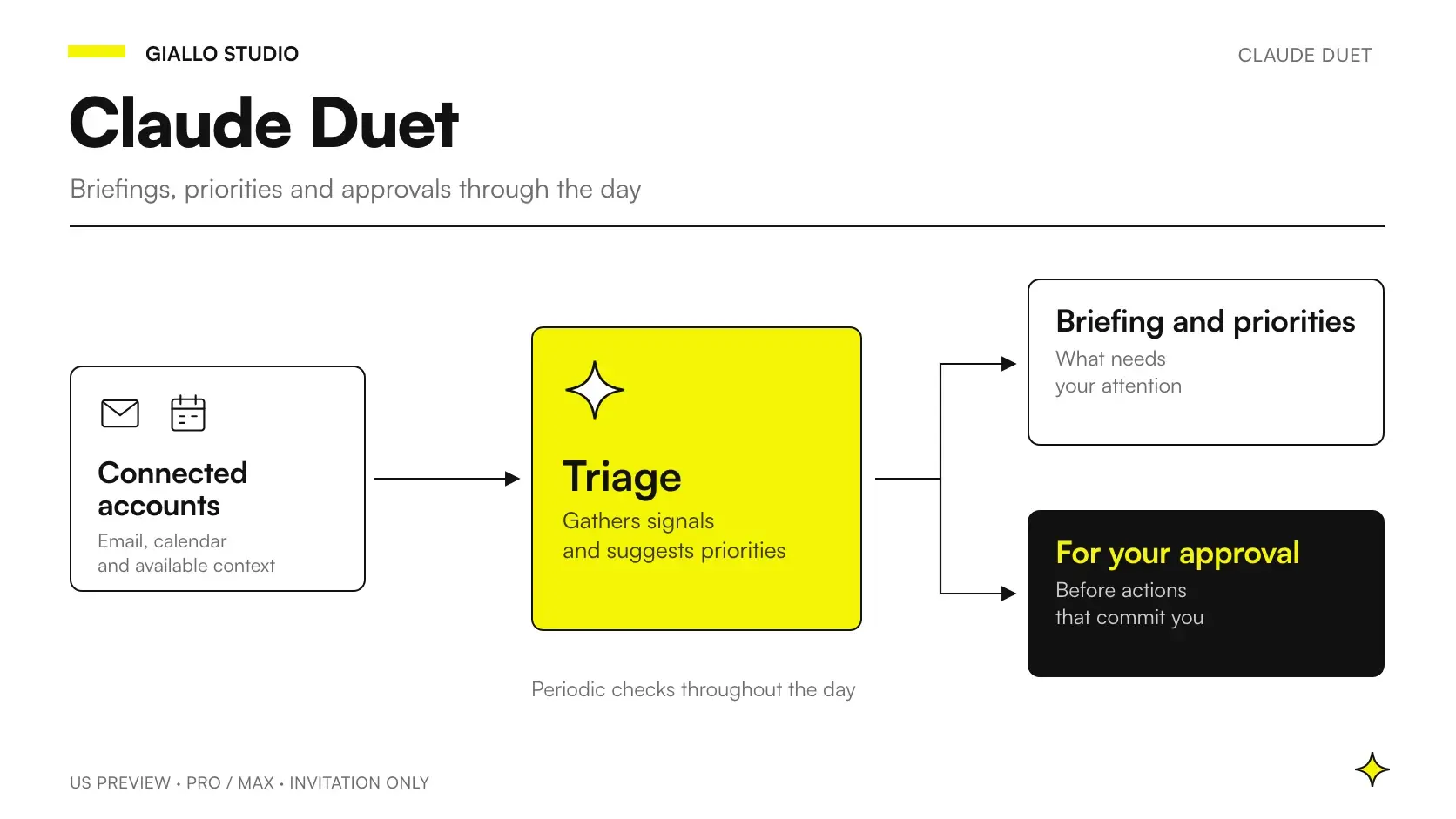
Claude Duet is Anthropic's proactive assistant: it follows tasks and suggests actions rather than only waiting for new requests. It was officially announced on 21 October 2026. Before asking whether your business needs it, the key point is how delegation changes when an assistant can draw your attention to something. Our description of the product starts with Anthropic's announcement.
This guide separates documented information from our proposed ways of working. We have not tested Duet directly: the examples, frameworks and assessment criteria are practical analysis, not findings from a Giallo test. Anyone looking for instructions to activate it from Italy must first check whether access is actually possible.
In summary
- Assessing a proactive assistant means deciding what deserves attention, not just writing a better request.
- A useful proposal should identify the problem, the information used and a next step that a person can check.
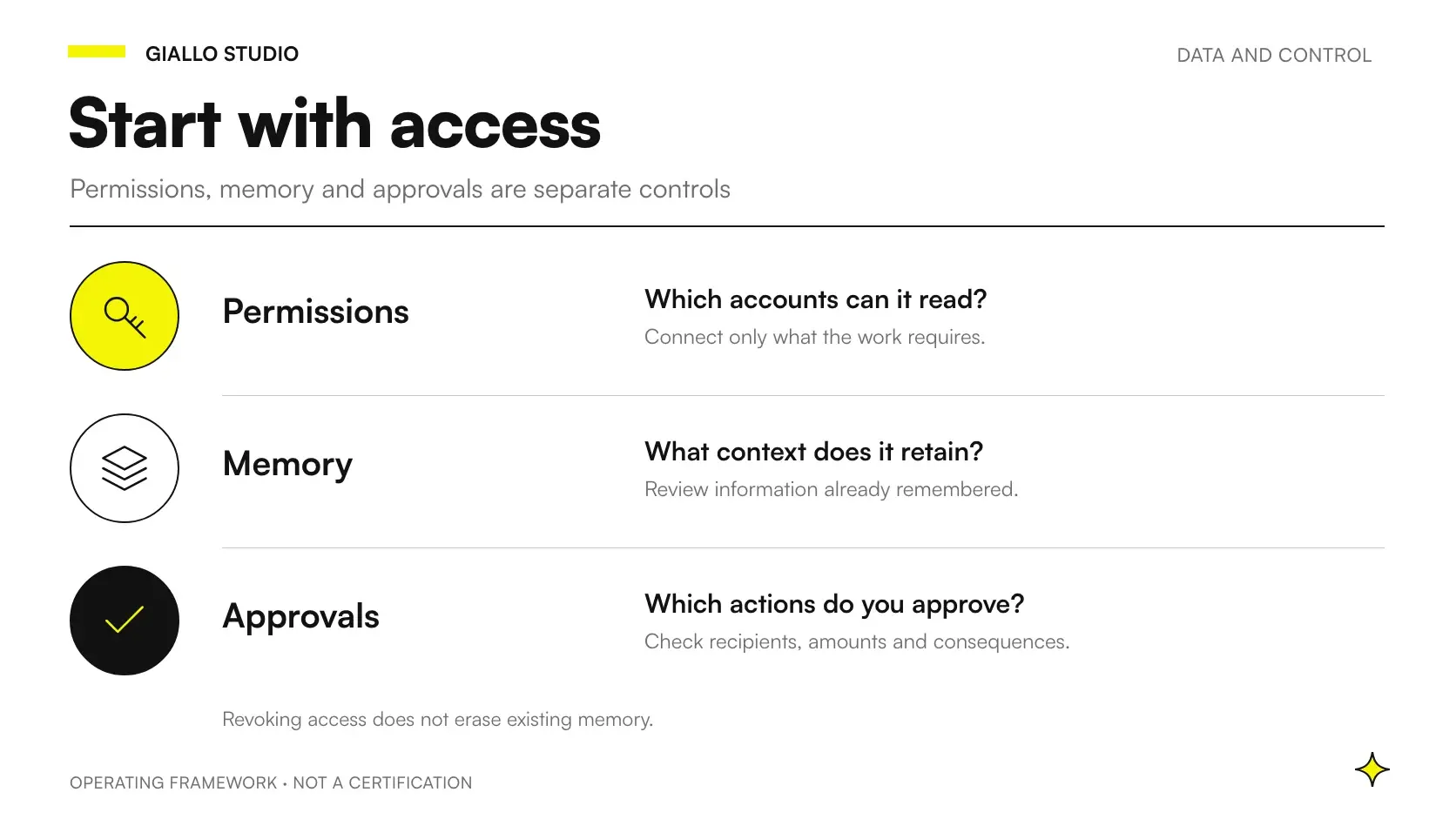
- Accessing data, preparing work and authorising action are separate decisions.
- A sensible first project covers a limited task, with an owner and a verifiable result.
Claude Duet availability: what has been verified
As of 22 October 2026, documented access is a US research preview for Pro and Max users, by invitation from a waitlist. The operational reference is the official guide to getting started with Duet. An Italian version of the announcement does not mean the product has launched in Italy.
This affects how the announcement should be read. We can study the product's direction and prepare an assessment; we cannot describe onboarding in Italy as something already completed or promise an unannounced date. This guide therefore focuses on what proactive delegation means and the questions to ask before adopting it.
Duet should also be distinguished from the model behind it. The product page names Opus 5.5: the experience and the model represent two different layers. A model produces reasoning and content; the product shapes how we request, receive and use them. This is a useful distinction when reading any AI announcement.
For the broader picture, see the guide to Claude AI. Here the question is more specific: when does an assistant that helps choose which work to move forward add value?
How Duet works: from assignment to result
You communicate with Duet by text or voice message, in its dedicated iOS and Android app or on the web. The assistant uses connected apps and its own computer in the cloud to carry out assignments. The work stays connected through a conversation: it can return documents and other materials for review, send a morning briefing and ask for a decision. Sensitive actions, such as sending messages or making payments, require approval. This cycle is described on the official Claude Duet page.
For the person delegating, there is a concrete sequence to observe: what was requested, which material was used and what comes back. Receiving a document does not establish that the assignment is finished. Review should confirm that the document meets the objective, distinguishes facts from assumptions and makes outstanding decisions clear.
From individual requests to managing attention
In a traditional conversation, a person identifies a problem, gathers the material and asks a question. The assistant's work starts after these steps. Its answer may be excellent, but noticing that something needs attention remains largely the person's responsibility.
A proactive experience shifts attention to that initial moment. Asking whether the system can draft text is not enough: you need to know whether the suggestion arrives in the right context, with a clear explanation and without unnecessary interruptions. The unit of assessment becomes the full task cycle, from identifying an issue to closing it.
Imagine a day full of open issues. Some need a response, some can wait, and others seem important simply because they arrived last. An assistant can help if it distinguishes these situations. It adds little value if it produces another list to sort manually or treats very different problems as equally urgent.
The practical question is: which issues do we want help noticing, and which judgements do we want to retain? Answering requires understanding the process. A folder full of documents does not necessarily explain the business's priorities. A recent message does not by itself establish a binding deadline. The rules connecting this information must be made explicit.
Three levels of delegation: observe, prepare, decide
The following framework is our editorial model for assessing an assistant. It is not an official Duet taxonomy and does not describe technical permissions guaranteed by the product.
| Level to discuss | Required result | Human review | Sign of a sound design |
|---|---|---|---|
| Observe | Highlight an issue with supporting information | Check the context's relevance and completeness | The suggestion explains why it deserves attention |
| Prepare | Create a draft, summary or work plan | Check sources, omissions and the intended recipient | The material is ready for a focused review |
| Decide | Make a commitment or authorise an action | Assess consequences and responsibilities | It is clear who gives final approval |
Separating these levels prevents common misunderstandings. Reading a document does not imply permission to share it. Preparing a reply does not mean it has been sent. Identifying a possible deadline does not establish that it is the one actually agreed. Each step changes the type of risk and the review required.
A good assignment can stop at the first level. For someone who loses track of many tasks, a well-explained alert can be worth more than an opaque chain of actions. In other settings, the value lies in preparation: having the material and open questions organised lets the review focus on decisions.
The choice need not be the same for everyone. Someone who knows the client may spot a nuance that a new colleague misses. The same draft will therefore require different checks. This is a reason to design the role of the person receiving the result, rather than speaking generally about automation.
Useful context is not the same as all available data
Before connecting tools, write down what the system needs to understand. Preparing for a meeting, for example, may require its objective, the last approved decision and outstanding questions. It does not follow that exposing every conversation or historical document in the organisation would help.
For more on the relationship between documents and authorisation, the guide to AI knowledge bases and permissions examines this boundary. For documented features and the checks needed specifically for Duet, we have an article on privacy, memory and business data.
First hypothetical scenario: preparing for a sales meeting
Consider a company that organises corporate events. Its owner needs to meet a prospective client, but the information is spread across an initial enquiry, a proposal and internal notes. This scenario is invented to explain the method: it is neither a Giallo client nor a test of Duet's features.
A sensible first request is not “manage the negotiation”. It is “prepare a meeting overview, separating what has been agreed from what we still need to ask”. The expected result includes a summary of the objective, confirmed decisions and a short list of open questions. The assistant should make the source of important points verifiable.
The person then checks that a preference has not become a promise and an indicative budget is not treated as approved funding. A sentence can sound highly professional and still be wrong for the commercial relationship. Review must address meaning, not just style.
If the result is not useful, do not immediately increase autonomy. First examine which information was missing or which criterion had not been explained. Perhaps the notes did not separate the client's requests from the team's ideas. Perhaps the current proposal was not identifiable. Correcting the context helps establish whether the tool is really the problem.
Second hypothetical scenario: following up on an open request
Now imagine a small company that installs audiovisual systems. After a site visit, availability, technical requirements and responsibility for preparing the room still need clarification. This is another hypothetical example, with no results attributed to Duet.
The delegated task could be a draft summary: what was requested, which details are still missing and what response is needed from the other party. The result should help the person responsible decide whether to write, call or request a technical check. It should not fill in missing information on its own.
Preserving uncertainty is a useful quality criterion. If a date has not been confirmed, the draft should present it as a proposal. If a technical detail requires another site visit, it should remain an open check. An assistant that makes everything appear final may save a cursory review and create a problem later.
Choosing the product comes after describing the task. If the need is personal and variable, assessing a general-purpose assistant may make sense. If the process must update several systems according to precise business rules, further checks are needed. This is explored in the guide to Duet and proactive AI agents for small businesses.
What to observe in an initial assessment
A well-designed trial does more than look for an impressive demonstration. It looks for behaviour that can be observed and discussed. Before starting, define what a good result should look like, which errors would make it unusable and how much review work is acceptable.
The following worksheet is a practical proposal from Giallo. It can be applied to a proactive assistant without assuming undocumented Duet features.
Open the worksheet to define the first assignment
- Situation: which event or issue needs attention?
- Responsible: who can recognise a correct result?
- Minimum context: which documents and information are sufficient?
- Result: what should be delivered to the person?
- Scope: which actions are outside the assignment?
- Verification: how will important claims be checked?
- Exit: how do you pause the trial and return to the previous workflow?
When comparing results, record the corrections needed too. A quickly produced draft can take a long time to check; a seemingly relevant alert may arrive after the person has already resolved the issue. Without observing the full cycle, generation speed risks becoming the only number considered.
There is no need to invent financial targets. Start by collecting simple evidence: which suggestions helped, which information was missing, which errors recurred and whether the person could explain why they approved or rejected the result. The comparison should be understandable to someone who did not set up the trial.
Design mistakes that weaken delegation
The first mistake is assigning a very broad objective without explaining what a good conclusion looks like. “Keep me updated” can produce a stream of messages without clarifying which updates matter. Specify the kind of issue you want brought to light and the context needed to assess it.
The second is using broad access to compensate for disorganised documents. Adding information does not automatically resolve contradictions or outdated versions. It can increase the material to interpret without improving how it is selected. Clear sources are part of good delegation.
The third is judging proactivity by the number of alerts. An assistant that interrupts often is not necessarily more attentive. It helps when it selects relevant issues, explains why it raises them and lets the person correct the criteria. Assessment should therefore include the cost of interruptions.
The fourth is turning a demonstration into a commercial promise. Showing a workflow in a presentation does not establish that it meets your business's needs. Available data, required operations, responsibilities and handling of incomplete cases still need checking. That is why the scenarios in this guide are described as proposals to assess.
How the approver's role changes
An approval request is useful only if it enables a decision. Whoever confirms an action needs to know the recipient, the content or planned commitment, the information used and any remaining uncertainty. A confirmation button alone does not provide that understanding.
This also concerns internal organisation. If work is prepared for someone who lacks the context, review becomes slow or superficial. Assign each type of result to someone with the knowledge and authority to assess it. That person need not be the one who gave the assignment.
Review should also match the consequences. An internal summary and an external communication have different requirements. A contractual commitment cannot be treated as simple rewording. The business's operating rules must remain recognisable when an assistant has prepared the material.
The theme links to the corporate policy for the use of AI: describing roles and boundaries before a trial helps interpret errors and decide whether to extend usage. If every exception is resolved only with another prompt, the process remains difficult to explain and maintain.
Duet, Claude and specialised tools: avoiding the wrong comparison
Choosing is not simply a matter of identifying the most powerful product. Writing, reasoning about a document, working on software and keeping track of different activities call for different ways of delegating. An overall ranking cannot replace a description of the assignment.
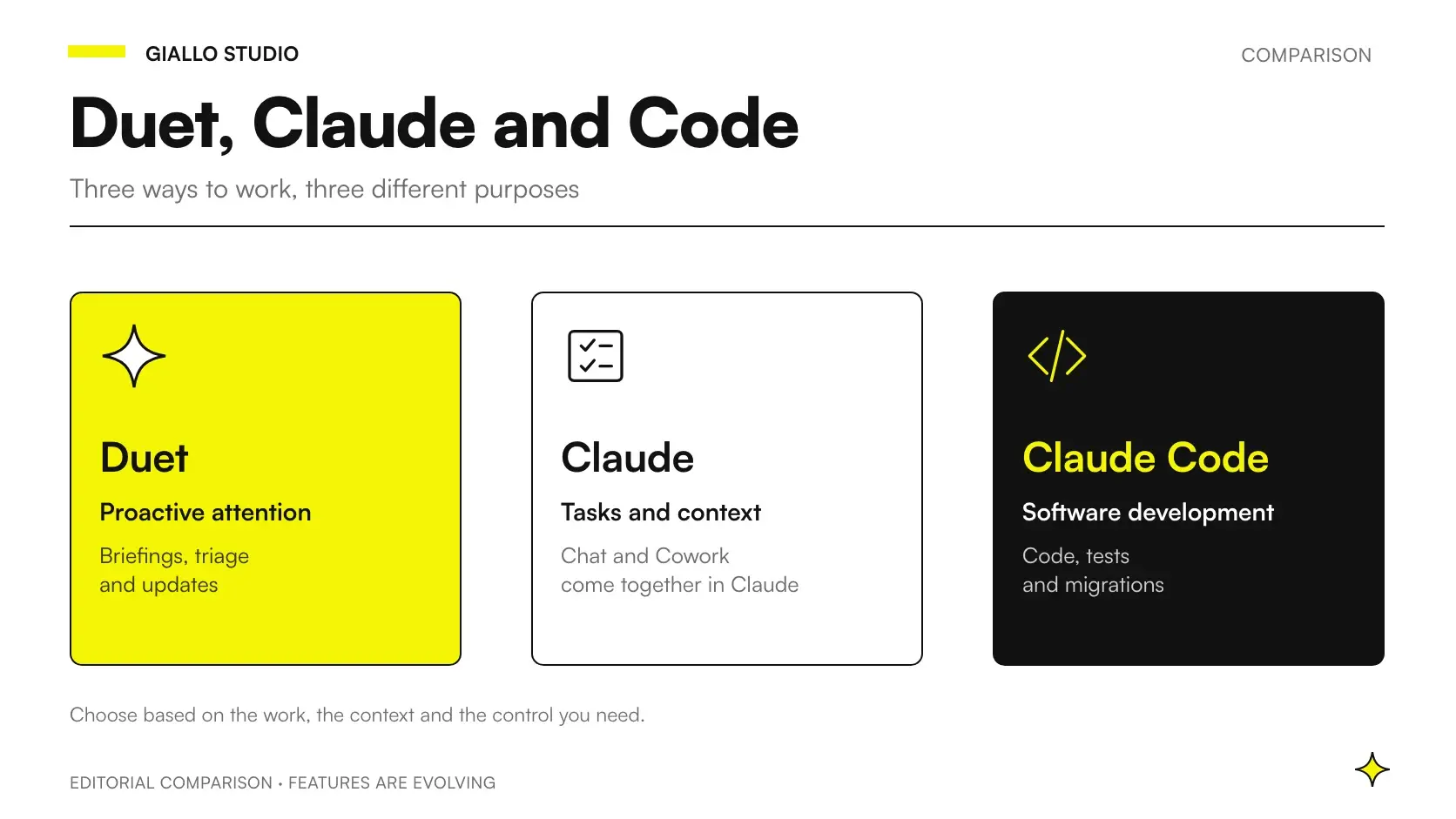
To choose between Anthropic's experiences, read the comparison of Duet, Claude/Cowork and Claude Code. The aim is to distinguish ways of working without assigning a product limitations that are no longer supported by current documentation.
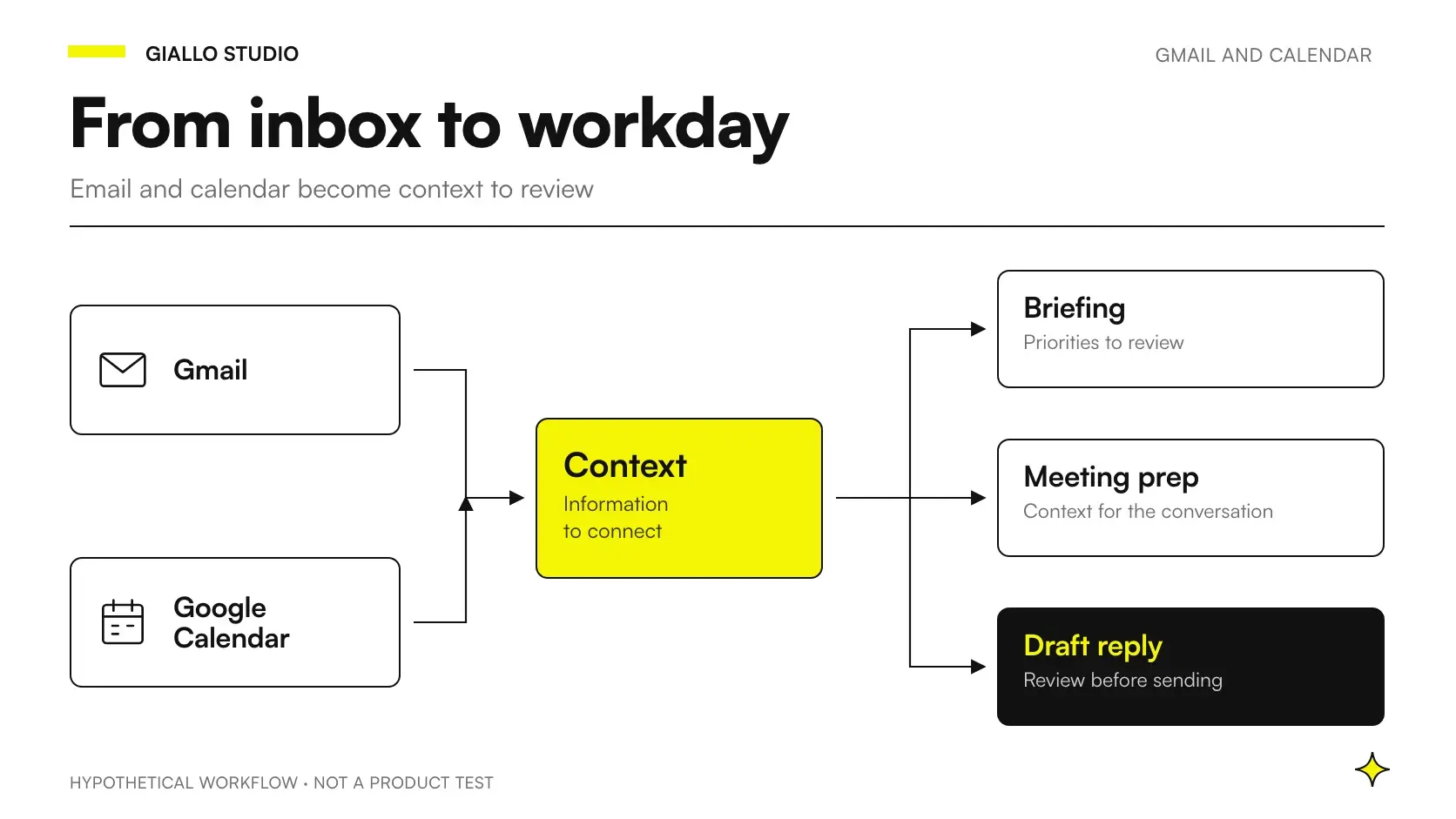
For work centred on email and calendars, define the expected result: meeting preparation, a summary of open issues or a draft to check. The guide to workflows with Gmail and Google Calendar offers focused examples and review criteria.
For a recurring business process, consider integrations, exception handling and responsibilities too. The guide to AI Agents for Companies covers this level. Accessing a new assistant and designing a process are related decisions, but they are not the same.
A practical path for an Italian small business
Useful work is possible even without access to the preview. Start with a single task that currently involves gathering scattered information or preparing material for a decision. The person responsible describes how they do it, which sources they check and which signals make them stop to seek clarification.
Next, prepare a small set of representative examples, using suitable trial material and removing unnecessary data. For each example, describe the expected result and the conditions that would make it wrong. The aim is to build an assessment criterion, not to pre-empt the choice of provider.
Finally, decide who will receive the result and how observations will be collected. A trial is valuable if it informs the next step: improve the context, narrow the assignment, change tools or continue with the existing procedure. Choosing not to automate part of the work can also be a good outcome when supported by evidence.
Claude Duet raises a broader question: which aspects of our attention can be assisted without making the work opaque? A useful answer for a business starts with its processes, responsibilities and what people can actually check.
Let's discuss the process you want to simplify and assess an AI agent suited to your business.
Giallo Studio guides: methodology and sources
How we apply it in the company
Related resources
 Claude Duet, Cowork and Claude Code: which to choose
 Claude Duet and privacy: permissions, memory and business data
 Claude Duet with Gmail and Google Calendar: workflows and checks
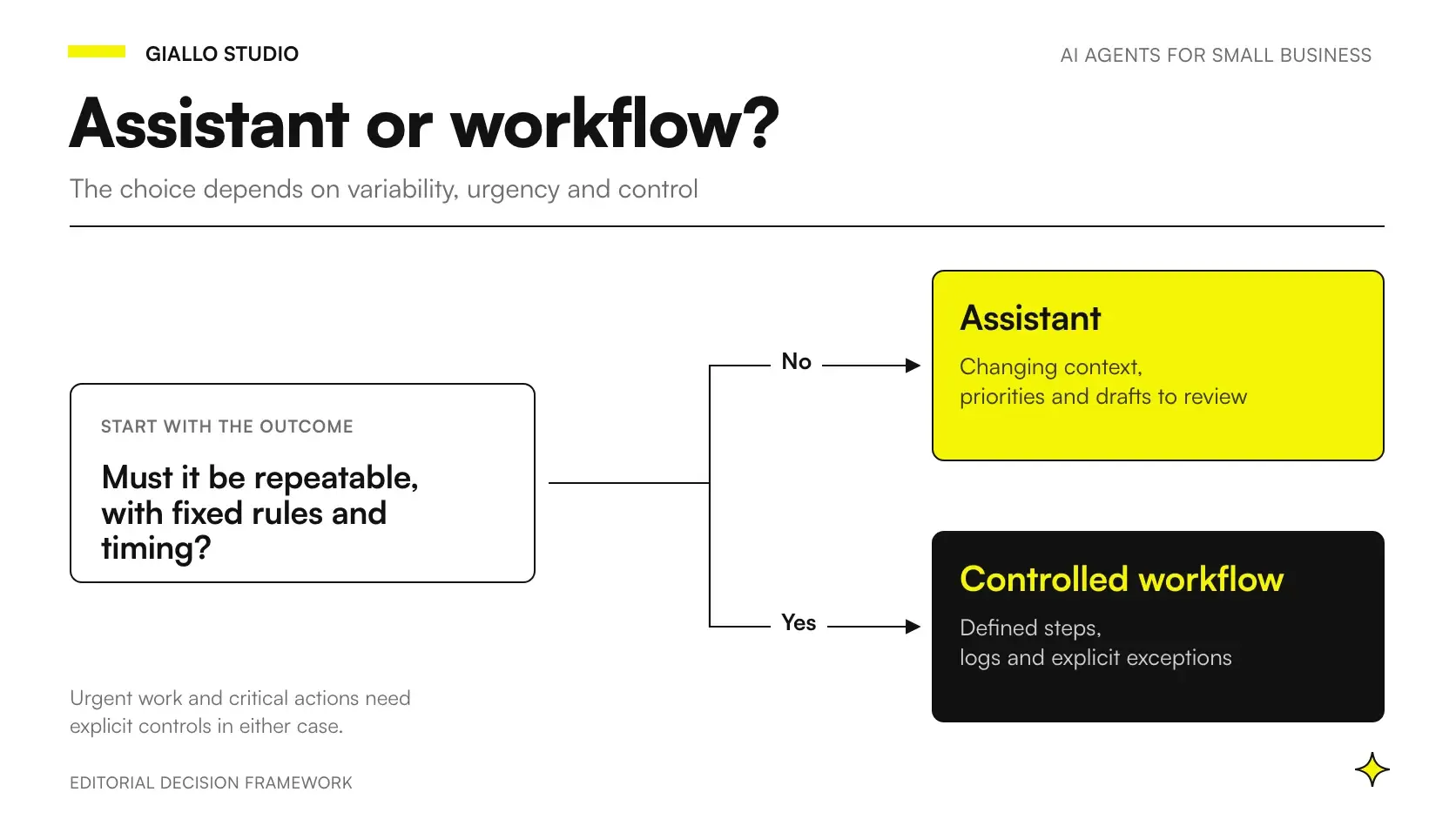 Claude Duet and proactive AI agents: what changes for SMEs
 Claude AI: what it is and when to use it
 Claude AI for companies
 ChatGPT Plus vs Claude Pro: which subscription to choose
 Claude vs Perplexity
FAQ
What is Claude Duet?
It is Claude's proactive experience, designed to follow tasks and suggest actions. To assess it, distinguish what it can observe, what it can prepare and what needs a person's decision.
Is Claude Duet available in Italy?
As of 22 October 2026, the documented preview is for invited US Pro and Max users. A page in Italian does not establish that the service is available in Italy.
Is Claude Duet a new language model?
Duet is a product experience, not the name of a model to rank on a benchmark leaderboard. Choosing an assistant also means considering context, tools, controls and the outcome you need.
Do I need to replace the tools I already use?
No. First identify a specific task and check whether the assistant improves it without adding review work. A new product does not make reliable procedures, software or automations redundant.
Are these examples hands-on tests by Giallo?
No. The scenarios in this guide are explicitly hypothetical designs. We have not tested Claude Duet directly and do not attribute time savings or results we have measured to the product.
Where can an Italian small business start today?
It can describe a process, organise the necessary documents, identify who approves the work and decide how to check the result. This is useful before gaining access to Duet, regardless of which product is eventually chosen.