
Claude Code Mods for Teams: Distribution, Policy and Security
Claude Code Mods security for business teams: private marketplaces, versions, reviews and managed policies, with code boundaries and an adoption plan.
Reading time: 12 min
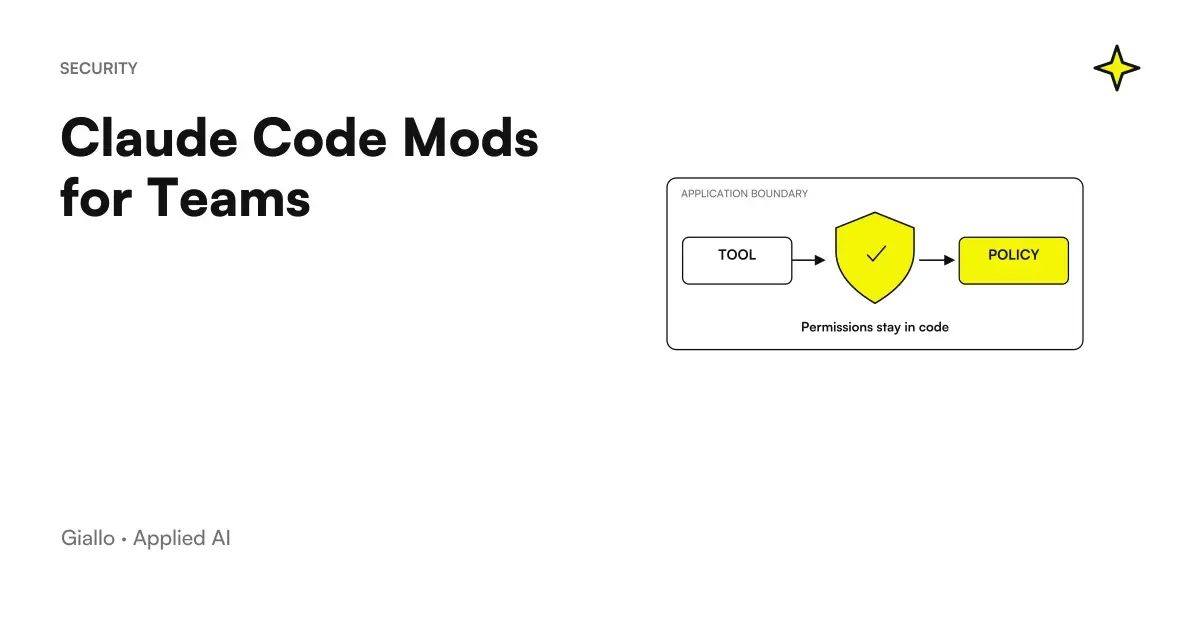
To adopt Claude Code Mods in an Enterprise team or environment We need a versed source, code review, and a risk-consistent distribution policy. An approved mod is not automatically sandboxed: its code performs operations with user privileges. The organizational guard protects specific boundaries, but does not transform every direct access to filesystems or processes into a controlled tool call. Mods Administrative Guide, plugin security.
Sources are verified on 9 October 2026. This guide proposes an adoption plan for a small team and two hypothetical Italian scenarios. Example policy is a project to be adapted and verified, not a certification of conformity. To choose the mechanism first, read What are Mods and the corporate policy for the use of AI.
In summary
- Each team mod must have origin, version, owner and declared function.
- Review of the code and tests precede the qualification on the working machines.
- An approved plugin does not automatically become sandboxed code.
- Managed provenance and enabling in settings are different conditions.
- Private distribution and publication in the Directory follow different paths.
What decisions do you make before you distribute a mod?
Start with the shared need. Who will use customization, in which repositories and for what decision? A personal indicator does not require the same procedure as a component that intervenes on authorisations. The distribution must follow the responsibility of the component, not a single rule based on the word ‘plugin’.
Then define the owner of the code and function. The former maintains the package; the latter knows the process and decides whether the behavior is correct. In a small team they may be the same person, but the responsibilities remain different. Anyone who can fix a TypeScript error may not necessarily authorize access to management software data.
Finally, prepare the exit. The team needs to know how to disable the component, what procedure to use if it is missing, and where to report a defect. A function that becomes indispensable without an alternative path introduces an organizational dependency before someone has evaluated it. A limited test allows instead to decide with observed facts.
What should the code review include?
The review compares actual behavior with promise. It controls read and written files, started processes, network, persistent data, and event decisions. A package presented as an indicator should not have unexplained access to sensitive content. The provenance helps to understand where the code comes from, but does not replace reading what it executes.
| Appearance | Review question | Useful Evidence |
|---|---|---|
| Provenance | What source does the package come from? | Repository or directory identified |
| Input | What data does it actually read? | Contract and calls in the code |
| Effects | Do you write, start processes or send data? | Used APIs and motivation |
| Status | What persists and for how long? | Life Cycle Requirement and Test |
| Authority | Does he inform or decide on the execution? | Managed Events and Negative Cases |
| Distribution | What version does each machine receive? | Manifest and update procedure |
| Recovery | What happens when the function is missing? | Alternative and Responsible Path |
Control must not turn into an abstract list. For each access ask what requirement justifies it. If the mod consults ticket, the contract may require title and status, not attachments and personal details. The Guide to commands and tools of the Mods API shows how to keep this function read-only, without confusing schema and authorization.
Private Marketplace: When is it a good choice?
A private marketplace can give the team a recognizable place for plugins. The source should contain versions, README, prerequisites and tests. The publication guide describes the plugin sharing path. It is a distribution solution, not an automatic guarantee on every package listed.
For a small group a simple structure can suffice: a package per function, an explicit version and a responsible one. Prevents each colleague from keeping a modified manual copy with no identity. If the code differs, the version number and provenance must allow the change to be recognized. Otherwise "the team version" becomes a description without a precise content.
The shared configuration of the project records the enablement, but does not automatically download the package on all machines. Each person must follow the planned installation path. For brooms, active copy and reloads, read install Mods in Claude Code. The adoption procedure should check the function, not just the presence of a settings file.
Why are versioning and updates part of security?
A version allows you to link a behavior to an identified package. When you correct an error or change the contract, distribute a new version and describe the effect. If a colleague reports a defect, you can compare installed code, active code, and requirement. Without this relationship the review made on one machine may not describe what runs on the others.
Prepare user-oriented change notes: which command changes, which input is rejected, which data is no longer maintained. A description as ‘various improvements’ does not help those who have to decide whether the update is workflow compatible. The note must be short enough to be read and precise enough to guide a test.
Do not automatically update a delicate function without a strategy. The team process must distinguish information components and components that influence execution. You don't have to promise a perfect block: you need to know which version has been verified and how to restore an approved path if the new function doesn't comply with the contract.
What protects the organizational guard and what stays out?
The administrative page describes an integrated guard on Teams, Enterprises and managed machines, with default protections on deny rules and policies. sec-default explains tiers and precedence. This model coordinates specific decisions; it is not an antivirus for any plugin code.
The decisive boundary is between a workflow tool call and a direct operation of the mod. Tool calls policy does not automatically protect every component call to filesystems or processes. For this a review must also include implementation, and operating system accesses remain part of the containment. Do not present a guard as a substitute for credential management.
If you adopt a demo like Blast Radius, documents its coverage distinct from the organization's policy. A panel that asks for a choice can help the manager, but does not grant each user authority over any environment. The Guide to AI and Data Security completes this reasoning on the process.
allowManagedModsOnly: where should it be configured and which source does it accept?
allowManagedModsOnly is an option of the integrated plugin below pluginConfigs, not a normal top-level key of the settings. The administrative guide distinguishes the absolute directory managed by cached downloaded copies through GitHub, git, URL or npm. An ordinary plugin can remain in the user tier even if enabledPlugins comes from managed settings. Distribution of Organization Mods.
This is a point of trust, not an aesthetic detail of the route. "The manager has enabled the plugin" and "the code comes from the managed directory" are different statements. With active restriction, a copy in the user tier can be rejected. Before correcting the rejection check the path provided by the version and policy, without lowering the control for convenience.
We do not provide a generic administrative JSON to copy on each machine: the structure and the route must be verified against the adopted product. The distribution dossier must indicate source, managed location, order and proof of loading. The Diagnosis of Mods helps to read the real reason if a machine does not receive the function.
How to write a minimum policy for a small team?
An illustrative policy can start with a few criteria: each mod has an owner; the allowed packages have an identified source; network and data access are motivated; changes are versioned; relevant controls pass before deployment. Functions that authorize actions require evidence of error and rejection. This is a policy project, to be adapted to real responsibilities.
Also define how to distinguish experiments and habitual adoption. A local prototype can be allowed in a controlled environment without automatically becoming part of the shared configuration. The team must be able to recognize that difference from the name, source or document, avoiding using a prototype as a silent dependency.
A ready-to-discuss rule proposal in the team
Each shared customization must declare function, owner, source, version, processed data and supported surfaces. The review compares the code to that contract. Tests include success and at least one relevant failure. The distribution verifies the active copy. The team maintains a path to disable the component and continue work when it is not available.
The policy must remain understandable to those who use the function. A huge document that no one consults does not improve the decision in the face of a mistake. A small rule, linked to evidence and accountability, can be updated when the risk or process changes. The Guide to AI Agents for Companies helps define these roles in the broader workflow.
What controls of plugin agents are likely to be ignored?
The subagent's general documentation speaks of Hooks in the frontmatter, but agents distributed inside a plugin ignore the field hooks of their frontmatter. The controls must be defined at the level of the plugin according to the documented contract. Copying an example from a general page without considering provenance may leave a rule only apparent. Agent Fields in Plugins.
During the review then looks for where the rule is actually recorded and which event activates it. It is not enough that the agent file contains text similar to that of the project. For a shared control it prepares a case that must pass and one that must be rejected, then observes the outcome in the actual distribution path.
This principle applies beyond that field: present instruction and applied control are different tests. The guide to test a mod helps turn a rule into a verifiable behavior. Team adoption must maintain the link between distributed configuration and verification, even when multiple components are packaged together.
Two hypothetical governance scenarios in Italy
Hypothetical example: a software house in Treviso adopts a shared indicator. The group prepares a private marketplace with package, README and version. The review confirms that the function reads only the necessary data. Two machines test the declared surfaces and the manager collects outcome and version. The function enters the workflow only after the team knows how to recognize an unavailable data.
When the component changes, a new version identifies the change. Colleagues do not exchange manual archives with the same name. If the UI does not appear, the procedure starts from active copy and surface; it does not change the policy by attempts. The result is a more understandable distribution, without declaring savings or a measured level of security.
Hypothetical example: an SME from Ravenna wants control over the team's actions. The manager distinguishes local demos, approved plugins, and organization code. It checks the managed provenance and prepares synthetic waste cases. A machine receives the plugin through an ordinary cache and does not exceed the intended restriction: the team corrects the distribution, maintaining the trust boundary.
The policy also specifies who can approve operations in different environments. No button can replace a business role. For sensitive data the group checks accesses and destinations separately from the guard. This attention avoids presenting the mod as an automatic process certification.
Public directory and official marketplace: are they the same route?
The publication guide distinguishes own marketplace, directory portal and candidature to the official marketplace claude-plugins-official. The portal has requirements of plan and role: the concrete availability must be verified in the official source before choosing the channel. Local validation does not automatically cover all portal rules. Publish a plugin.
For an internal function, public distribution may be superfluous. Before making it available to everyone, check whether it contains configurations, references, or data that belongs to the team. A locally useful plugin does not necessarily have to become a public product. The choice of channel depends on recipients, maintenance and responsibility.
What governance errors leave only apparent protection?
The first is to call an editable directory without a trace of the content "approved version". The second is to confuse an entry in managed settings with the source required by the policy. The third is to deploy a plugin agent expecting it to apply Hooks defined in an ignored frontmatter. They are different conditions, to be verified each in the real path.
The fourth is to assign the component a wider role of its contract: an indicator becomes a certification, a UI choice becomes business authorization, a local test becomes proof of integration. The fifth is to leave the mod unresponsible after the experiment. Correct these errors by linking each statement to a test and each function to who decides on the process. The policy remains useful when the team knows its boundaries, not when it promises to solve everything with a single setting.
How to start sustainable adoption?
Choose only one mod with a shared need and a verifiable contract. Prepare source, version, test and review. Test the route on representative machines, save the result and assign maintenance. If the experiment does not clarify a team decision, you can stop it before it becomes addictive. The reversibility of the proof is a quality of the project.
To set up this adoption with clear responsibilities and data, the AI Consulting can link policies and workflows before custom development. The guides to Mods and to company policy They help decide which customizations deserve shared distribution.
Giallo Studio guides: methodology and sources
How we apply it in the company
Related resources
 Mods by Claude: what they are and when they are needed in Claude Code
 Install Mods in Claude Code: scope, reloads and updates
 Test a Claude Code Mod without login or model calls
 Claude Code Mod not working: loading, hot reload and state
 Blast Radius in Claude Code: Assessing Commands Before Acting
 Corporate policy on the use of AI: how to write it
 AI and data security: concrete risks and how to manage them
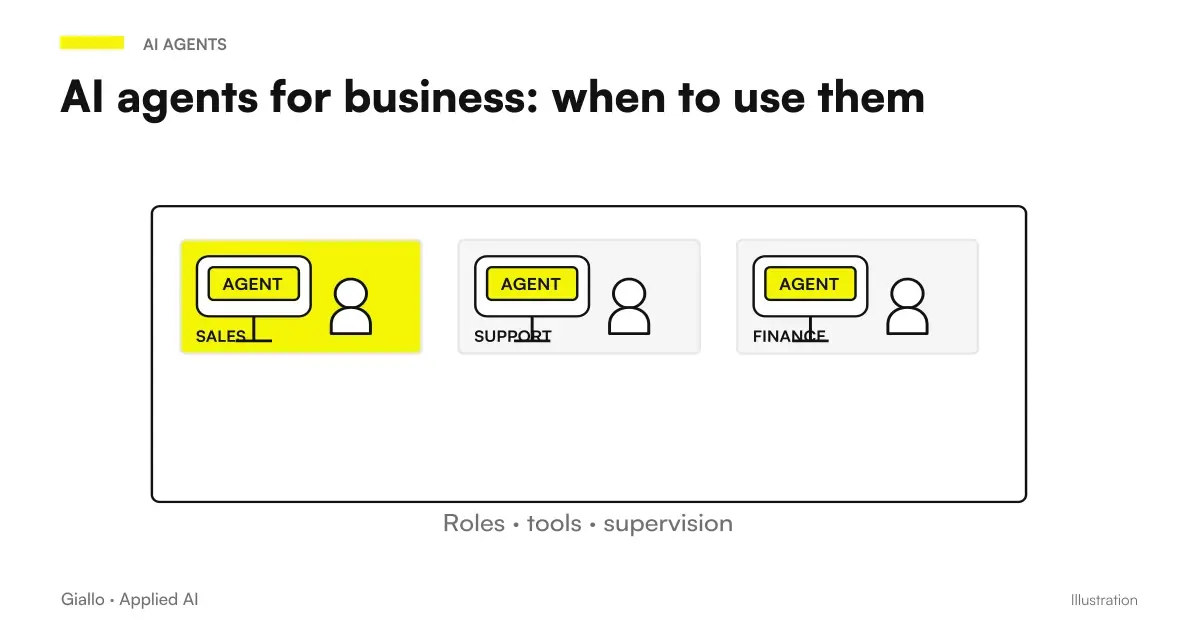 AI agents for business: when they are useful and how to adopt them
FAQ
How to distribute a mod to a team?
A mod is distributed as a plugin, through a stable and versioned source. A private marketplace can organize team packages. Before adoption define review, requirements, responsibility, update and verification on the affected machines.
Is an approved mod sandboxed?
No. Mods execute code with user privileges and are not sandboxed. An approval describes an organizational decision, not a universal containment of operations. It is also necessary to examine the direct accesses of the component.
Where should I set up allowManagedModsOnly?
The administrative guide describes it as an option of the built-in plugin under pluginConfigs. It is not a normal top-level key of the settings. Check the structure of the installed version and the expected managed path before applying a policy.
Does enabling a plugin in managed settings make it an organizational mod?
Not automatically. The guide distinguishes the managed absolute directory from cached copies from GitHub, git, URL or npm. An ordinary copy can remain in the user tier even when enabledPlugins is set by managed settings.
Are the controls in the frontmatter of a plugin agent applied?
Component documentation specifies that the hooks field in the frontmatter of agents distributed within a plugin is ignored. Define those controls at the plugin level, with the relevant cases. The general subagent page should not be copied without considering the provenance.
Is local validation enough to publish to the Directory?
No. The guide distinguishes local validation, the Directory portal, and applications to the official marketplace. The portal has its own plan and role requirements. Preparing the package does not mean that all the rules for public distribution have been met.