
Blast Radius in Claude Code: Assessing Commands Before Acting
Claude Code Blast Radius Mod: previews, user choices and the limits of recognised commands. Evaluate it while distinguishing a demo from a business policy.
Reading time: 12 min
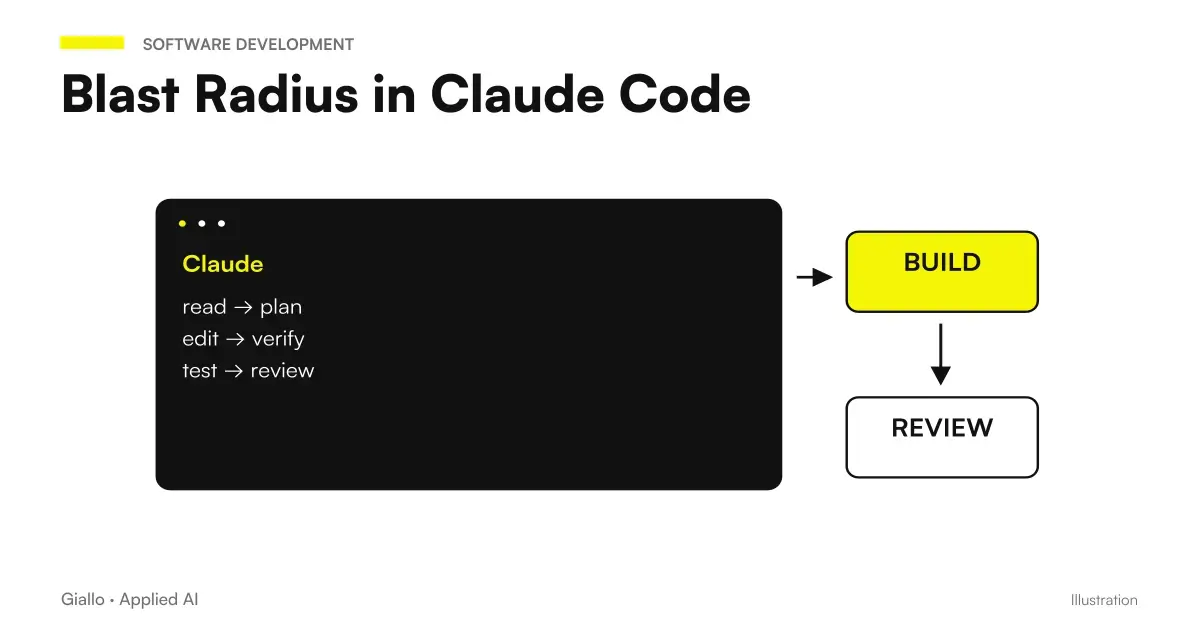
Blast Radius is a demo by Claude Code Mods that asks for a decision before certain shell commands. It suspends the call, represents what it might touch and allows the user to proceed or cancel. The utility is to make the impact readable at the point of choice; the demo does not automatically recognize every dangerous command. Official Blast Radius README.
This guide, verified on 9 October 2026, explains how to evaluate the flow without proving it on production or attributing absolute safety to it. The Italian examples are hypothetical. To understand the general mechanism, read What are Claude's Mods; for a rule configured on an event, compare the Guide to Hooks.
In summary
- Blast Radius makes an impact visible before a recognized call.
- The user choice is about that command, not universal workflow approval.
- An unrecognised handwriting or composition can escape the perimeter of the demo.
- The preview must be linked to repositories, directories and data really involved.
- The test must include undoing, error, and no response in an isolated environment.
What decision should make it clearer?
The initial question is "what will change if I authorize this operation?". The user must understand the object, extent and reversibility of the change. A list of files may be useful, but it is not enough if the relationship with the task is missing. A small file can be essential; a large folder can only contain reconstructable artifacts. The volume of the impact does not coincide with its value.
A good decision also needs the current state and the goal. An operation that eliminates local changes has a different meaning before or after a review. A migration must be linked to the environment and to the plan of change, not read as a generic maintenance. The UI may submit information, while the controller compares that information with what it has actually authorized.
This explains why an interactive demo does not replace team rules. The corporate policy for the use of AI should determine who can approve which category of action. A colleague who can read the screen may still not have the authority to edit a shared system. Showing two buttons does not resolve this organizational distinction.
What categories of commands does the official example deal with?
The README describes categories such as recursive deletions, loss of Git edits, cleanup of untracked files, push rewriting remote history, and some migration tools. They are documented capabilities of the demo, to be read along with the limitations. The useful comparison is not between ‘safe’ and ‘dangerous’ at all, but between the recognised transaction and the information that can be obtained before the choice.
| Category | Useful information in the preview | Additional verification of the manager |
|---|---|---|
| Deletion of paths | Involved files and overall size | Are they original data or reconstructable artifacts? |
| Git operation on local changes | Status of affected files | Is there work to be preserved? |
| Cleanup of untracked | Candidate Paths | What files do not appear in the repository but serve? |
| Rewriting Remote History | Effects on Branch Comparison | Who else depends on that story? |
| Migration | Supported tool readable state | Are the environment, plan, and responsibility correct? |
The preview must be interpreted according to the category’s contract. "Untracked file" does not mean "useless file"; "uncommitted change" does not mean "wrong change". These are technical states, not business decisions. The mod’s value lies in showing them before the step, so they are not overlooked behind a compact command.
For the test, prepare an isolated repository with synthetic names and content. Its purpose is to observe choice, not to test the luck of a real system. If you want to know how to distribute the component after an evaluation, follow Installation and Update of Mods, retaining the distinction between local demo and approved component.
Why does directory and shell composition matter?
The impact depends on where a command runs. A relative path read in the wrong repository can produce a preview that appears precise but is irrelevant. The README explains that the demo accounts for some directory changes and Git command forms with an explicit path. This statement must not be extended to every possible composition without evidence.
A shell allows sequences, substitutions, and structures that do not summarize with a prefix. A recognition based only on the beginning of the string may lack operations embedded in different forms. The documentation on permissions distinguishes the analysis of operations from text-based shortcuts. For a real policy it is necessary to define the technical perimeter, the excluded cases and what happens when the parsing is not reliable.
During the evaluation then uses cases designed before opening the plugin: same category in different directories, path with spaces and composition provided for in the contract. Don't invent a risky command on the real system to look for a hole. A synthetic test can demonstrate a lack of coverage without turning that demonstration into harm.
How to read Proceed and Cancel without automating approval?
The README presents an explicit decision: proceed let the command execute, cancel refuse the call and communicate a reason to Claude. The mod puts the user in the step, but the choice remains significant only if the screen can be understood. Repeated approval by habit reduces the value of control.
The choice should also be linked to the current task. If the command changes purpose with respect to the initial request, a new evaluation is needed. A proper preview of the impact does not make relevant an action that the person responsible has not asked for.
A good process involves a short criterion: required operation, correct environment, compatible impact and possibility of recovery. If one of the points is unclear, the user can cancel and request a more limited proposal. Undoing is not a failure of the project; it may be the correct result of the evaluation. It must allow us to continue with an understandable alternative.
The Guide to Mods events shows the principle of a hold call pending choice. To turn it into a team function it is not enough to play the panel. You have to define what happens in the absence of response, when a data is missing, and when the interaction is interrupted.
What happens when the preview is incomplete?
An honest UI must make the missing data recognizable. If the tool cannot list pending migrations, the screen should not suggest "no migration". Absence of information and absence of impact are different conditions. The README distinguishes supported migration tools and cases for which it cannot offer a list.
The manager can choose a separate verification or restrict the operation. The criterion is not ‘the window has opened’: it is ‘the decision can be made with sufficient information’. An unsourced number or a list that omits a limit can create a trust that is worse than the simple "given unavailable" message.
A tab to decide in front of an incomplete preview
Identify what data is missing and whether that data changes the decision. Controls the environment and the objective of the action. If the impact is not evaluable, cancel and prepare a separate verification path. It records the category excluded from the component contract, so the team does not consider it covered in the next test.
What interface and environment requirements to check?
The demo uses a terminal UI with panel and an alternative in the band when space is insufficient. It requires local tools to calculate some previews. The README also documents rejection for timeout or interruption. These requirements relate to a specific version and surface; they do not demonstrate identical behavior in any Claude Code environment.
The initial check includes terminal size, present prerequisites, and message in case of error. A function that appears on one machine may be absent on another for layout or loading reasons. The Diagnosis of Mods allows you to separate these causes from the result of the gate. Do not change a policy just to correct a panel that is not drawn.
For repeatable testing, prepare positive and negative cases in the same environment. It checks the behavior when the user cancels, when the data does not arrive and when the interaction ends. The Guide to test a Claude Code Mod distinguishes the flow simulation from the yield test on the adopted surface.
Which state must be stable at the time of choice?
A preview describes a detection. If the environment changes while the user evaluates, the decision may no longer refer to the same state. We do not claim that the demo automatically checks every variation: it is a requirement to check when designing a business component. The team needs to know what conditions still make the choice valid and when it is necessary to redo the assessment.
Consider a repository where another process writes files while waiting. The initial count may not describe the next set. Or consider a migration plan modified by a colleague: the preview read before the change is not a new authorization on the updated plan. These are scenarios designed to reason on the consistency, not results observed in the official demo.
A team solution can limit the decision window, request a new detection, or reject when the status is not verifiable. The choice depends on the category and the consequences of the action. Write it in the contract and prepare the negative case: changed status, recognizable previous information and expected behavior. If you can't prove that the decision is about actual action, a more detailed UI doesn't solve the problem. This verification completes the review of the interaction without attributing to the prototype coordination capabilities never before proven.
Two hypothetical scenarios: maintenance and migration
Hypothetical example: an SME in Modena maintains an internal dashboard. The team wants to make operations on untracked files easier to understand. In the teaching repository, it prepares rebuildable artefacts and a brief document to preserve. The test checks that the preview helps distinguish the two and that cancellation prevents the operation specified by the test.
The review is not limited to counting: it compares the routes with the goal of maintenance. If the important document appears along with the artifacts, the proposal should be restricted. The desired outcome is a correct decision on that case, not a statement that any future cleanup will be safe. The policy continues to ban unauthorized actions and require a recovery path.
Hypothetical example: a software house in Rome evaluates a migration. The handler uses a expendable environment and a synthetic dataset. The preview allows you to discuss the transition with the colleague who knows the plan. If the tool does not provide the necessary details, the group suspends the decision and consults the control path envisaged by the project.
The same screen is not then adopted as a substitute for production approvals. A tighter contract is needed for distribution: environments, prerequisites, responsibilities, and misbehavior. The Guide to Team and Security Mods treats this difference between useful customization and organizational policy.
What mistakes give a false sense of security?
The first is to consider any unintercepted command harmless. The second is to trust a preview without checking the directory. The third is to equate a small amount to a small impact. The fourth is to ignore the missing data. The fifth is to turn a single approval into authorization throughout the session.
There is also a deeper limit: a mod's code is not sandboxed. A tool call guard does not automatically protect any direct access of the mod to filesystems or processes. The plugin security requires trust and component review. The guide to AI and Data Security helps to distinguish this boundary from controls on the business process.
Also do not use this demo to infer the semantics of Hooks settings errors. They are distinct mechanisms. The release 2.1.295 introduces onFailure: "block" for command and HTTP Hooks, but we do not provide an unverified operating pattern here. The fact is documented in Official Releases; does not prove that the demo covers every failure of another system.
How to decide whether to adopt this type of interaction?
Evaluate whether the team encounters a choice that the preview can really make clearer. Then write down what's covered, what stays out and who can approve. If the unrecognised cases are just the most frequent, perhaps a different check is needed. If the problem is just to understand the result of a shift, it might be enough Replay Theater along with the actual diff.
To design an assisted decision consistent with your environment, the path of custom software can start from a category of operations and an explicit negative proof. The comparison between Mods and Hooks helps to choose the mechanism with responsibilities and limits understandable to the team.
Giallo Studio guides: methodology and sources
How we apply it in the company
Related resources
 Mods by Claude: what they are and when they are needed in Claude Code
 Claude Code Hooks: a practical guide in Italian
 Claude Code Mods for Teams: Distribution, Policy and Security
 Test a Claude Code Mod without login or model calls
 Replay Theater in Claude Code: review a turn's changes
 AI and data security: concrete risks and how to manage them
 Corporate policy on the use of AI: how to write it
 Copilot, SharePoint, and OneDrive: Finding Reliable Documents
FAQ
What does Blast Radius do in Claude Code?
The official demo suspends certain shell commands, shows a preview of the impact and proposes a choice to the user. Proceed lets the command run; cancel refuses the call. Coverage is the one stated by the example, not every possible risky operation.
Does Blast Radius intercept every dangerous command?
No. Its detection has a defined scope, and uncovered spelling variants or command combinations must be considered. The demo is useful for studying a decision interaction, but it is not universal shell protection.
Can I test it on the production database?
To assess its behaviour, prepare a disposable environment with synthetic data and a controlled procedure. Do not use production to demonstrate that a gate works. Testing a demo does not replace the policies, backups, and authorisations of the real process.
Is Blast Radius a Settings Hook?
It is a mod: it runs code inside Claude Code and uses events and UI to ask for a choice. A settings hook can deal with a need for control with a different mechanism. The choice depends on the required behavior and team policy.
What happens if I don't respond to the request?
The README documents rejection of the call by timeout or interruption. However, the behavior of the adopted version and surface should be checked. The test must include no response, cancellation and exit from the interaction.
Is installing it enough to protect a team?
No. Mods are not sandboxed and a demo does not automatically define a company policy. We need code reviews, access rules, negative cases and a distribution managed in a manner consistent with risk.