
Businesses in ChatGPT: what OpenAI's announcement says and what an SME can do
Businesses in ChatGPT according to OpenAI: what the announcement says, what it doesn't yet, and how an SME can prepare without guessing.
Businesses in ChatGPT is the name OpenAI has given to a tool designed for businesses: according to the official announcement it is meant to manage your business information, understand how your business appears, and turn interest into action inside ChatGPT. That is everything the source says, and it is best to start from there without adding anything.
Plainly put: the announcement names three functions, namely managing business information, getting insights into how the business appears, and turning interest into action. The exact nature of the tool and how these three functions work are not known: the published material is a very short presentation, not technical documentation.
For this reason the article does two things. It reports precisely what the announcement states, and then builds a working method: what to prepare now, which questions to ask the official documentation, and which mistakes to avoid before making decisions. Where facts are missing, we say so instead of filling the gap.
In summary
- Businesses in ChatGPT is presented by OpenAI as a tool for managing business information inside ChatGPT.
- The source also mentions insights into how the business appears and turning interest into action.
- The announcement gives no requirements, costs, countries, plans or activation steps: none of these should be taken for granted.
- An SME can already prepare by putting its business data in order, which is needed everywhere anyway.
- OpenAI's official documentation should be read before any operational decision.
What is Businesses in ChatGPT, in plain words?
The announcement's sentence can be read in three parts. The first is about information: the company can manage its business information. The second is about reading: the tool offers insights into how the business appears. The third is about action: people's interest should be turned into something concrete, always inside ChatGPT. This is confirmed by the OpenAI announcement.
It is a familiar idea for anyone who has looked after their business listing on an online map or a search engine: you check the data, look at the statistics, and try to get the contact to arrive. Here the context changes, because the surface is a conversation with an AI assistant. A caution, though: this comparison is ours, to help orient you. The source does not say it works the same way.
What does the official source really say?
There is a single, very short source: OpenAI's presentation page. This table separates what is written from what remains open, with a reference to the original page.
| Topic | What the source says | What remains to be verified | Source |
|---|---|---|---|
| Data Management | Business information can be managed | Which fields, who can edit them, how they are verified | OpenAI |
| Insights | You get insights into how the business appears | Which metrics and in how much detail | OpenAI |
| Action | Interest is turned into action in ChatGPT | Which actions are possible and for which sectors | OpenAI |
| Costs and plans | Not indicated | Whether there are costs, plans or requirements | OpenAI |
| Availability | Not indicated | Countries, languages and activation times | OpenAI |
The practical rule is simple: what sits in the right-hand column should not be presented to customers, partners or colleagues as if it were established.
Why should it matter to an SME?
Because it concerns the presence of the business inside a tool many people use to ask questions. The announcement speaks precisely about how the business appears, and this is a topic a small company cannot ignore, even if today it has no details to act on. Anyone who already has an idea of how to use ChatGPT in the company, for example after reading the guide on ChatGPT for business, has an advantage: they already know where the risks and the benefits are.
There is also an organizational reason. Managing business information in one more place means one more source to keep aligned. If opening hours, services, contact details and descriptions are scattered across different files, every new channel amplifies the disorder. If instead there is a single, up-to-date record, adding a channel costs little.
How could it work in practice? Two examples
The two scenarios below are hypothetical examples, built to show the reasoning. They do not describe functions confirmed by the source and they do not involve real clients.
Example one: a neighborhood trattoria. The owner has the menu in a PDF, the opening hours on the website and a phone number on a social profile. Before even wondering how the restaurant appears in ChatGPT, they put everything into a single record: opening hours, closing days, allergens handled, booking method. When the official documentation says which information the tool accepts, the preparation work will already be done. And if the documentation fails to convince them, the record remains useful for the website and the other channels. This kind of order also underlies the work described in AI for restaurants.
Example two: a consulting firm with three professionals. Here the point is not the shop window but accuracy. The firm describes its services differently in three places: website, sales presentation and professional profile. Before any activation it decides on one official description, and establishes who can edit it and who approves it. If the tool allows managing information, the approval process already exists. For this kind of internal control, you can use the checklist on how to verify AI answers before using them.
In both cases the right move is the same: prepare the data, don't bet on undocumented features.
What can you prepare today?
Without knowing how activation works, you can still work on what any channel will require. This list is a working proposal, not an OpenAI requirement.
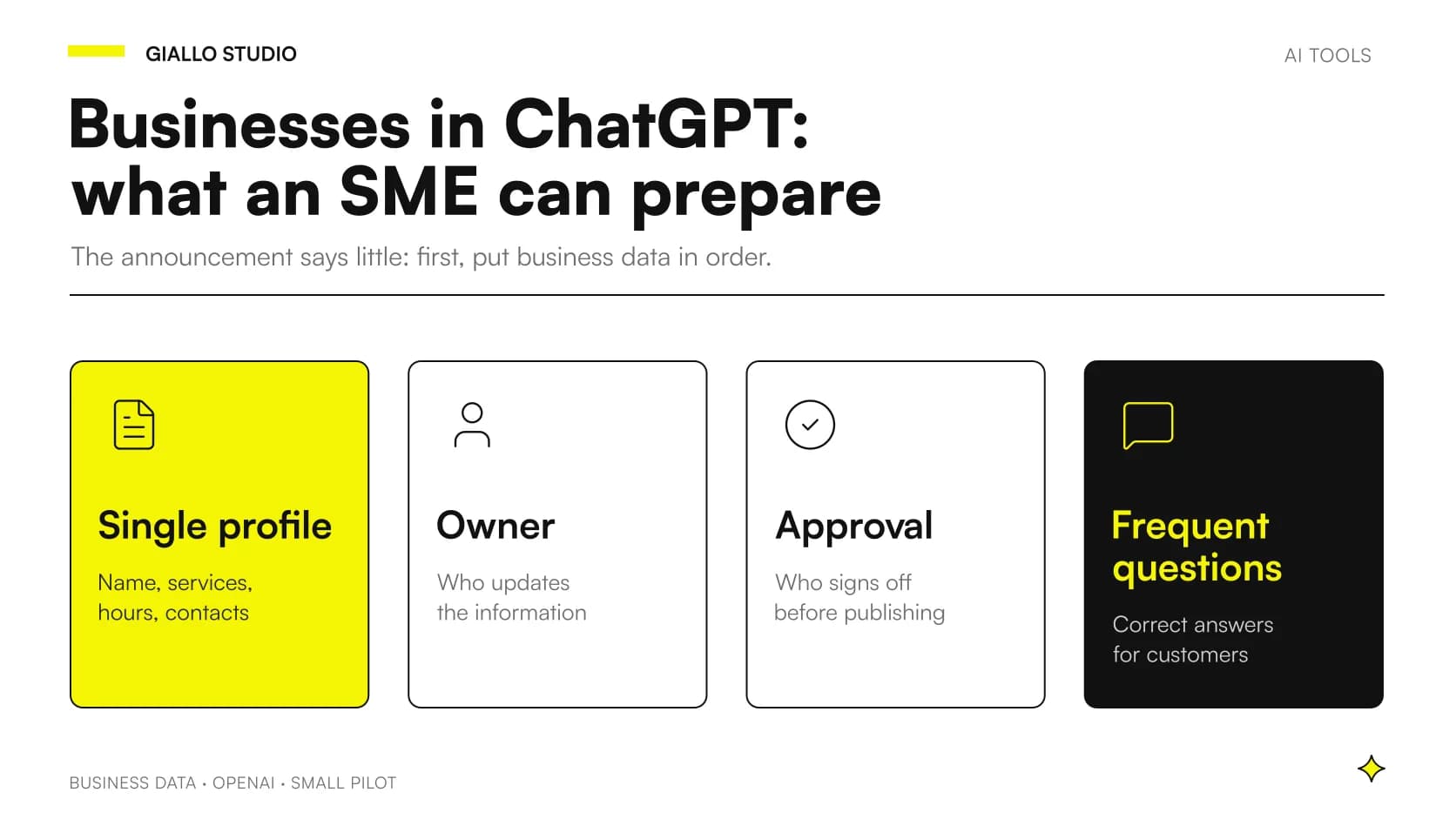
- A single record with the business's name, description, services, opening hours and contact details.
- A person responsible for updating the information.
- A rule on who approves changes before they become public.
- A list of customers' most frequent questions, with the correct answers.
- A check of the personal data that must not appear in any channel.
The last point deserves attention: before uploading information to any external tool, it is worth rereading what happens to company data when you use AI.
Which mistakes should you avoid?
There are four, and they almost always come from the rush of a new announcement.
Assuming it is available
This happens because the announcement is public and the tool's name is clear. But the source gives no countries, plans or availability dates. Avoid it by checking the official documentation before promising anything to the people you work with.
Confusing insights with business results
The source speaks of insights into how the business appears, not of sales or contacts obtained. It happens because the word insight sounds like a result. Avoid it by deciding in advance which business indicators really matter to you, and reading the insights only as context information.
Neglecting the data before the tool
You rush to activate and only afterwards discover that the opening hours differ in three places. It happens because the tool is the visible part and the data work is not. Avoid it by starting from the single record described above.
Using it instead of a content strategy
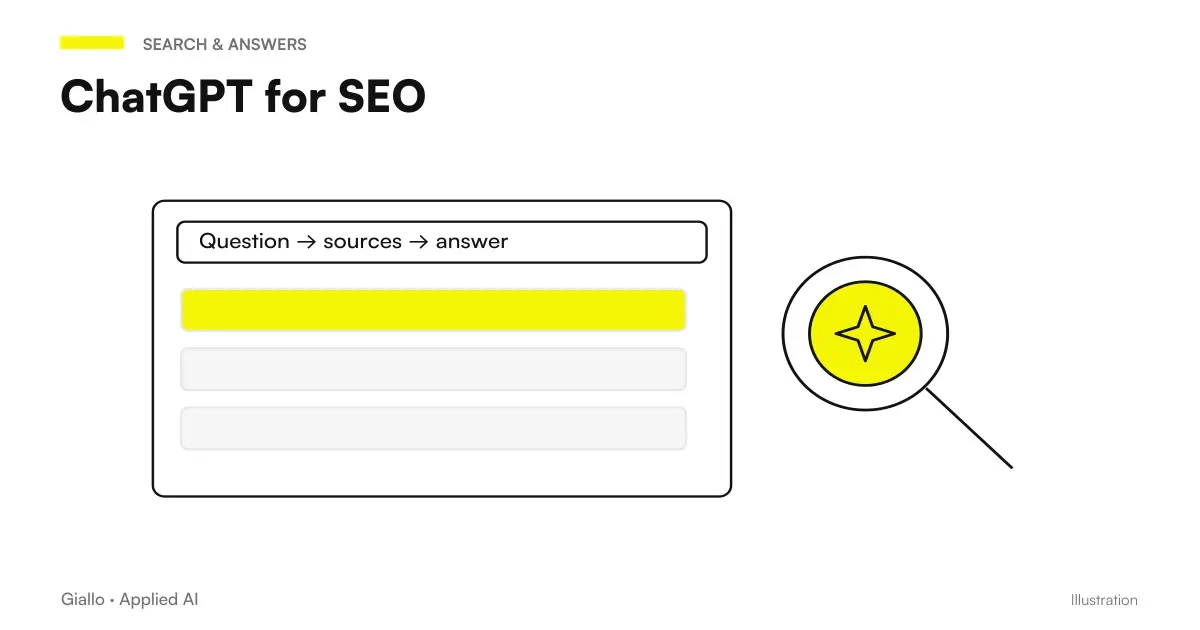
A presence inside ChatGPT does not replace your website, nor the visibility work you already do. For how AI behaves in search and content, see the in-depth article on ChatGPT for SEO. Avoid it by treating the new channel as an addition, not a replacement.
How do you apply it in your company, step by step?
A prudent path, suited to those who don't yet have operational details, could be this.
- Read OpenAI's presentation page and note in your own words what it states and what it does not.
- Look for the official documentation and verify requirements, costs, countries and activation steps.
- Prepare the business's single record and assign a person in charge.
- Decide what you want to learn: for example how the business is described and where the information turns out to be wrong.
- Run a small trial, with one person checking every piece of information published.
- After a period you set yourself, review what worked and decide whether to continue.
If the business is already present in other parts of the OpenAI ecosystem, for example with advertising, it is worth comparing the approach with what is explained in ChatGPT Ads: they are different tools and here only the approach is compared, because the metrics of Businesses in ChatGPT are not known.
Worth remembering. OpenAI's announcement is a presentation, not an operational guide. Everything concerning requirements, costs, availability and metrics must be verified in the official documentation before acting.
What do we still not know?
The available material does not describe detailed functions, activation steps or requirements. It gives no prices or plans, and it does not explain how businesses actually appear in ChatGPT or which metrics are available. These are the declared limits of our source, not defects of the tool: they could be clarified in the official documentation.
For an SME this means one thing only: informed waiting is a legitimate choice. Waiting for the documentation to be clear costs less than reorganizing everything after following a wrong hypothesis. Anyone who wants to place the topic in a broader path can start from the guide on AI for SMEs.
How do you proceed with support?
Organizing the data, choosing who approves and setting the trial method are jobs done before any tool, and they work with any channel. If you want to talk through how to set them up in your business, you can start from our AI consulting: we begin with your data and your processes, not with the latest announcement.
Giallo Studio guides: methodology and sources
Want to apply this to your business?In 30 minutes, free of charge: the first process to automate and its estimated return, in writing.
Book the free auditHow we apply it in the company
Related resources
FAQ
What is Businesses in ChatGPT?
According to OpenAI's presentation, it is a tool for managing your business information, getting insights into how the business appears, and turning interest into action inside ChatGPT. The source gives no further details. For specifics, the official documentation is needed.
How much does Businesses in ChatGPT cost?
The available material gives no prices or plans. It is therefore not possible to say whether it is free or paid. Before deciding, consult OpenAI's official documentation.
Is it already available in my country?
The source gives no countries or availability dates. For this reason it cannot be said to be active in your country. Check OpenAI's official pages.
How do you activate Businesses in ChatGPT?
The announcement describes no activation steps or requirements. It is best to look for the official documentation and follow only that. In the meantime you can prepare a single record with your business data.
What can an SME do right now?
It can put its business information in order, choose someone responsible for updates, and decide who approves changes. These are useful jobs with any channel. Then it can wait for the official documentation before activating the tool.
Are the insights OpenAI mentions sales data?
The source speaks of insights into how the business appears, not of sales or contacts. It does not even describe which metrics are available. They should therefore be read as context information until the documentation says otherwise.