Skip to content
Giallo

AI for HR: agents for the paperwork, never for judging people.

Where does AI really help in an HR office?

AI for HR works on repetitive paperwork, not on evaluations: AI agents that answer employees about leave and policies, guide new hires, collect overtime and leave requests that need approval before month-end close and prepare internal training. Giallo Studio designs them with Claude, GPT and Gemini; hiring, evaluations and disciplinary measures stay with people.

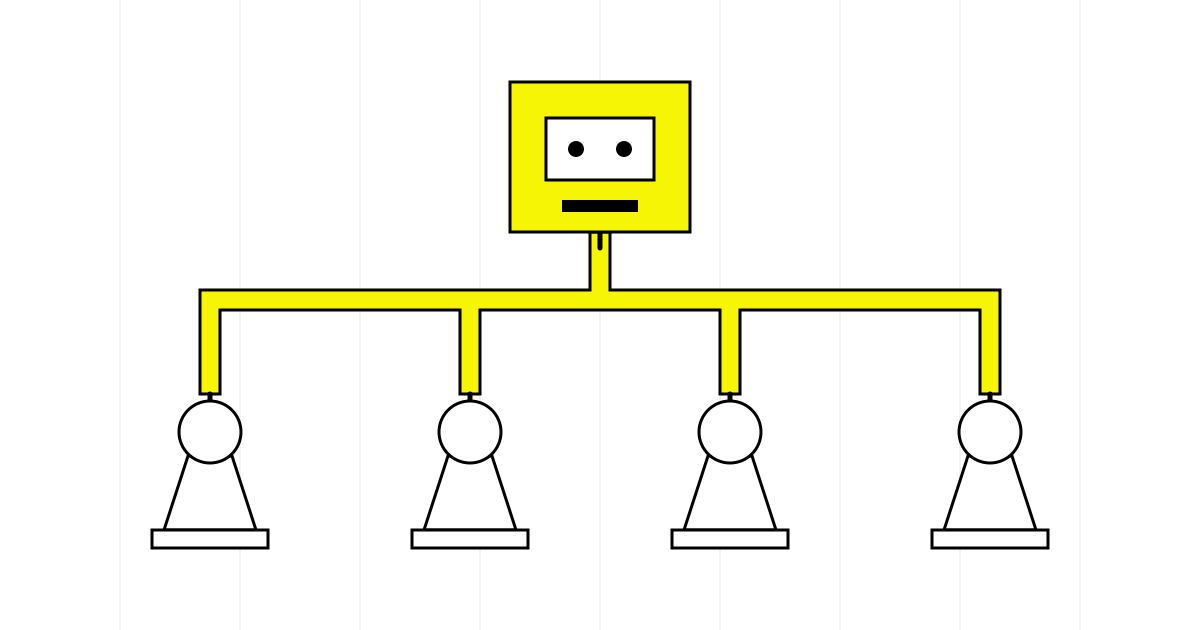
An AI agent coordinates an org chart of four people, represented by white game pieces joined by yellow branches

We write for HR managers, HR offices in SMEs and owners who manage the company's people on their own. We follow an employee's journey, from the first day to the payslip, and for each step we show you the agent we would build, the tools it connects to and what always remains an HR decision.

Where time gets lost today.

These are the points we hear about most often. Each one is a possible first agent.

The same questions arrive at all hours

How many vacation days do I have left, how do I request time off, what does the benefits plan cover: the HR office answers one by one, over email, internal chat and in the hallway.

An internal assistant answers from company policies and the applicable national collective agreement (CCNL), and passes to HR only what concerns the employee's personal situation.

Every new hire is a document hunt

Contract, documents, system access, equipment, mandatory training: the checklist lives in the head of whoever handles it, and something gets lost when several people start at once.

For every new hire an agent opens the checklist, reminds whoever needs to act of the deadlines and shows HR what's still missing.

At month-end, department heads' sign-offs are missing

Overtime never authorized and leave requests left unanswered surface at the last minute, and HR chases managers while the payroll firm waits.

Each manager receives in time only their team's items to approve, and HR gets a month that's already closed.

The procedures exist, but nobody can find them

Policies, operating instructions and training materials sit in different folders, written at different times and often contradicting each other.

An agent puts them in order, flags the contradictions and turns them into short guides and quiz questions for internal training.

The AI agents we design, one by one.

The new hire agent as a gear: with each click the person who needs to act lights up among HR, new team member, IT and manager, and their checklist item is ticked off; the safety course not yet scheduled goes back to HR along with the first-month summary.

HR assistant for employees

Answers employees' questions based on the company handbook, the applicable collective agreement and HR communications.

Whenever an employee has a question about rules, time off or services.

  1. Receives the question in internal chat or on the employee portal, after company login.
  2. Looks for the answer only in HR-approved documents and states which document it comes from.
  3. For personal data, such as the leave balance, it reads only that of the employee who is writing, if the attendance software allows it.
  4. Recognizes sensitive topics, such as illness, maternity, conflicts or whistleblowing reports, and invites the person to talk to HR without going into the substance.
  5. Logs unanswered questions, so HR knows which rules need to be written better.

Connects to: Microsoft Teams or Google Chat · Employee portal · Company handbook and collective agreement · Attendance software

Claude Sonnet
Works on long policies written in legal language, turns them into simple answers and respects the rules on what not to comment on.
Gemini
If the company stores policies and memos in Google Drive, we consider it for reading directly from there with the existing permissions.

Who approves. HR approves the list of documents the assistant can answer from and the list of topics that always go to a person.

New hire agent

Coordinates the task list for each new hire and reminds everyone, HR, IT, manager, what they need to do and when.

From contract signing to the end of the first month.

  1. When HR records a hire, it creates the task list set for that role.
  2. Asks the new team member for missing documents with a clear message, without collecting unnecessary data.
  3. Alerts IT and the manager about access, equipment and shadowing.
  4. Sends reminders for mandatory safety training deadlines and flags to HR the courses not yet scheduled.
  5. At the end of the onboarding, gives HR a summary of what was done and what is still open.

Connects to: HR software or hiring spreadsheet · Company email · Shared calendar

Claude Haiku
Handles many short, repetitive reminders that must go out on time and stay low-key.
Codex
Writes and maintains the connections with HR software, calendar and the IT ticketing system; we review the code, and it doesn't see personnel files.

Who approves. HR decides the task list for each role; a person always checks the new team member's documents and data.

Pending overtime and leave agent

Gathers the decisions that belong to department heads and that the payroll firm can't see: overtime to authorize and leave requests still unanswered.

A week before month-end close, when department managers still have time to decide.

  1. Reads from the attendance software the unauthorized hours beyond shift and the leave or time-off requests still open.
  2. Compares pending leave with the shift schedule and shows where a yes would leave a department understaffed.
  3. Sends each manager only their team's items, with a yes or no to give before the close.
  4. Once decisions are made, HR checks the summary and forwards it to the payroll consultant.

Connects to: Attendance software · Shift schedule · Managers' email or internal chat

GPT
Cross-references attendance software exports and shift schedules in different formats and returns lists by department, checkable line by line.

Who approves. Authorizing overtime or granting leave remains the manager's decision; the agent doesn't change clock-in records and doesn't judge people.

Procedures and internal training agent

Gathers procedures and materials, flags contradictions and turns them into concise guides and quiz questions.

When a procedure changes or a new group needs training.

  1. Reads the procedures and materials indicated by HR and department managers.
  2. Flags the points where two documents say different things on the same topic.
  3. Writes short guides by role and quiz questions on the key steps.
  4. Puts everything in draft for the procedure owner, who corrects and approves it.

Connects to: Procedure folders · Internal training platform · Shared documents

Claude Opus
Comparing many long procedures to find contradictions is rare, delicate work, suited to the model with the most accurate reasoning.
Claude Sonnet
Writes the guides and quiz questions in language suited to the people who will use them in their department.

Who approves. No procedure or guide becomes official without its owner's signature.

Which AI model we use, and for which task.

We don't tie you to a single provider: we work with Claude by Anthropic, GPT and Codex by OpenAI, and Gemini by Google, and we choose the version during testing, on your own cases.

Claude Sonnet

  • HR assistant for employees. Works on long policies written in legal language, turns them into simple answers and respects the rules on what not to comment on.
  • Procedures and internal training agent. Writes the guides and quiz questions in language suited to the people who will use them in their department.

Gemini

  • HR assistant for employees. If the company stores policies and memos in Google Drive, we consider it for reading directly from there with the existing permissions.

Claude Haiku

  • New hire agent. Handles many short, repetitive reminders that must go out on time and stay low-key.

Codex

  • New hire agent. Writes and maintains the connections with HR software, calendar and the IT ticketing system; we review the code, and it doesn't see personnel files.

GPT

  • Pending overtime and leave agent. Cross-references attendance software exports and shift schedules in different formats and returns lists by department, checkable line by line.

Claude Opus

  • Procedures and internal training agent. Comparing many long procedures to find contradictions is rare, delicate work, suited to the model with the most accurate reasoning.

How we choose between models: the best AI model for agents.

How we work with you.

  1. The questions that reach HR

    For a few weeks we collect the requests that reach the HR office, without names, and see which have a written answer and which don't.

  2. Boundaries written before the code

    We decide with HR what the agents never do: no evaluations, no scores, no reading of health or union data.

  3. Informing employees

    Before launch, we prepare with the company the text that tells employees which agents exist, what they read and whom to contact.

  4. Testing in one department

    We start with one department, collect the questions the assistant couldn't answer and fix documents and instructions before rolling it out further.

Your staff's questions, in order

List the questions colleagues ask most often and the programs you use for attendance and payroll: we start with the request that causes you the most interruptions.

Prefer the full form? Go to the contact page.

No spam or sales pitches. Response within 1 business day.

We use this data to contact you and, if we work together, to manage the project. We store it in Giallo's internal management system, on servers in the European Union, where only our team can see it; by email we only receive a notice, without your data. If you do not become a client, we delete it 3 months after our last contact. Details and your rights: privacy policy.

Do you prefer to write or call us?

Frequently asked questions, straight answers.

Answer employees' recurring questions based on the company's documents: vacation, time off, expense reimbursements, benefits, working hours. Questions about personal situations or sensitive topics go to the HR office.

Few, and tailored to the heaviest workload. You usually start with the assistant for employee questions or with overtime to get approved before month-end close; other AI tools for HR are added only if the first one works.

With the question that interrupts you most often. You list the requests colleagues make every week and the programs you use for attendance and payroll, and the first agent starts from there.

Only if the task requires it, and with access limited to the individual employee. We generally prefer the assistant to explain payslip items in general terms and leave personal calculations to HR or the payroll consultant.

Not in these agents. Here we deal with the paperwork for people already in the company; for hiring there is a dedicated page on recruiting agents.

AI agents for human resources

Which question would you like to stop hearing every week?

List the questions colleagues ask most often and the programs you use for attendance and payroll: we start with the request that causes you the most interruptions.