
SynthID Detector open to all: how to verify AI images, audio and video
SynthID Detector opens to the public: what it checks, how to interpret a negative result and how to use it to review marketing materials.
Reading time: 11 min
SynthID Detector checks for SynthID watermarks in supported content. It does not determine whether any image, audio or video is true. For a company it is a useful control when materials from suppliers or collaborators arrive, as long as the result is interpreted together with provenance and rights of use.
On October 7, 2026, Google globally opened the public portal, available in English. It is an extension of access, distinct from the Detector's debut in 2025. Verification concerns Google materials and compatible partners: not every generator on the market. Official announcement of opening.
In summary
- SynthID Detector looks for a compatible watermark, not all possible traces of AI.
- A negative result does not prove that the content is authentic or human.
- A positive result does not certify the rights, consent of people or correctness of the message.
- Verification should be associated with the precise file and information received from the provider.
- The portal can enter a review process, without replacing the editorial decision.
What does SynthID look for inside a content?
The watermark is a signal inserted through a compatible process. The Detector looks for that signal, while a person who observes the content looks for other clues: uncredible hands, strange shadows, unusual voices. They're different controls. The Google documentation describes SynthID as a watermarking and detection technology for content generated with systems that use it. Official SynthID Documentation.
The distinction is especially useful when a control is delegated. «Check if this image is AI» is too broad a request to describe what the portal does. A more precise delivery is: «Check if the file has a SynthID watermark and record the result». The person in charge can thus separate the technical result from the assessments on the resource and its use.
This does not make the control any less useful. A positive signal can help clarify how a received material was produced, ask for missing information, and apply the company's editorial rules. The important thing is not to attribute to the instrument a perimeter that it does not have. The question "where does this file come from?" remains broader than the question "does this watermark contain?".
How to read a positive, negative or inconclusive result?
A positive result is an indication related to the supported technology. It does not prove that the depicted subject exists, that it has given consent or that the content can be published. A synthetic photograph could be perfectly suited to an internal illustration and unsuitable to present as real a product never made. The technical outcome does not decide the editorial context.
A negative result is not a certification of authenticity. The content may have been generated by a system not covered by the verification or it may not have a detectable signal. Google spells out this limit in SynthID documentation. A company should therefore retain the formula of the outcome without turning it into a ‘human image’ or ‘verified video as true’. Limits described by Google DeepMind.
If the control does not allow a useful conclusion, the operational road is to ask for the source and the processing materials, when appropriate. You can also choose not to use a resource as long as relevant doubts remain. The absence of a binary response is not a process failure: it is information to be managed. Corporate rules on Data security in AI help decide which files should be submitted to external services.
What is a reasonable procedure for the marketing team?
It starts from the file actually received, retaining name, version, sender and intended destination. Before loading it is checked that the material can be treated through that service. A still-confidential advertising asset, a customer registration, or an image with sensitive information require an assessment consistent with the company's rules and relationship with the provider.
Then you access the SynthID official portal and follow the current directions for the type of content. It is preferable to read the requirements shown by the portal instead of using upload limits retrieved from old guides from other Google verifiers. The result is recorded by associating it with the checked file, without assuming that it is automatically valid for later versions or for an entire folder.
Finally, the content manager decides what to do with it. You can accept it according to internal rules, request clarification or replace it. This decision must consider message, rights, consent and destination, in addition to the watermark. In the guide to AI for Marketing Agencies the central point remains to organize production: verification is a passage of that work, not a label that makes any material publishable.
What information do you keep along with control?
| Information | Why It Serves | What Doesn't Prove Alone |
|---|---|---|
| File and controlled version | Link the outcome to a precise resource | That all variants have the same outcome |
| Declared provenance | Allows you to ask the contact person for clarification | That the statement is complete |
| Outcome of Detector | Document supported watermark control | Universal Content Authenticity |
| License or permission received | Clarifies the stated conditions of use | That the watermark verified the rights |
| Editorial destination | Link control to publication context | That any future use is appropriate |
| Decision of the person responsible | Makes acceptance or rejection traceable | That the instrument has made the decision |
The record must not become a store of unnecessary data. Retain what lets you locate the asset, understand the check and justify the choice. The business can define retention periods and access according to its process. If the file is changed for a new campaign, the record should let you understand which checks concern the original and which concern the subsequent version.
Why do rights of use remain a separate verification?
A watermark is about the compatible generation process; a license is about the permitted use. A consent concerns a person or a specific representation. None of these elements automatically replace the others. That is why SynthID's outcome should not compile the "verified rights" field in a marketing archive alone.
The company can prepare a simple request for those who deliver materials: origin, tools used if relevant, any third-party elements and conditions of use. There is no need to ask each supplier for a technical explanation of the watermark. It is necessary to make it clear that the delivery includes sufficient information to decide where and how to employ the resource.
The distinction becomes particularly useful when producing numerous variations. A creative flow such as that described for Higgsfield Ad Multiplier requires attention to the starting reference and the transformed elements. SynthID may be one of the controls on supported materials, but it does not verify that the reference was authorized or that a variant respects the brief. Editorial control remains linked to each use.
The supplier says ‘the Detector did not find AI’: how to respond?
Ask to report the precise outcome and indicate the checked file. Failure to detect SynthID watermarks does not exclude generation with other systems. To decide on the use still need provenance, authorizations and editorial context. Avoid turning control into a general statement of authenticity.
An agency that receives videos from collaborators: hypothetical scenario
Imagine a small agency that receives short videos from outside professionals for a campaign. The client asked to distinguish real shots and synthetic materials. In this hypothetical scenario, the agency would not use the Detector to automatically classify the whole folder as "real" or "AI". It would put it in a procedure that first collects the statements of the collaborators.
A successful video would be associated with the production information and brief. If the use of synthetic content is compatible with the campaign, the manager may continue the review. A video with a negative result would remain accompanied by the statement of origin, without automatically becoming a real shot. The discrepancies between declaration and control would be clarified with the referent.
The process would also be useful for variants produced during the creative revision. Figma AI, Design Agent and Weave they concern other parts of the creation, but they highlight the same organizational need: to know from which materials an output is born and who approves it. It is not assumed that every creative tool uses SynthID; a coherent archive is defined regardless of the generator.
An e-commerce that receives product images: hypothetical scenario
Consider an e-commerce that buys photographs and settings from a provider. The images must correctly represent the colour, shape and accessories of the product sold. In this second hypothetical scenario the main risk would not be the use of AI itself, but publishing a detail that the product does not possess. The watermark does not answer this commercial question.
The team could check the supported materials with SynthID and still compare the image with an authorized card and photograph of the product. A synthetic scene might be suitable as a setting, as long as it does not alter important characteristics and the conditions of use are clear. An image without a watermark may instead contain a touch-up error or come from an unauthorized source.
The final decision should follow the intended use: product page, campaign or editorial content. The card manager would retain the link between resource and sold item. When the material enters advertising channels, the aspects told in ChatGPT Ads news on formats and measurement are about distribution; resource verification must be completed first, without confusing asset control and campaign results.
How to treat a modified or received resource without original?
In campaigns the file delivered rarely remains unchanged. It can be cropped, mounted together with other items or exported in a new version. The process should distinguish what is known about the original from what has been verified about the final resource. There is no need to formulate technical assumptions about each transformation: it is necessary to prevent a result associated with one file from being extended without control to another.
If only a preview, screen capture or forwarded video arrives, you can ask for the material that will actually be published and the delivery information. This makes the control repeatable. The manager must be able to find the file and figure out which version has been approved, without reconstructing the story between messages and personal folders.
When the original is not available, the limit must be recorded along with the decision. You can look for an alternative resource or ask for a more explicit editorial permission according to the company rules. It is incorrect to fill the missing information with the result of the Detector: the watermark does not necessarily tell the whole delivery chain.
This attention also helps when multiple people work on the same project. Those who prepare the assembly should know which items are already approved and which require clarification. Those who publish should receive the final version and the information useful to that context. The goal is to make the decision travel along with the resource, not to accumulate disconnected verifications that no one can interpret after delivery.
The misunderstandings to avoid when introducing the Detector
The first misconception is to write 'authentic content' after a negative result. It is the most dangerous shortcut because it turns a circumscribed control into a broader guarantee. The second is to use the positive outcome as an automatic waste: a synthetic material can be predicted by the brief and properly authorized. We need an editorial rule that says when it is admitted and how it is reviewed.
The third is to assume that a control covers any generator or format. The ad is about Google-supported content and compatible partners, not a universal detector. For the current coverage, the SynthID documentation. The fourth is to import into the new portal limits or procedures of an old Gemini function: different interfaces may have different requirements.
Finally, verification should not come only when the campaign is ready. If provenance and authorizations are asked on delivery, the next work is clearer. Those who produce images can use a AI image prompt structure to describe the brief, but must also retain what allows you to control the result. A detailed prompt does not replace the approval of the final resource.
How to turn control into a sustainable transition?
The best start is a category of materials already managed by the team: for example the resources received by collaborators for a campaign. We define requested information, responsible person, file placement and outcomes that require clarification. We try the procedure with materials that the company is allowed to treat, observing where the information is missing or is misinterpreted.
Control can be manual without losing value. Before designing automations it is necessary to understand if the service and the process allow the planned integration: the opening of the public portal does not prove the existence of an automatic interface available for any use. The recording of the outcome must also maintain the correct meaning, without turning ‘undetected watermarks' into a universal category.
SynthID Detector then adds useful information to the review, provided the team knows what it means and what it leaves open. We can help you draw a content control process and marketing steps where files, statements, verifications and approvals remain linked. The result sought is a traceable editorial decision, understandable even to those who will resume work after the campaign.
Giallo Studio guides: methodology and sources
How we apply it in the company
Related resources
 AI and data security: concrete risks and how to manage them
 AI for marketing agencies: content, reports and AI labels
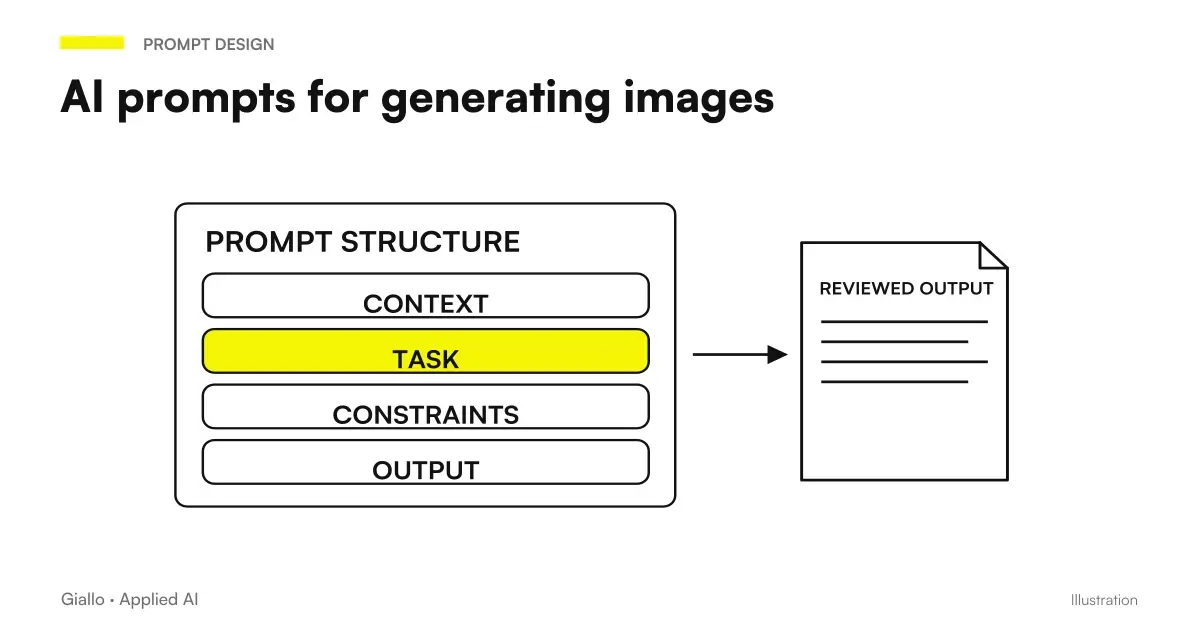 AI image prompts: examples for Midjourney, ChatGPT and Firefly
 Figma AI: Design agent and Weave tools exit beta, consumption changes
 Higgsfield Ad Multiplier: creating variants of advertising videos from a reference
 ChatGPT Ads: new formats, lead measurement and availability in Italy
 Kimi AI for presentations: from sources to slides
 Superintelligence for SMEs: waiting for it or using AI today?
FAQ
What does SynthID Detector check?
It looks for SynthID watermarks in supported content. It is not a universal detector of all AI-generated content.
Does a negative result prove that the content is real?
No. The absence of a watermark detected does not prove human origin or authenticity. Information on the origin and context of the material is still needed.
Does SynthID Detector also verify usage rights?
No. Watermarking and use authorizations are separate verifications. A positive result does not certify licenses, people's consent or the correctness of the message.
Is the public portal SynthID in Italian?
The global opening announced by Google concerns a portal in English. For current formats and requirements, the official interface should be consulted.
What's new with respect to the previous Detector?
The news is about opening up to the global public. It should not be confused with the Detector's previous debut.
How can a marketing team use it?
A team can include it in the review of authorised files, recording the result and version checked. The editorial decision must also consider the content's provenance, rights and intended destination.