
Higgsfield Ad Multiplier: creating variants of advertising videos from a reference
Higgsfield Ad Multiplier: variants from a reference video, new web interface, variable costs and controls on product, rights and message.
Reading time: 11 min
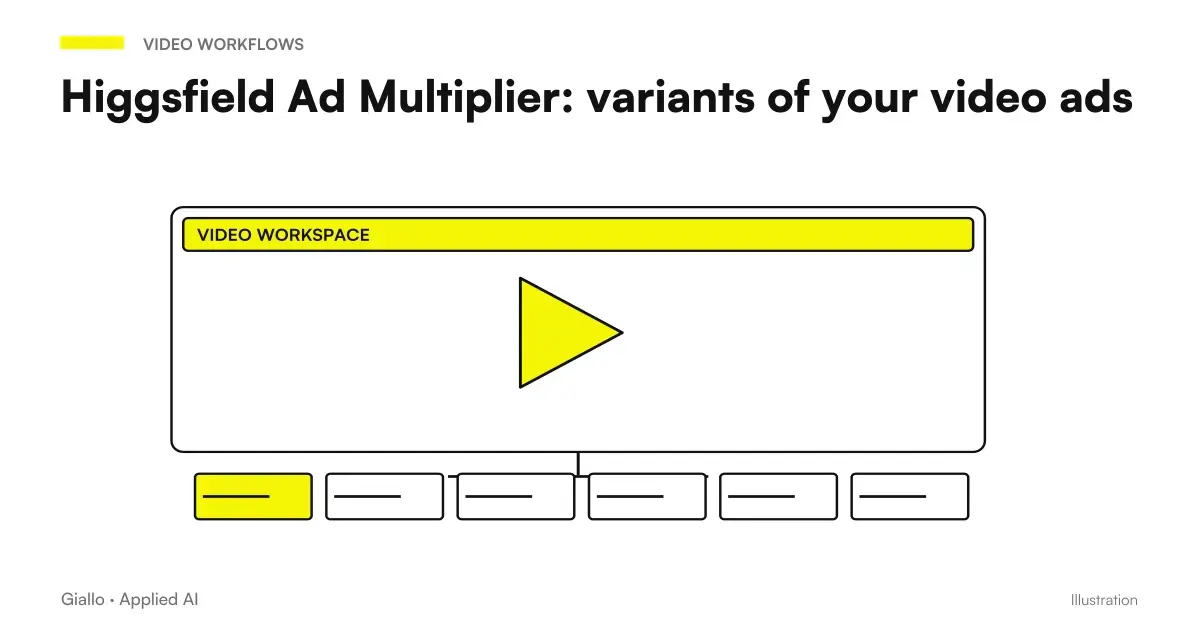
Higgsfield Ad Multiplier creates variants of an advertising video from a reference. The team can intervene on product, characters, setting, opening, script or invitation to action. The result is creative material to be reviewed and tested, not an automatic test of higher campaign performance.
The novelty of 6 October 2026 is the arrival of the visual interface on the web. This is not the first time the function has existed: MCP skill, extension and other surfaces were previous. The changelog describes video references from 4 to 30 seconds, until 20 images and output to 480p, 720p or 1080p. Changelog Higgsfield.
For an SME, the potential value is to organize a controlled variation process: starting from a message, changing an item and checking whether the proposal remains correct for the product. It is not enough to upload a successful ad and ask for many copies. We need authorized materials, brand briefs, review and a measure of outcomes.
In summary
- Multiplier transforms an advertising reference into creative variants.
- The announced novelty concerns the web interface, distinct from the previous surfaces.
- Cost varies with generation and must be verified before execution.
- Reference materials, faces and products must be usable in the project.
- The quality of the variant and the commercial result require separate verifications.
What can you vary in an ad?
The official description includes changes to product, characters, location, hook, script and CTA. This allows you to reason by elements of the message: which problem is shown, which product responds, what action is proposed. It does not mean that each variant is consistent with the catalog or brand positioning. Guide To Multiplier.
A reference video contains more than the spoken text. It has rhythm, shots, relationship between subject and product and a sequence of information. The team must decide what to keep and what to change. If you edit each item at the same time, it becomes difficult to tell what difference you are evaluating in the campaign.
The Guide to AI prompt for video helps to express scene and constraints. In advertising work a distinction must be added: the characteristics of the product are made to be respected, while style and rhythm are creative choices. An AI should not imaginatively complete what is lacking in commercial information.
How to choose a useful and usable reference?
The starting point should be material owned or authorized for intended use. An ad that is visible online is not automatically a freely reusable resource. Prior to generation, the team must verify rights, waivers, and conditions relevant to the project, without assuming that the transformation will erase any constraint.
Even the technically suitable reference may be of little use. A video based on a product with different characteristics might suggest incorrect promises. A scene designed for a specific audience may be inconsistent with the brand. It is advisable to choose a reference for the creative principle that you want to explore, not just because it seems to have been successful.
No evidence on an Italian account or campaign results are presented here. The page of To Multiplier identifies the surface of the product, while actual conditions and options must be verified in the account. The material produced should be checked as a draft, even when the video appears finished.
How to build a brief that holds the product still?
The brief should describe audience, video target, confirmed information, tone and constraints. A physical object needs consistent images and details: shape, packaging, elements that cannot change. For a service, they must be clear about what is offered and what is not to be promised.
It is useful to separate constraints and variables. The color or label of the product may be constraints; the narrative opening may be the variable to explore. If the model alters a bound element, the variant is discarded even if it is pleasant. This criterion avoids confusing visual quality and commercial correctness.
The team should also define how to deal with the text in the video. A price, discount, or deadline requires an approved business source and a final check. They're not decorative details. Later generations may introduce unwanted variations, so each version intended for publication must be independently verified.
What variants to compare in the same test?
| Item | Variation possible | What to Keep Consistent |
|---|---|---|
| Opening | Question or demonstration | Product Promise |
| Environment | Different use context | Realism and the public |
| Character | Role or presentation | Authorizations and tone |
| Script | Order of information | Facts and Conditions |
| Call for Action | Proposed next step | Actual page and offer |
The table is a working method, not a universal experimental plan. The comparison depends on the channel, the budget and the audience. Before starting the campaign, it is necessary to decide what outcome to observe and what differences can make the comparison uninterpretable.
The Guide to AI models for video It offers a framework of tools. At Multiplier it has a specific role here: to produce variants from an advertising reference. The choice should be assessed on the task and the amount of review needed, avoiding absolute rankings based only on the quality of a demonstration clip.
Hypothetical scenario: an artisan workshop shows the product
Let's imagine an Italian workshop selling home accessories. He owns a video of the product in use and wants to explore different openings for the campaign. The brief maintains form, materials and characteristics, while the narrative context varies. The manager checks that the product is not shown with non-existent functions.
The team prepares a tab for each variant: reference, changed item, approved text and checks made. A clip that alters proportions or finish is discarded. A clip that only changes the rhythm but not the message is evaluated for actual utility in the comparison.
This is a hypothetical scenario. No commercial results or saved time are attributed to the laboratory. The initial test concerns product correctness and message readability. Any advertising test must then distinguish the behavior of creativity from other campaign factors, including audience and landing page.
Hypothetical scenario: a training company varies the openness
Consider a company that offers vocational training. It has an authorized reference and wants to compare an opening centered on the problem with one centered on the demonstration of the service. The brief prohibits promises of guaranteed results and keeps the conditions of the offer identical.
The team controls voice, text, and character representation. If you use real faces, please check your consent and terms of use. If it uses synthetic figures, it evaluates clarity of message and presentation to the public. A convincing scene must not seem like an authentic testimony of a non-existent client.
This case is also hypothetical. The result to look for is a variant that better communicates a real offer. The number of videos generated is not a measure of value: they count the correct, usable and consistent with the goal. A larger production without revision can only multiply errors and materials to be discarded.
How to read cost and additional attempts?
Higgsfield describes a variable cost shown before generation. Additional attempts increase spending, so a universal price for a finished ad should not be taken. The estimate must consider discarded variants and necessary corrections, in addition to the first execution. Official cost information.
Before work it is useful to define a review point. The team assesses whether the results are close enough to the brief to continue or whether it is necessary to change the reference. Repeating the same request without understanding the error can consume resources without improving the material. Sometimes the best fix is a clearer product image or a more precise constraint.
This criterion also applies in visual projects with Figma AI and Credits Design. Products have different consumption patterns and do not necessarily share budgets. The business comparison must cover the cost of the revised material, not the similarity between credit names or the attractiveness of a temporary promotion.
What check to do before exporting a variant?
Open the tab for reviewing the advertising video
Check product, texts, voice, faces, logos and conditions of the offer. Compare each promise with approved information. Verify rights of reference and added materials. Watch the full video, including the last screen, and check that the call to action leads to a consistent page. Register the approved version.
The revision must include details that may go unnoticed: deformed labels, accessories that appeared without a pattern, unreadable text or gestures that are not consistent with actual use. A frame control can be useful when the product changes shape or fleeting information appears. Judgment should not stop at the first impression.
The synthetic provenance of materials is another theme. SynthID Detector concerns the verification of certain AI content, but a detection signal does not automatically establish rights or commercial usability. The team must maintain its own track of materials, permissions, and publishing decisions.
How to avoid variants all similar but difficult to compare?
A variant should respond to a precise hypothesis. If the assumption is that the client's problem is unclear, the opening is changed. If the product is not understood, you work on the demonstration. Changing color, character, and message together produces a difference, but makes it less clear which choice contributed to the outcome.
We also need an orderly archive. File name, brief and version must allow you to recognize what has been approved. A discarded video should not be published by mistake because it looks like the latest version. AI production makes it easier to create alternatives and therefore more important to distinguish them.
The team should periodically review the reasons for discarding. If an error occurs on the product, the problem could be in the starting material. If an improper promise occurs, the brief could be ambiguous. This reading turns the revision into an improvement of the process, rather than a sequence of random requests.
Why doesn't a good clip prove a good performance?
The commercial result also depends on supply, audience, page, price, availability and measurement. A nice clip can attract attention without generating relevant requests. A more sober variant can better communicate a complex product. There is no ROAS guarantee applicable to a specific SME in the official material cited.
The Shopify report on AI purchase intentions provides a context on the stated behavior of consumers, not a forecast of the sales obtainable with these videos. For your e-commerce you need campaign observations and a quality control of the purchases or contacts generated.
The Guide to the AI for e-commerce helps to connect creativity and operations. If the catalog is inconsistent or the page does not answer essential questions, producing multiple ads does not solve the path. Before increasing the variations, the team should verify that the destination keeps the promise of the video.
What specific errors to avoid with Ad Multiplier?
The first is to present the web interface as the first absolute launch of the function. The second is to use a reference without checking its conditions of use. The third is accepting product alterations because the clip looks more effective. The fourth is to turn a synthetic figure into a seemingly real testimony.
Another mistake is confusing the available resolution with guaranteed quality. The options indicated by the changelog describe the output, do not certify correctness, readability or suitability for each channel. Specifications in the changelog. The material should be checked in the actual destination, with the expected format and context.
Finally, there is no need to assume price conditions or permanent promotions. Plan, options and actual cost must be verified before generation. This article is based on official sources and not on an account proof: availability for the individual user remains an operational control to be carried out in the project.
How to deliver materials to those who run the campaign?
The delivery should include the approved video, the expected message, and the landing page. Who uploads the material must know which texts are already verified and which ones still require confirmation. A folder full of stateless variants can produce inconsistent publications, even when every single creative phase has been carefully carried out.
It is useful to maintain a visible distinction between draft, revision and approval. The file name can help, but it shouldn't be the only information available. The team should be able to trace the reference and constraints of the brief when a question about a face, product or commercial promise emerges.
After the test, the match must return to the creative process. A variant can generate unrelevant requests because it communicates a different offer than the real one. In that case the work is not just about changing the pace or character: you have to correct the message and check again for consistency with the page.
How to start with a verifiable creative cycle?
Choose an authorized reference and a product with approved information. Define a variable to explore, prepare the brief and review the first proposals before increasing production. It retains the reasons for acceptance and discard and links each material to the correct page or offer.
If you want to build a creative process that combines AI, brand control and campaign testing, the Giallo Services can start from a single family of variants. The useful result is a maintainable production of correct materials, with legible hypotheses and concrete verifications before publication.
Giallo Studio guides: methodology and sources
How we apply it in the company
Related resources
 Figma AI: Design agent and Weave tools exit beta, consumption changes
 Buying with AI in Italy: what the Shopify report says about Christmas 2026
 SynthID Detector open to all: how to verify AI images, audio and video
 Best AI Models for Video
 AI video prompts: Runway, Kling and Gemini alternatives to Sora
 AI for e-commerce: compliant returns, product descriptions, discounted prices and reviews
 Kimi AI for PDFs and documents: analysis to verify
 Superintelligence for SMEs: waiting for it or using AI today?
FAQ
What does Higgsfield Ad Multiplier do?
It creates advertising variants from a reference, modifying the elements described by the product. Each result must be reviewed before use.
Did the feature originate with the new web interface?
The new development concerns the visual web interface. The MCP skill, extension and other interfaces existed earlier, so it should not be presented as the first-ever launch.
How much does a finished ad cost?
The cost varies and must be checked before generation. Additional attempts, rejected outputs and revisions mean that a universal price for finished material cannot be assumed.
Can you use any ad found online?
You must own the reference or have permission for its intended use. Being visible online does not establish the right to reuse materials, faces or trademarks.
Does a variant guarantee a better ROAS?
No, creative quality and commercial performance require different checks. The offer, audience, page and measurement influence the campaign's outcome.
What should you check before publication?
Product, text, voice, faces, logos, offer conditions and landing page. The approved version must remain distinguishable from drafts.