
Artificial superintelligence: where the idea comes from and what research says
Where the idea of artificial superintelligence comes from, what sources say and what it means for an SME: verified facts, limits and practical steps.
In everyday language, artificial superintelligence is the idea of an artificial intelligence system more capable than people at most tasks. This is a working definition, not a technical one: the sources we consulted do not give one and do not attribute the term to a specific author. Above all, they do not document any system that achieves it. Today it is a hypothesis, not a product.
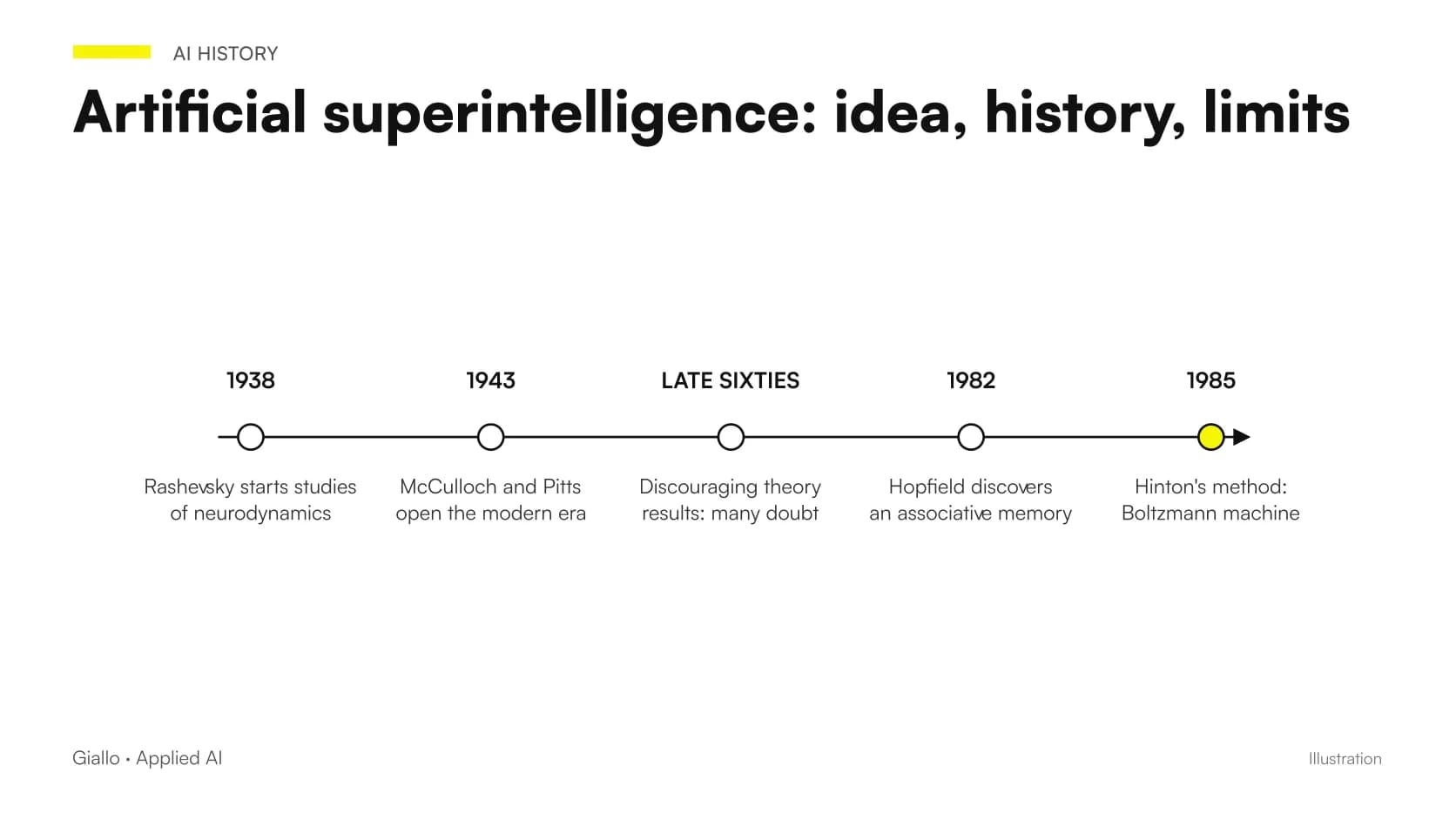
The idea sits within a longer history. It is linked to the desire, present since the beginnings of computing, to build machines as intelligent as human beings, and to the history of neural networks. The starting point the literature gives for the modern era is the 1943 work of McCulloch and Pitts, as told in the Treccani encyclopedia's account.
For a business owner, the useful question is not whether a superintelligence will arrive, but what is truly known today and what changes in everyday decisions. In this guide we line up the origins of the idea, the available data and the documented limits of current models. If you want the big picture of the topic, the reference guide is artificial superintelligence: meaning and applications.
In summary
- Artificial superintelligence is a hypothesis: the sources consulted do not document any system of this kind.
- The historical roots of the topic lie in neural network research, with the work of McCulloch and Pitts as the starting point of the modern era.
- The term is neither defined nor attributed to an author in the verified materials, so who introduced it remains an open question.
- A model can seem very capable without having a coherent model of the world, and fail when the task changes slightly.
- For an SME, context matters: AI systems already influence loans, hiring and software writing, and they need to be checked.
What is artificial superintelligence, and who coined the term?
In this article we use the working definition seen above: a hypothetical system that surpasses people at most tasks. It should be kept distinct from the artificial intelligence we use today, which performs specific tasks and sometimes surprises us, but is not this. For the distinction between artificial intelligence, AGI and ASI there is a dedicated deep dive: differences between AI, AGI and superintelligence.
On who first used the term, to be honest, the verified materials say nothing. We therefore cannot say who first spoke of superintelligence, and we prefer to leave the question open rather than attribute it to someone without evidence.
One fact, however, is documented: according to Our World in Data, from the very beginning of this story some computer scientists have tried to make machines as intelligent as human beings. The ambition, then, long predates today's models.
Did you know? The concept that circulates in newspaper headlines has an origin the sources cannot date precisely. What is documented is the underlying goal: machines as intelligent as people, a target some computer scientists have pursued from the start, as reported by Our World in Data.
Where does research on a thinking machine come from?
The modern era of neural networks and artificial intelligence, writes Treccani, begins with the 1943 work of W.S. McCulloch and W. Pitts. A human detail: in 1942 Pitts, then a seventeen-year-old student of Rashevsky, was introduced to McCulloch.
According to the same source, that result was remarkable because it established once and for all the validity of formal models of brain mechanisms, if not their truthfulness. In plain words: the brain could be described with mathematical models, without this proving that the brain really works that way. Treccani also recalls that the studies now known as neurodynamics began with Rashevsky in 1938.
Another piece is Hebb's hypothesis: connections in the brain change continuously as the organism learns different tasks, and these changes create organized assemblies of cells, as the Treccani entry explains again.
Here are the main milestones in a single view.
| Milestone | What happened | Source |
|---|---|---|
| 1938 | Rashevsky starts the studies now known as neurodynamics | Treccani |
| 1942 | Pitts, a seventeen-year-old student, is introduced to McCulloch | Treccani |
| 1943 | The work of McCulloch and Pitts opens the modern era of neural networks | Treccani |
| Late Sixties | Discouraging theoretical results make many researchers doubt the usefulness of networks | Nobel Prize Outreach |
| 1982 | Hopfield discovers an associative memory | Nobel Prize Outreach |
| 1985 | Hinton's method is published as the Boltzmann machine | Nobel Prize Outreach |
Why did research stall and then restart?
The story was not linear. The Nobel Prize in Physics popular information recounts that in the late Sixties some discouraging theoretical results led many researchers to suspect that neural networks would never be truly useful.
The restart runs through two names. The physicist John Hopfield discovered an associative memory in 1982, and the process of searching among similar words to find the right one, in today's systems, is reminiscent of that very memory, according to the same source. Hinton's method, which used an equation from physics, was published in 1985 under the flashy name of the Boltzmann machine.
The source also notes that the development of machine learning has exploded over the last fifteen to twenty years and is based on a structure called an artificial neural network. And it clarifies a point often lost in headlines: computers cannot think, but machines can now imitate functions such as memory and learning (Nobel Prize Outreach). To better understand the technical foundation, you can read what machine learning is.
When might human-level AI arrive?
Nobody knows, and the sources treat it as a matter of forecasting, not fact. Our World in Data cites perhaps the most discussed study of this kind, published by researcher Ajeya Cotra, and reports that many experts believe there is a real chance of developing human-level AI within the coming decades; some think much sooner.
The same page explains the idea that such a powerful system would bring the world into a "qualitatively different" future. These are scenarios, not observed data: no source consulted documents an existing superintelligence.
There is, however, a measurable figure on the computing power used to train systems. For the first six decades it grew in line with Moore's law, doubling roughly every 20 months; from around 2010 the exponential growth accelerated, with a doubling in only about six months (Our World in Data). Note that this measures the computation used, not how intelligent a system is.
Does a model that seems good really understand the world?
Here recent research is useful because it tempers enthusiasm. MIT News reports a study according to which even the best large language models do not form a true model of the world and its rules, and can therefore fail unexpectedly on similar tasks.
In the New York streets test, the researchers found that the maps implicitly generated by the model contained many nonexistent streets, which curved across the grid and connected distant intersections (MIT News). The model gave plausible answers, but the map it had "in its head" was wrong.
The clearest figure is this: Vafa, one of the authors, says he was surprised by how quickly performance deteriorated with a detour. By closing just 1 percent of the possible streets, accuracy drops from nearly 100 percent to only 67 percent, as you can read on MIT News.
In the same study, a transformer managed to predict valid moves in Connect 4 almost every time, without understanding any of the rules (MIT News). The implications, the source warns, can be serious for generative models used in the real world: a model that works well in one context can break if the task or the environment changes slightly. It is the same theme as the risks of errors and hallucinations in models.
Did you know? A model can play valid moves almost every time without knowing the rules of the game: this is shown by the Connect 4 example, told by MIT News. Correct answers do not prove that there is understanding.
What changes for an Italian SME?
Superintelligence is not a technology you can buy, but today's AI is already inside processes that touch businesses. Our World in Data observes that AI systems increasingly determine whether you get a loan, whether you are entitled to a benefit or whether you are hired for a certain job, and that they help program the software we use and translate the texts we read.
Two examples, hypothetical and built to illustrate the reasoning:
- A manufacturing company that selects staff. It adopts a tool that ranks résumés. The New York streets test is a reminder that a system can seem reliable as long as conditions are those of the test. Before entrusting it with selection, the company tries it on cases different from the vendor's and keeps a person responsible for the final decision.
- A professional firm that uses a coding assistant. A consultant writes small programs to automate spreadsheets with the help of an assistant. It works, but MIT News warns that a correct result in one context does not guarantee the same result when the task changes: the code must therefore be checked every time the input data change.
To understand how this reasoning translates into an assessment of costs and benefits, you may find it useful to read wait for superintelligence or use AI today.
What mistakes should you avoid when talking about superintelligence?
Taking for granted what is not documented
It happens because headlines mix forecasts and facts. The verified sources report expert opinions on human-level AI, but none documents a superintelligence already in existence. You avoid it by always separating what is measured from what is hypothesized.
Attributing the term to an author without evidence
It is convenient to cite a name to lend authority, but in the verified materials the authorship remains open. It is better to write "it is not clear who introduced the term" than to invent a quotation.
Trusting a model because it shines in a test
The New York case shows that near-perfect accuracy can collapse with a small change. You avoid this by testing the tool on cases close to, but different from, the vendor's, and not only on the demo (MIT News).
Confusing computation with intelligence
The rapid growth of training computation, described by Our World in Data, is a fact. That a machine more intelligent than us follows from it is instead a forecast. You avoid this by looking at results on your own tasks, not at the declared power.
How to use this information in your company?
You don't need to become an expert in the history of AI. A small routine of caution before introducing a tool is enough.
- Separate facts from forecasts: when you read news about superintelligence, look for the source and check whether it describes something measured or hypothesized.
- List the processes in which an AI system already plays a role, such as staff selection, customer assessments or software writing, because these are the ones the sources indicate as already influenced.
- Test each tool on cases slightly different from the usual, to see whether it holds up when the task changes.
- Assign to one person the final responsibility for important decisions and document how you verify the results.
To structure the check, you can rely on the guide on How to Assess the Risks of an AI System and the one on controlling agents. If you need a basis to clarify the terms, there is also what artificial intelligence is and the role of deep learning explained simply.
Where to start?
Superintelligence remains an open question, but the history of research, from the neural networks of the Forties to today's models, helps us reason calmly. If you want to understand where AI can truly serve your company, and where it is better to wait or verify more, you can start with an AI consultation designed for companies and professionals.
Giallo Studio guides: methodology and sources
How we apply it in the company
Related resources
FAQ
What is artificial superintelligence in simple terms?
It is the idea of an artificial intelligence system more capable than people at most tasks. The sources consulted give no official definition of it and document no system that achieves it. For this reason it should be treated as a hypothesis.
Who invented the term superintelligence?
The verified materials do not say. We therefore do not attribute the term to any author, because that would be a claim without a source.
Does superintelligence already exist?
No source consulted documents an existing superintelligence. What does exist are AI systems already used in areas such as loans, hiring and software writing, which require checks.
Since when have neural networks been studied?
According to Treccani, the modern era begins with the 1943 work of McCulloch and Pitts. Rashevsky's neurodynamics studies are earlier still, and Hebb, Hopfield and Hinton were later added to that history.
Does a language model truly understand how the world works?
According to the study reported by MIT News, even the best models do not form a true model of the world and its rules. They can seem very capable and then fail unexpectedly when the task changes. For this reason, results should be verified on different cases.
Does an SME have to wait for superintelligence to use AI?
The sources do not describe superintelligence as a technology available on the market. Current AI, however, is already used in many processes. The reasonable choice is to evaluate today's tools, with checks, without basing decisions on forecasts.