
AI Training Preferences and robots.txt: What Changes for Your Website
OpenAI will honor a shared robots.txt signal for AI training preferences. What we know, what is missing and how to act on your website.
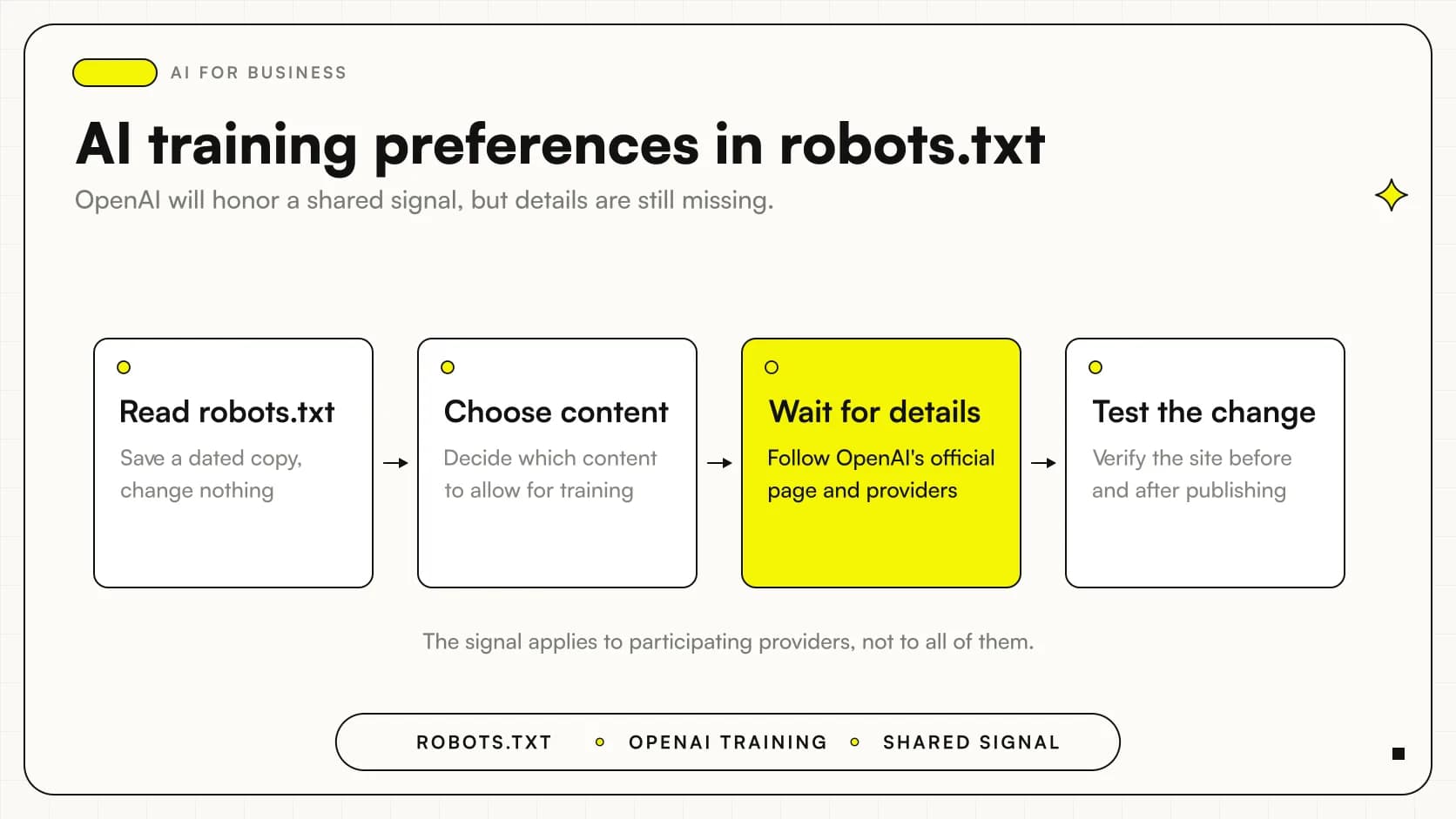
OpenAI has announced that it will respect a shared robots.txt signal, designed to help site owners communicate their AI training preferences to the providers taking part in the initiative. This comes from the official page Making it easier for websites to express AI training preferences. The underlying idea is a signal shared among the participating providers.
To clarify the terms: robots.txt is a text file located at the root of a website that gives instructions to the automated programs that visit it. A shared signal is an indication written once and interpreted in the same way by several parties. Training preferences concern the choice of whoever publishes content: whether or not to allow its use to train artificial intelligence models.
The available material, however, is very short. It does not describe the technical details of the signal, does not list the participating providers and does not say when the measure will be operational. This article carefully separates what is confirmed from what remains open, and proposes a cautious method for an entrepreneur or professional who has a website.
In summary
- OpenAI has stated that it will respect a shared robots.txt signal for AI training preferences.
- The signal is meant to communicate preferences to the participating providers, not to all providers automatically.
- Technical details, the list of participants and the effective date are not in the official material we reviewed.
- For an SME, the issue is control over how the content of its website can be used.
- Before touching robots.txt, it is best to read it as it stands today and wait for more complete guidance.
What did OpenAI announce about training preferences?
The announcement is concise. According to the official OpenAI page, the company will respect a shared robots.txt signal to help site owners communicate their training preferences to the participating providers. This is the only verified fact we have.
Three words deserve a careful reading. "Will respect" indicates a commitment by OpenAI, not a legal obligation described in the material. "Shared" suggests that the signal is not reserved for a single provider. "Participating" is a reminder that effectiveness depends on who joins: a signal only works if someone reads it.
Everything else, for now, is interpretation. We do not know how the signal is written, whether it adds to the rules already in the file or replaces them, or how other providers treat it. A good article does not fill these gaps with guesses presented as facts.
What is robots.txt and why does it matter for AI training?
Robots.txt is a public file, usually reachable by adding its name to the site's main address. It contains rules for the programs that scan pages: which areas to visit, which to avoid. Anyone with a site built on a content management system has often never opened it, because it is generated automatically or configured by the agency that built the site.
The link to training is this: content published online can be collected by automated programs and then used to train models. Robots.txt is a channel through which a site gives instructions to these programs. The initiative described by OpenAI goes in that direction: using an already familiar channel to also express a training preference, with an interpretation common to the participating providers, as the official source.
A useful clarification: robots.txt is an indication, not a technical barrier. Whoever respects it does so by choice or by commitment. That is why it is important to know who commits to respecting it, and that is precisely the information missing from the material.
What do we know and what do we not know yet?
The table separates facts from uncertainties, so as to avoid decisions based on assumptions.
| Topic | Status | Source |
|---|---|---|
| OpenAI's commitment to respect a shared robots.txt signal | Confirmed | Official OpenAI page |
| Purpose: communicating training preferences to participating providers | Confirmed | Official OpenAI page |
| Syntax and technical details of the signal | Not stated in the material | To be awaited |
| List of participating providers | Not stated in the material | To be awaited |
| Effective date | Not stated in the material | To be awaited |
| Reading of the signal by other providers | Not clarified | To be awaited |
Warning. The material we reviewed contains no line to copy into your own robots.txt. Any instructions found online that promise to block training should be treated as unverified until there is an official specification.
Why should an SME with a website care?
Because a website is a showcase and, at the same time, an archive of content: product pages, articles, service descriptions, price lists, carefully written texts. Deciding how they can be used to train models is a business choice, not just a technical one. Some companies may see an opportunity for visibility in this, others a matter of protecting creative work.
According to the official OpenAI page, the company will respect a shared robots.txt signal to communicate these preferences to the participating providers. For site owners, this means having, in the future, a simpler way to express their position. Before acting, it makes sense to check your file and current settings, without taking for granted effects that the material does not describe.
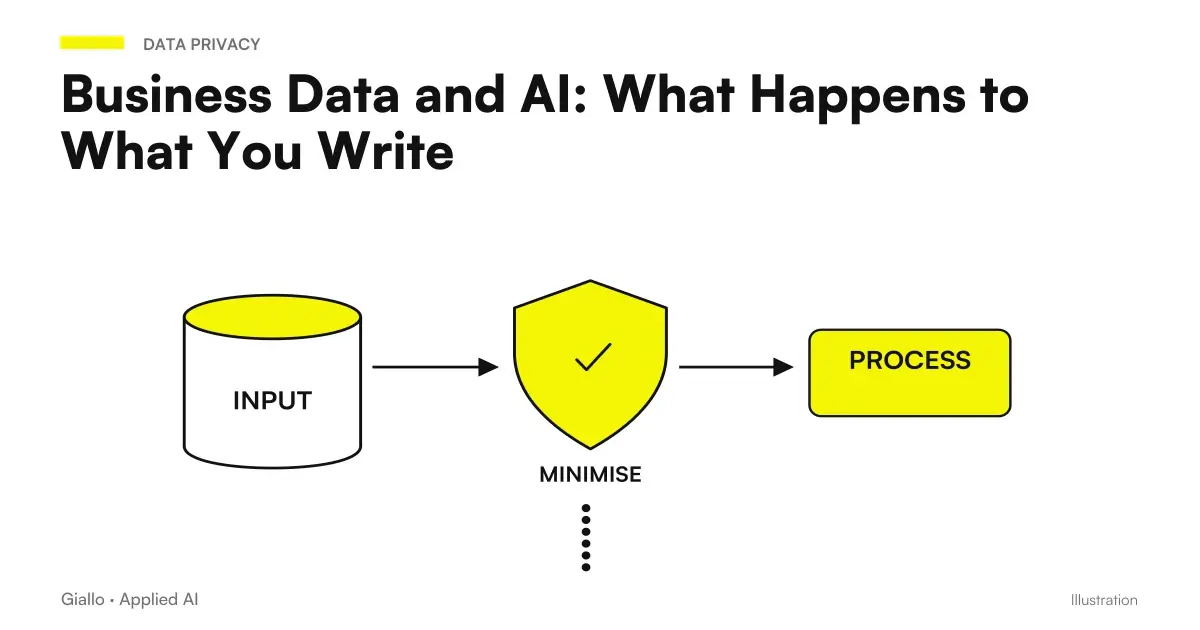
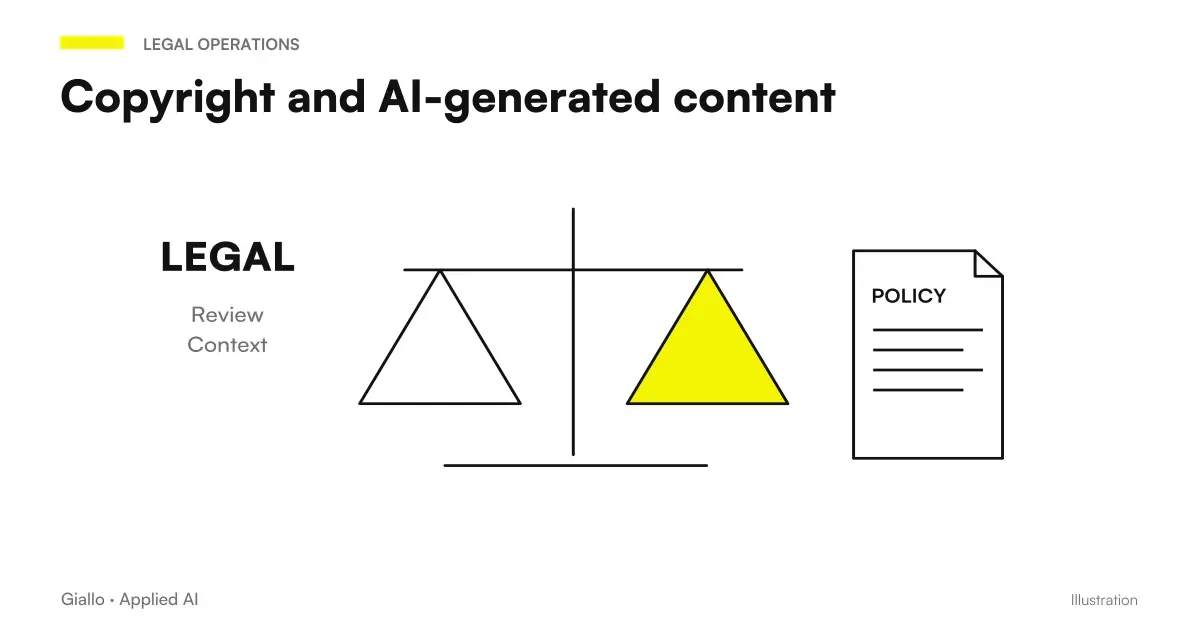
The topic connects to other business choices. Understanding what happens to the data you enter into tools is the subject of Business Data and AI: What Happens to What You Write. If training also involves texts or images you have produced, it is worth reading copyright and AI-generated content to get your bearings on the rights involved.
How might two different businesses reason? Two examples
The following are hypothetical examples, built to show the method. They do not describe clients or real situations.
Example one: an accountant's office with a blog. The office publishes educational articles to get known. The owner might be happy for the content to circulate, because it contributes to reputation. Or they might fear that their intellectual work will be reused without control. In both cases the first move is the same: find out what is in the robots.txt today and who manages it. When complete specifications are available, they will decide with their consultant whether and how to express a preference.
Example two: a small e-commerce shop selling handmade ceramics. The shop has carefully made photographs and descriptions, which represent an investment. The owner might prefer to keep the use of these materials under control. Not knowing which providers participate, they would avoid assuming that a single setting is enough to protect them. They would note the issue in a checklist and come back to it when the details are available. For an online shop, the broader picture of AI uses is in the article AI for e-commerce.
In both cases the point is not to block or allow in advance. It is to move from a situation you merely undergo to a conscious choice that is documented and can be revisited.
Which mistakes should you avoid?
Four mistakes recur when a technical news item reaches people who have to decide quickly.
Copying instructions found online
It happens because the news is recent and guides promising solutions appear immediately. The official material, however, does not report the signal's syntax. How to avoid it: use only the guidance published by providers as a reference, and do not modify the file until it exists.
Believing a signal applies to all providers
The commitment concerns OpenAI and the participating providers. It is not written that every operator respects it. It happens because "shared" is read as "universal". How to avoid it: treat the signal as an additional tool, not as a guarantee, and find out who joins.
Changing robots.txt without checking the impact on the site
Every change to the file must be checked before and after publication. It happens when the change is delegated without testing. How to avoid it: keep a copy of the current file, have every change verified by someone who knows the site, and check after publication.
Leaving the decision to the technical department alone
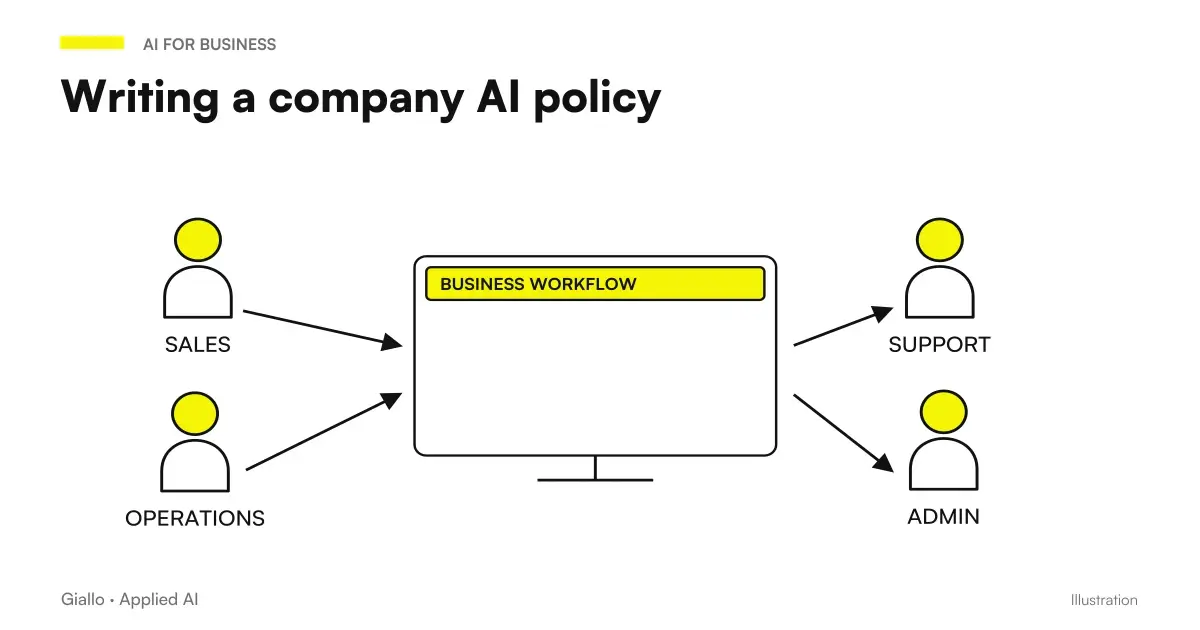
The choice of whether to allow or limit the use of content has commercial, legal and image implications. It happens because robots.txt looks like an IT detail. How to avoid it: involve the owner, whoever manages the content and, if needed, a consultant, and record the decision in a corporate policy on the use of AI.
How can you apply this today, without waiting for all the answers?
You can do a lot without touching anything. The method is preparation only, so that when the specifications arrive the decision will be quick.
- Identify who manages the site and where the robots.txt file is located: it may be the web agency, a collaborator or the content management system provider.
- Read the current content and save a dated copy, without changing anything.
- List the site content that is most valuable to you and decide, as a matter of principle, whether you want it to be used to train models.
- Follow the official OpenAI page and the communications of the providers that interest you, for the technical specifications and the list of participants.
- When the information is complete, apply the change in a test environment or with a follow-up check, and verify that the site remains reachable by search engines.
- Record the choice and the date in an internal document, to be revisited when the rules change.
A rule of common sense goes with these steps: every claim about effectiveness and timing should be verified at the source. If a provider or consultant guarantees results that you do not find written in an official document, ask for the reference.
How does this connect to privacy and compliance topics?
Training preferences concern published content, while privacy concerns personal data. They are different planes, which however often meet in the life of an SME. If the site holds customer data, forms or restricted areas, the discussion moves to data protection: for this reason it is useful to know about GDPR and artificial intelligence in the company and, regarding the tools you use every day, AI and corporate privacy.
If instead you are thinking about how AI enters your processes, the guide AI for SMEs: a practical guide to really getting started offers the general picture. And if you already have an assistant for site visitors in mind, business website chatbot explains how it works and when it is worthwhile. For the European regulatory aspect, AI Act: the guide for Italian companies is the starting point. Nothing in this article constitutes legal advice: specific cases require a professional.
Where to start, in practice?
OpenAI's commitment is a positive sign for those who want more control, but today it says little about how to act. The sensible response is to work on your own awareness: know what you publish, who manages the file, which decisions you would like to make. The rest is added when the specifications are public.
If you want to discuss how to fit these choices into a broader AI adoption path, you can look at our AI Consulting.
Giallo Studio guides: methodology and sources
How we apply it in the company
Related resources
FAQ
What did OpenAI announce about robots.txt?
OpenAI stated that it will respect a shared robots.txt signal. It is meant to help site owners communicate their AI training preferences to the participating providers. The official material we reviewed is short and adds no further details.
Should I change my site's robots.txt right away?
No, it is not advisable to do so before complete specifications are available. The material does not describe the signal's syntax or when it will take effect. In the meantime, it makes sense to read the current file, save a copy and find out who manages it.
Does the signal apply to all AI providers?
That is not stated. The commitment concerns OpenAI and the participating providers, and the list of the latter is not in the material. It is therefore not correct to treat it as a universal guarantee.
Is robots.txt a technical protection for content?
It is a public indication that automated programs can choose to respect. On its own, it does not prevent access to pages. That is why it matters to know who commits to respecting it.
What can an SME do now?
It can check its file and current settings, decide in principle which content it wants to protect, and follow the official updates. When the specifications arrive, it can act with a check on the impact on the site. It is useful to record the choice in an internal policy.