
The Dartmouth Conference and the Origins of the Name Artificial Intelligence
Who coined the term artificial intelligence, and where? The story of the Dartmouth workshop, Turing and early models, with sources.
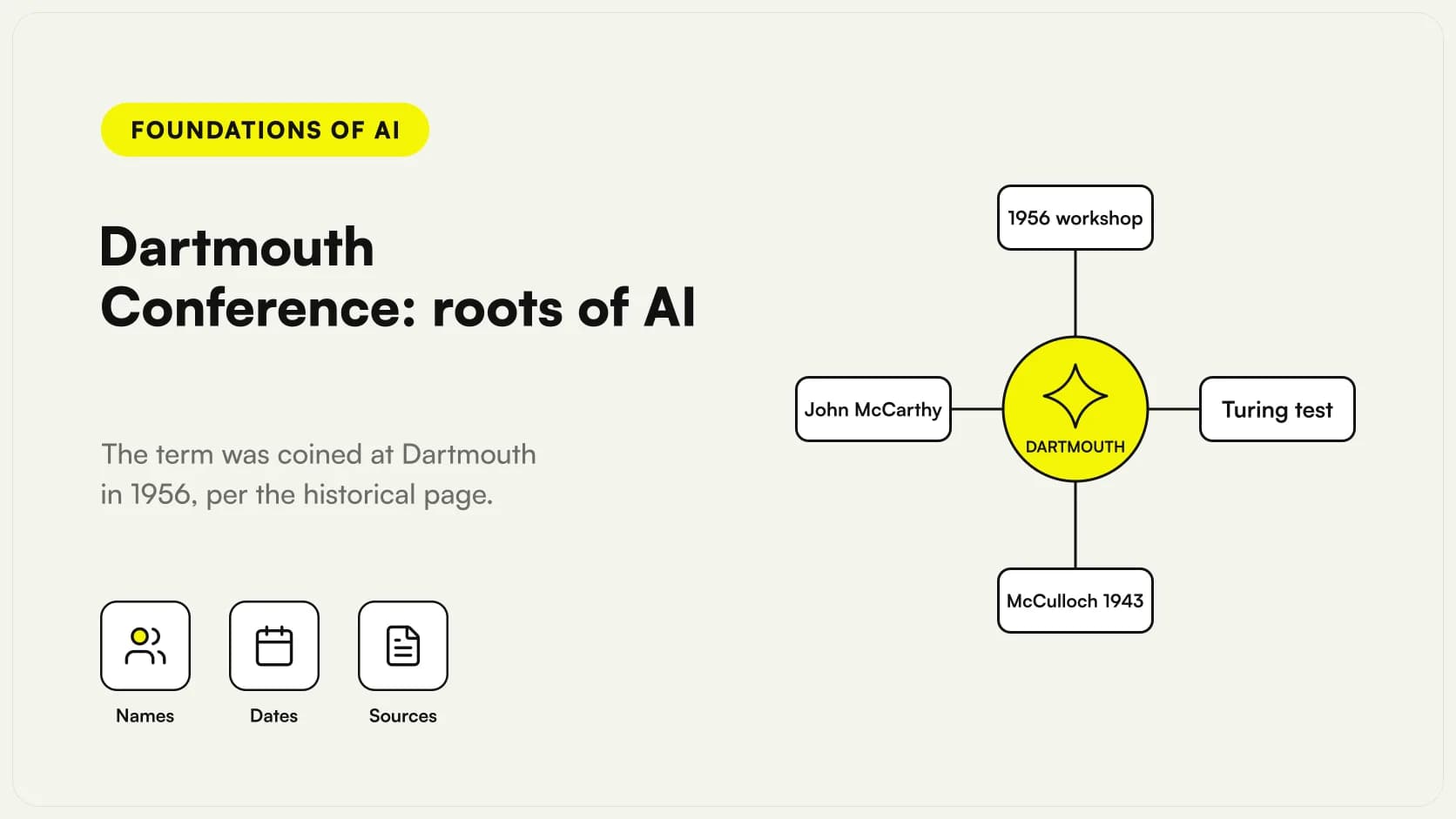
The name “artificial intelligence” was born in the summer of 1956 at Dartmouth, in the United States. According to the AI at Dartmouth history page, a small group of mathematicians and scientists gathered to discuss whether human intelligence could be recreated in a machine, and in those classrooms and corridors the term was coined, discussed and defined for the first time. The same source does not credit the coinage to one person: it says the workshop was convened under the leadership of John McCarthy.
In this historical sense, “artificial intelligence” is the name of a research field before it is the name of a product: the idea that learning and every other feature of intelligence can be described so precisely that a machine can be made to simulate them. According to the source, Dartmouth thus became the cradle of a new scientific discipline.
In this article we reconstruct what the sources really say, what they do not say, and why the history matters even for those who run an SME. If you need today's definition, you will find the full picture in Artificial intelligence: what it is and how it works.
In summary
- The term "artificial intelligence" was coined during a summer workshop at Dartmouth in 1956, as reported by the university's history page.
- The workshop was titled Dartmouth Summer Research Project on Artificial Intelligence and was led by John McCarthy, then a young mathematics professor.
- The sources consulted do not credit the coinage of the name to a single person: it is better not to do so in their place.
- Turing and his paper on thinking machines are central to AI, but the sources do not explicitly link them to the conference.
- The history of AI offers no operational guidance: it helps you use the right words, not decide on an investment.
Who coined the term artificial intelligence, and on what occasion?
The occasion was a summer workshop. The AI at Dartmouth page describes it as a gathering, in the summer of 1956, of a small group of mathematicians and scientists. Its formal title was Dartmouth Summer Research Project on Artificial Intelligence, and it was convened under the leadership of John McCarthy, then a young mathematics professor at Dartmouth.
On the "who," caution is needed. The source states that the term was coined, discussed and defined in that setting, but it does not name a specific author. Writing "McCarthy invented it" as an established fact would go beyond what we have verified. The correct wording is: the name was born at the workshop that McCarthy convened and led.
What the sources do not say. The materials consulted do not reproduce the workshop's original proposal: the most famous sentence appears only as a quotation on the Dartmouth page. They also do not say whether the goals set back then have been achieved today: they speak of legacy, not of verification.
What did the participants at Dartmouth ask themselves?
The underlying question was whether human intelligence could be recreated in a machine. The Dartmouth page also reports a sentence that sums up the project's ambition: every aspect of learning, or any other feature of intelligence, can in principle be described so precisely that a machine can be built to simulate it, as stated in the university's official source.
It is a working hypothesis, not a commercial promise. Whoever formulated it was not selling software: they were proposing a research program. This difference is useful today, when the term appears in every brochure.
Among the participants, the same page mentions Claude Shannon, who helped shape the first generations of AI research. No further names are needed to grasp the point: people from different areas of mathematics and science met at Dartmouth, and the name gave a common label to work that previously had none.
What role did Alan Turing play, and where should we stop?
Turing is often associated with the birth of AI, and with good reason. The Treccani encyclopedia presents him as a pioneer of information science and artificial intelligence, tied to a method for giving a precise meaning to the intuitive concept of a function computable by an abstract machine: the Turing machine. He is also credited with the Turing test, a criterion for deciding whether a machine is intelligent, based on the impossibility of telling, in a written dialogue, a human interlocutor from an artifact. During the Second World War he also helped decrypt the Enigma code used by the Germans.
The Stanford Encyclopedia of Philosophy adds two details. Turing (1912–1954) never called himself a philosopher, but his 1950 paper "Computing Machinery and Intelligence" is among the most cited in the modern philosophical literature. His thesis was that a computer, suitably programmed, could rival the brain, and this founded the artificial intelligence program of the following decades. His 1936 paper "On Computable Numbers", by contrast, was perhaps his greatest triumph: it defined computation and set an absolute limit to it, and it is considered the founding work of modern computer science.
Where to stop: none of the sources explicitly links Turing's work to the Dartmouth conference. We can say that Turing is a founding figure of AI and that Dartmouth is the place where the name was coined. We cannot say that the two facts are tied by a direct relationship.
Why is the work of McCulloch and Pitts cited?
Because, according to a Treccani overview of the history of neural networks, the modern era in the study of neural networks and artificial intelligence began with the 1943 work of W.S. McCulloch and W. Pitts. This is a different dating from that of Dartmouth, and the two do not contradict each other: one marks the beginning of a line of study, the other the birth of the name.
A curiosity from the same Treccani overview: in 1942 Pitts, then a seventeen-year-old student of Rashevsky, was introduced to McCulloch. A meeting between a boy and a researcher lies at the origin of a work still cited today as a starting point.
What happened after Dartmouth?
The Dartmouth page tells of a local continuity. In the early Sixties the mathematicians John Kemeny and Thomas Kurtz launched the Dartmouth Time-Sharing System and created BASIC, a language designed to make using a computer intuitive even for students of every discipline, not only for specialists, according to the same source. The legacy of 1956 is described as a common thread in the mission of opening up technology and making it accessible.
Research continues today: again according to the university, the AI and Mental Health Lab led by Nicholas Jacobson produced Therabot, a generative therapy chatbot that completed the first randomized clinical trial of its kind. This is a piece of scientific news, not a recommendation for use.
Another recent step concerns language models. As reported by Google Research, the Transformer architecture, developed by Google researchers in 2017, provided the foundation for BERT's success. If you want to understand how this family of techniques reached today's tools, read how language models (LLMs) work and the guide to machine learning explained simply.
How can the facts be summarized, with the source for each?
The table collects only what the sources report. Each row points to the material it comes from.
| Topic | What the sources report | Source |
|---|---|---|
| 1956 workshop | Group of mathematicians and scientists at Dartmouth; the term "artificial intelligence" was coined, discussed and defined | AI at Dartmouth |
| Workshop leadership | John McCarthy, then a young mathematics professor | AI at Dartmouth |
| Turing machine and test | Method for defining computability; criterion based on written dialogue | Treccani, Turing |
| 1950 paper | Among the most cited in the modern philosophical literature | Stanford Encyclopedia |
| 1943 work | Start of the modern era of neural networks and AI | Treccani, neural networks |
| 2017 Transformer | Foundation for BERT's success | Google Research |
What concrete examples are there for an SME or a professional?
History does not change a company's balance sheet, but it helps you communicate better. Two examples, presented as working hypotheses.
An accountant preparing an in-depth page. An Italian accounting firm wants to explain to clients what AI is before introducing a tool for reading documents. A short historical introduction, limited to what the sources confirm (the term born at the Dartmouth workshop), makes the text credible and promises nothing operational. For the practical side, point to AI and GDPR: What a company needs to know.
A small window-and-door manufacturer writing a newsletter. A manufacturing company in the province of Brescia wants a monthly explanatory column. An issue on the birth of the name "artificial intelligence" works as a curiosity, but the company keeps it separate from offers and from choices about tools. For those, the reader can consult which artificial intelligence to choose for each use.
In both cases the criterion is the same: tell the history without turning it into a sales argument.
What mistakes should you avoid when telling this story?
There are five, and they almost always come from haste.
Crediting the coinage to a single person
It happens because "McCarthy invented the name" is a short, memorable sentence. The sources say the term was coined during the workshop he convened. Write that.
Presenting Turing's link to the conference as fact
Turing is a central figure, and it comes naturally to put him in the scene. But the materials do not establish a direct relationship. Present him as a founding figure, not as a participant.
Saying that Dartmouth's goals have been achieved
It is a temptation of celebratory articles. The sources speak of legacy, not of verification. If you want a comparison with today's AI, rely on sources that document it, for example the guide to generative AI and what it is for.
Mixing up different dates
The 1943 of McCulloch and Pitts, the 1950 of Turing's paper and the 1956 of Dartmouth are three different moments. It happens when people look for a single starting date. Always state what began in each.
Quoting sentences without saying where you found them
The sentence about intelligence described with precision appears on the Dartmouth page as a reference, not as a verified original text. Attribute it to the page, with the link.
How do you use this information in practice?
If you need to write an explanatory text, a post or the introduction to a presentation, proceed as follows.
- Open the Dartmouth page and copy the workshop name, year and leadership only as you find them written.
- Write a single sentence on the coinage of the term, without attributing it to a person if the source does not.
- Add, if needed, Turing as a founding figure with a reference to Treccani or the Stanford Encyclopedia, without linking him to the conference.
- Recheck every date and every name against the source before publishing.
- Close by bringing the reader back to an operational piece of content, keeping the history separate from purchasing decisions.
To place the history within the framework of current concepts, you can continue with deep learning explained simply.
Where to start now?
The Dartmouth story shows how a technical term is born from a research project and becomes common language. For a business the value is this: understanding the words you use helps you tell a concrete project from a slogan. If you want to think about where AI can truly serve in your business, an initial conversation with an AI consulting service is a sensible starting point.
Giallo Studio guides: methodology and sources
How we apply it in the company
Related resources

FAQ
Where did the term artificial intelligence originate?
It originated at Dartmouth, in the United States, during a summer workshop. The [AI at Dartmouth page](https://ai.dartmouth.edu/our-story) says the term was coined, discussed and defined for the first time in those classrooms and corridors.
Who led the Dartmouth workshop?
The workshop was convened under the leadership of John McCarthy, then a young mathematics professor at Dartmouth. This is reported by the [university's source](https://ai.dartmouth.edu/our-story). It does not say, however, that he alone coined the name.
Did Turing take part in the Dartmouth conference?
The sources consulted do not say so, and they do not explicitly link his work to the conference. Turing is nonetheless regarded as a pioneer of artificial intelligence, as [Treccani](https://www.treccani.it/enciclopedia/alan-mathison-turing/) explains.
What is the Turing test?
It is a criterion for deciding whether a machine is intelligent. It rests on the impossibility of telling, in a written dialogue, whether the interlocutor is a human being or an artifact, according to [Treccani](https://www.treccani.it/enciclopedia/alan-mathison-turing/).
Does the work of McCulloch and Pitts predate Dartmouth?
Yes. The [Treccani overview on neural networks](https://www.treccani.it/enciclopedia/storia-dei-concetti-e-delle-tecniche-nella-ricerca-sulle-reti-neurali_(Frontiere-della-Vita)/) dates the start of the modern era of neural networks and AI to their 1943 work. The name "artificial intelligence" came later, at the Dartmouth workshop.
Is the Dartmouth story useful to an SME?
It helps you understand where the words you use come from and communicate precisely. The sources give no operational guidance for businesses, so it should be kept separate from decisions about tools.