
Gemini Decisions API: What It Is and What It Could Change for an SME
Google announces the Gemini Decisions API for fast, calibrated multimodal decisions. What is known, what is missing and how to prepare without rushing.
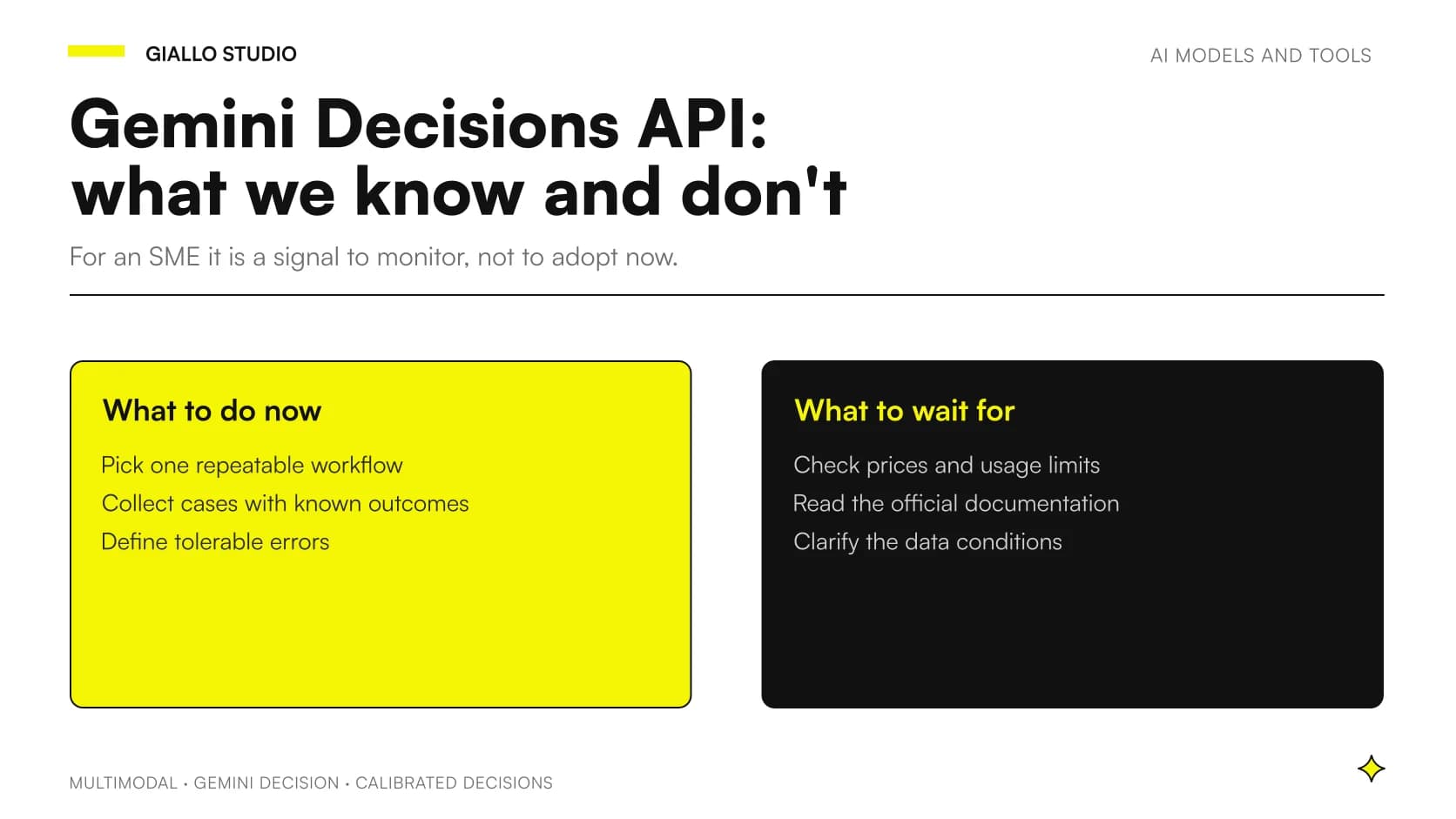
The Gemini Decisions API is an application programming interface announced by Google on its official blog. In the announcement text, Google presents it like this: "Meet the Gemini Decisions API, powered by our state-of-the-art model Gemini Decision for fast, calibrated multimodal decisions". In plain words: a service that a program can call to get a decision, based on more than one type of input, which Google describes as fast and calibrated.
A clear definition helps avoid confusion. A decision API is not a chat where you hold a conversation: it is a component that sits inside a workflow, receives a case and returns an outcome. The provider states that the underlying model is called Gemini Decision and that the goal is fast, calibrated decisions.
There is one limit to state right away, though. The public material we verified is a single sentence of announcement. It reports no prices, availability dates, technical requirements or usage limits. For this reason the article carefully separates what is written from what remains to be discovered, and offers guidance on method rather than promises.
In summary
- Google announced the Gemini Decisions API on its official blog, based on the Gemini Decision model.
- According to the announcement, it is meant for fast, calibrated multimodal decisions.
- The sources lack prices, availability dates, technical requirements and usage limits.
- Speed and calibration are described only by the provider, with no data or metrics.
- For an SME it is a signal to monitor: evaluate it when the official documentation is released.
What is the Gemini Decisions API?
It is the name Google gave to a new API, presented as powered by the Gemini Decision model. The source is the official Google blog dedicated to developer tools, which introduces it as a tool for fast, calibrated multimodal decisions.
For those who don't program, a translation is in order. API means that another piece of software, for example a company's management system or website, can send a request and receive a response in a structured form. Decision means that the response is not free text but an outcome the workflow can continue from: accept, discard, pass to a person. This reading is our own general explanation of the concept of a decision API, not a description of the product's technical details, which the announcement does not provide.
What do "multimodal" and "calibrated" mean?
Multimodal means that the input may be more than text. In general, a multimodal system can work with several formats, for example text and images. If you want to explore the concept independently of the product, you will find an explanation in the article on what multimodal AI is and how it works. Which formats the Gemini Decisions API actually accepts, however, is not stated in the announcement cited.
Calibrated is the more delicate term. In a general sense, a system is calibrated when the degree of confidence it declares matches how often it is right. If it says it is very sure, it should rarely be wrong. The practical value is evident: a decision with reliable confidence lets the machine decide the clear cases and send the doubtful ones to a person. A caution applies here, though: Google uses the word in the official announcement, but that text provides neither metrics nor measurements that would allow it to be verified.
What do we really know, and what is missing?
The table separates facts from gaps. The column on the right is not a criticism: it is the list of what you should ask the documentation before any decision.
| Topic | What the sources show | What they do not show |
|---|---|---|
| Existence | Announcement on the official Google blog | Release status |
| Model | Based on the Gemini Decision model | Technical characteristics of the model |
| Objective | Fast, calibrated multimodal decisions | Speed and calibration metrics |
| Costs | No information | Prices, quotas, plans |
| Usage | No information | Limits, requirements, terms of use |
The correct reading is a cautious one. An announcement says what the provider wants to communicate, not what the product guarantees in real conditions. On how much weight to give vendors' claims, the article on why vendor benchmarks are not comparable.
Worth remembering. Speed and calibration are, for now, claims by the provider. Until there is data or documentation, they should be treated as hypotheses to verify and not as established features. Source of the announcement: official Google blog.
What could a decision API be used for?
To reason without making things up, it helps to look at categories of similar products already described elsewhere. Other companies have presented tools to classify requests and tickets with controllable responses: we cover them in the articles on OpenAI Decisions API for classifying tickets and requests and on Perplexity Decider for routing tickets with controllable thresholds. They are different products, with different documentation, and nothing written there automatically applies to Google.
The kind of work where a decision API makes sense is recognizable, though: repetitive cases, with fairly clear rules, where reaching an outcome quickly matters and where you know when to call a person. On that last point, the piece on confidence and human reviewis useful, as it explains why a threshold without human control over doubtful cases is a risky shortcut.
What concrete examples can an SME imagine?
The examples that follow are working hypotheses for reasoning, not real cases or confirmed features of the API. They serve to understand how an evaluation might be set up once the documentation is available.
A window and door company with after-sales support. Reports arrive with photos of a defect and a short description. The idea to evaluate is whether a multimodal decision could suggest a case category, for example warranty or paid repair, leaving the final word to a technician. The announcement speaks of multimodal decisions but does not say which formats, photos included, are accepted: the first step would be to read the documentation. A useful deep dive on the topic is AI for ticket management.
A professional firm with incoming documents. A firm receives scans, emails and photographs of client documents every day. The hypothesis is to use a decision service to say whether a document is complete or whether a supplement should be requested. Here too the value would depend on how the outcome is expressed and how reliable the declared confidence is. None of these points can be estimated from a one-sentence announcement.
In both cases the right question is not "does it work?" but "in which cases do I trust it and in which not?", and the answer must be sought with a test on the company's real cases, not on promises.
What mistakes should you avoid with an announcement like this?
There are five common mistakes when a new tool comes out, and all of them apply here too.
Taking for granted that it is already usable
An announcement is not availability. The sources provided report no availability dates, so it is not known who can use it and when. You avoid this by checking the official page before planning any work.
Confusing "calibrated" with "correct"
A calibrated decision expresses well how sure it is, but it can still be wrong. It can happen because the two words sound similar. You avoid it by keeping human control over cases where confidence is low and a sample check on the others as well.
Trusting declared speed and quality
The speed and calibration characteristics are described only by the provider, without data. It happens because press releases are written to present, not to measure. You avoid it by setting your own criteria before testing: which errors are acceptable, which are not.
Estimating costs and timelines without data
Without prices and usage limits no serious quote is possible. It happens when you want to arrive at a meeting with a number. You avoid it by writing "to be defined" and deferring the estimate to the documentation, as the guide on how to set up an AI pilot project.
Forgetting data privacy and permissions
If the cases contain client data, you need to know where and how they are processed. The announcement gives no terms of use. It happens because people think about the function and not the data. You avoid it by reading the service terms and involving whoever handles data protection before sending any real information.
How can you prepare without waiting blindly?
There is no need to wait passively: much of the useful work can be done without the API. The point is to prepare the ground, so you can evaluate quickly when the documentation is ready.
- Choose a single repetitive workflow where a quick decision would save work, and describe it in words: input, expected outcome, who decides today.
- Collect a set of real cases already resolved, with the correct outcome known, to use as a test bench.
- Define which errors are tolerable and which always require a person.
- When the official documentation is available, check prices, limits, accepted formats and data conditions.
- Test on a sample of the collected cases, compare the outcomes with the known ones and decide whether to go ahead.
A starting checklist, useful to anyone following the news:
- I have read the original source and not just the commentary.
- I can tell what is declared from what is demonstrated.
- I have a candidate workflow and test cases.
- I have decided in advance who checks the doubtful outcomes.
- I have verified where the data goes before sending it.
To check the answers of any system before using them, a practical reference is the checklist for verifying AI answers. Those who want to understand how Google approaches tools for companies can also read what Google announced about the Gemini agent for companies.
Should an SME move now?
No, and not out of distrust of the tool. The available material does not allow an assessment of its costs or suitability, and whoever decides on a single sentence of announcement risks chasing the name rather than the problem. The sensible move is twofold: observe, keeping the official source among your references, and meanwhile identify the workflow where a well-controlled automatic decision would make sense.
If that workflow exists, you can already work on the process, regardless of the model you later choose. Good automation depends more on the clarity of the rules, the quality of the data and the points of human control than on the name of the API. If you want to think through your own case with someone who has already set up projects of this kind, you can start from our AI consulting.
Giallo Studio guides: methodology and sources
Want to apply this to your business?In 30 minutes, free of charge: the first process to automate and its estimated return, in writing.
Book the free auditHow we apply it in the company
Related resources
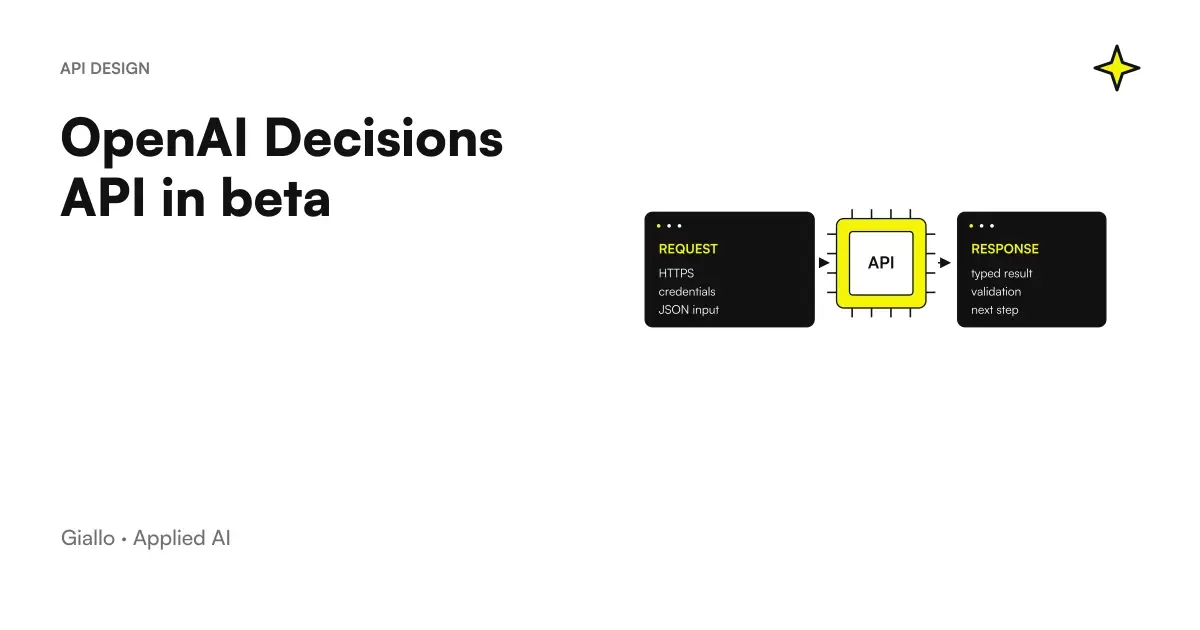 OpenAI Decisions API in beta: classify tickets and requests with controllable answers
 Perplexity Decider 1.1: sorting tickets with controllable probabilities and thresholds
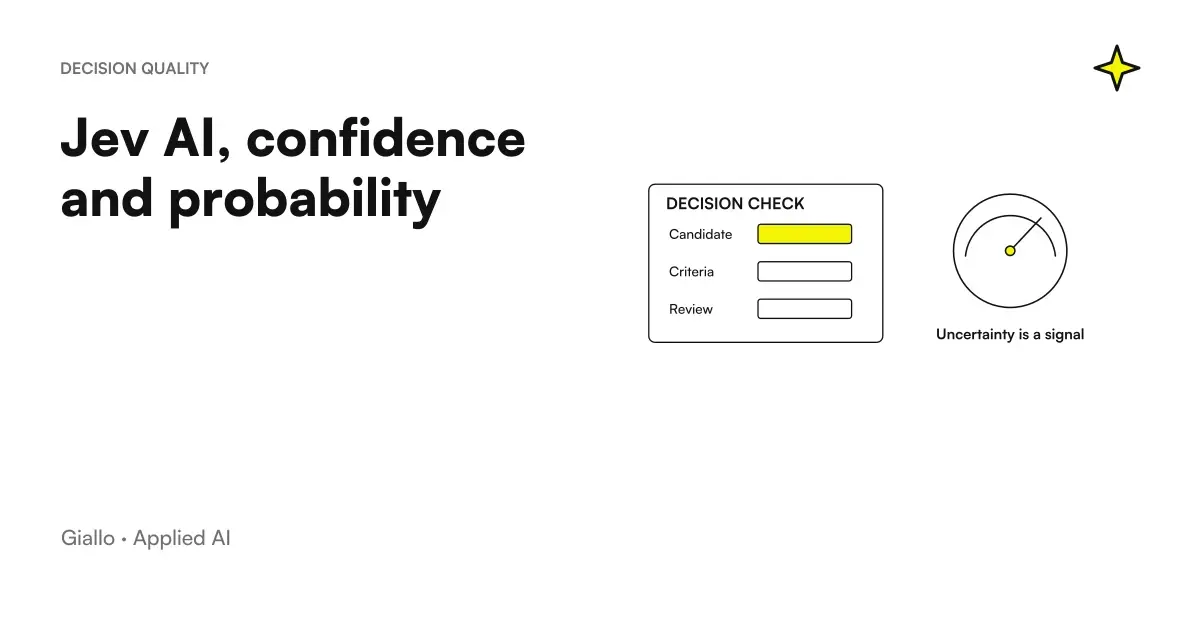 Jev AI, confidence and probability: when to get a person to intervene
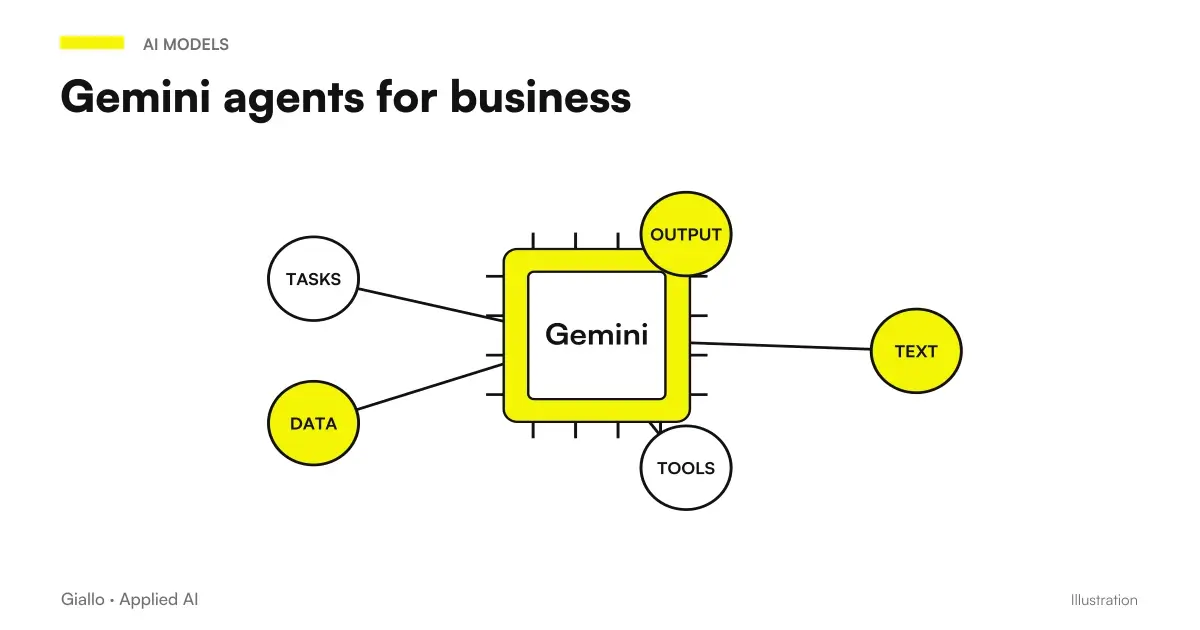 Gemini agent for companies: what Google announced and what to check before using it
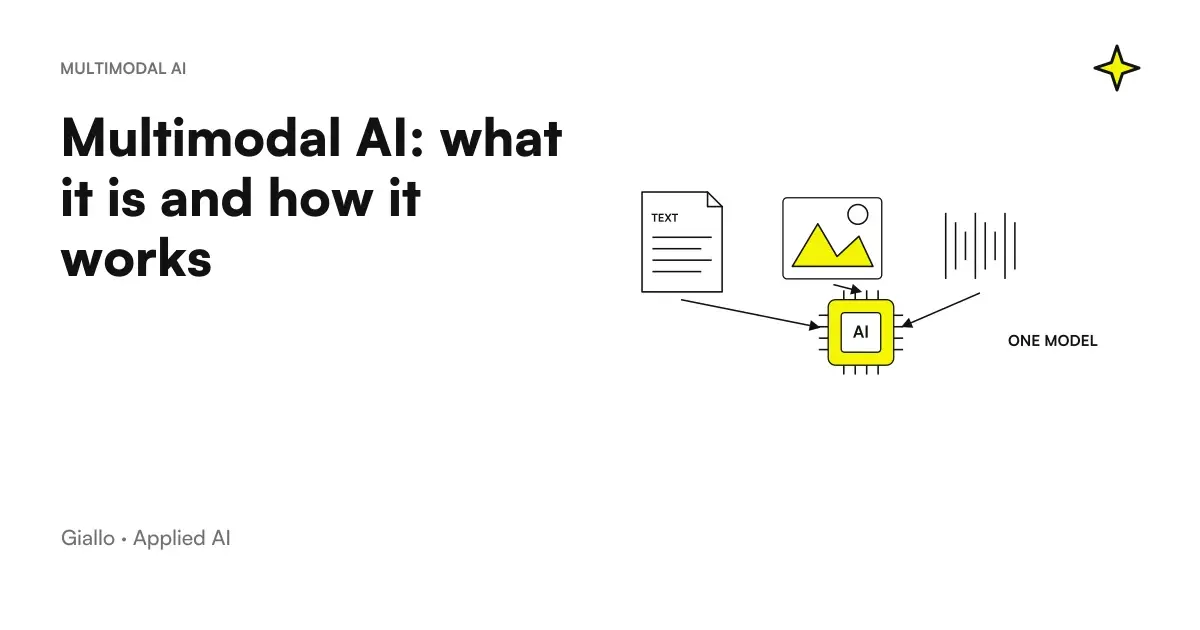 Multimodal AI: what it is and how it works
FAQ
What is the Gemini Decisions API?
It is an API announced by Google on its official blog. According to the announcement, it is based on the Gemini Decision model and is meant for fast, calibrated multimodal decisions. No other details appear in the sources provided.
How much does the Gemini Decisions API cost?
The verified sources report no prices. For this reason no estimate is possible. It is better to wait for the official documentation before doing any calculation.
When will it be available?
The announcement gives no availability dates or geographic areas. So it cannot be said when or for whom it will be accessible. Google's official page is the place to check.
What does a calibrated decision mean?
In general it means that the confidence the system declares matches how often it is right. It does not mean it never makes mistakes. In Google's case, calibration is described only by the provider and without metrics.
Should an SME adopt it right away?
No, as long as documentation, costs and usage limits are missing. The advice is to watch the news and meanwhile prepare a test workflow with real cases. The decision should be made when the official data is available.
Can I use it with client documents and images?
From the announcement, all that appears is that the decisions are multimodal. Which formats are accepted and how data is handled is not stated. Before sending client information, you need to read the official terms of use.