
Best AI model for customer care
Choose an AI model for customer support: why latency matters as much as quality and what the model must be able to do.
Reading time: 9 min
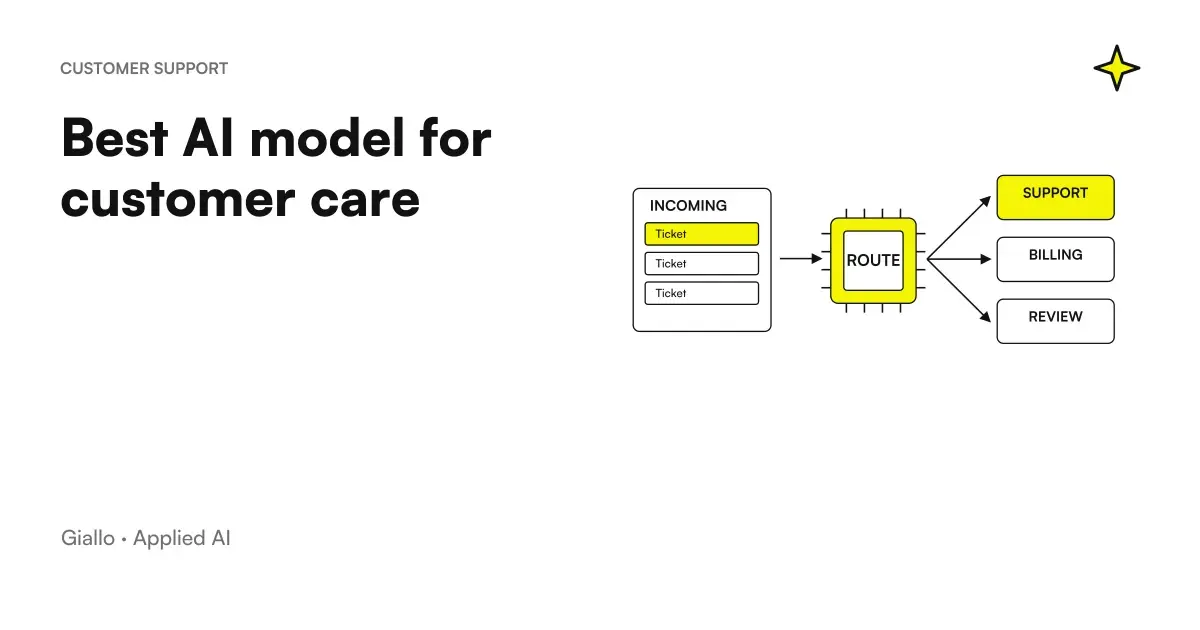
The customer care is the most common AI use case and the one in which the criteria of choice are most often mistaken. The reason is that things that no benchmark measures count here: perceived speed and behavior when the model doesn't know.
This guide proposes the right criteria and explains why the most used metric in this area rewards exactly the wrong behavior.
In summary
- The latency matters as much as quality: the customer waits.
- In most cases, the economic or intermediate zone.
- The model must respond from documents, not from memory.
- The greatest risk is Safely Answering the Wrong Thing.
- The transition to a person goes designed from the beginning.
- The metric "conversations closed by AI" is misleading.
Why latency comes first
In almost all other use cases latency is a secondary variable. In customer care it is the first, and for a simple reason: the customer is watching.
An answer that comes in two seconds keeps the conversation alive. One that comes in eight interrupts her: the customer gets distracted, opens other, often abandons. No quality gain makes up for a perceived overhang, because the world's best answer does not serve those who have already closed the window.
This has a direct consequence on the choice: light bands, which are the fastest, are often the choice correct and not a downward compromise. The complete reasoning is in AI models latency by comparison.
The task is simpler than it looks
Top-level customer support seems complex because there are many questions, but in practice they are reduced to about ten recurring intents: shipments, returns, availability, billing, schedules, conditions.
The task is therefore recognize the intent and respond from the document base. They are two recovery and reformulation operations, not reasoning. The economic belt handles them well.
The real complexity comes about out-of-the-box cases: the customer who describes an ambiguous situation, who has a problem that doesn't fall into any category, or who is angry for a reason he hasn't explained yet. Those should not be solved at all costs: they should be recognized and passed.
The specific risk of customer care
In an internal process, a wrong model produces a data to be corrected. In customer care it produces a commitment to the outside.
If the model tells a customer that the return is free when it is not, or that the product arrives tomorrow when it does not arrive, the company is faced with a promise made in his name. Cost is not the correction: it is the choice between honoring the commitment or disproving it.
- The answers must come from the corporate documents, not from the model's memory
- The model must quote the source of every statement
- Must declare when not finding the Information
- Sensitive categories — refunds, guarantees, commitments — go excluded from the automatic response
- It serves a Easy Pass to an operator
- Conversations go recorded and sample magazines
The fourth point is the most effective and easiest protection to implement: some categories are never closed by AI, by explicit decision, regardless of how safe the model looks.
The metric that deceives
The most widely used measure in this area —the percentage of closed conversations without human intervention.rewards exactly the wrong behavior.
A system that responds to everything, even what it didn't understand, gets an excellent score on that metric and produces dissatisfied customers and wrong commitments. A system that passes difficult cases correctly gets a lower score and is better.
Useful Metrics
- Problems Actually Solved
- Satisfaction declared by the customer
- Cases reopened after closing
- Time to first useful answer
Misleading Metrics
- Percentage closed by AI
- Number of responses generated
- Reduction of open tickets
- Average talk time
The third line on the left is the most informative of all: a re-opened case means that the first answer has not resolved. It is the most honest signal about the real quality of the system.
The Recommended Setting
An economic model manages the first level: it recognizes intent, responds from documents, cites the source. When it does not find the information or recognizes an out-of-the-box case, it does not improvise: it passes.
The transition can go to a more capable model for complex but manageable cases, and to one person for everything else. In both cases the context of the conversation should be transferred, so that the customer does not have to repeat.
How much does it cost, with the numbers
We take a service that handles 60,000 conversations per month, with about 2,000 input tokens —instructions, reference documents, conversation history —and 250 outputs.
| Headband | Input (120M) | Output (15M) | Monthly Total |
|---|---|---|---|
| Economic (0.20/1.20 $) | 24 $ | 18 $ | 42 $ |
| Intermediate (2/10 $) | 240 $ | 150 $ | 390 $ |
| High ($5/25) | 600 $ | 375 $ | 975 $ |
List prices verified on August 19, 2026 for Anthropic and OpenAI and on September 3, 2026 for Google on the Standard plan.
The jump between the first and last line is over twenty times. But the most interesting data is another: even the most expensive line is modest compared to the cost of an operator managing the same conversations. The value of these projects is not in saving on the API, it's in people's time.
The Growing Historian
There is a technical detail that in customer care has a specific economic impact: the conversation grows at every exchange.
On the first question the model receives the instructions plus the question. At the tenth exchange he received instructions plus nine questions and nine previous answers. Input consumption therefore grows more than linearly relative to the number of messages.
- Put a limit the length of the transmitted historical
- Summarize Trades older instead of transmitting them in full
- Always keep the Key Information of the customer
- Check real consumption on one long conversation, not on a short
The last point is the one that jumps in the estimates: you measure on a conversation from three exchanges and you find in production that the real average is eight.
Three Mistakes You See Often
Make the model answer from his memory. An assistant who responds to shipping conditions or return policies based on what he "knows" instead of company documents will say plausible and not necessarily true things. Information must be provided, always.
Not providing an exit route. A system that doesn't offer an obvious way of talking to a person generates frustration that you download onto the brand, not the chatbot. The button must be there and be visible.
Optimizing to close. Configuring the system to solve as many conversations as possible leads to a model that responds even when it doesn't know. It is the error that produces the worst damage, and it almost always arises from the wrong metric.
| Setting | Real Effect |
|---|---|
| "Always respond" | Invented Answers, Wrong Commitments |
| "Reply if you find, or else pass" | Fewer closures, more problems solved |
| Sensitive categories excluded | Protection from unwanted commitments |
| Mandatory source citation | Testable sample responses |
The last three lines describe a system that closes fewer conversations and works better. It is the distinction that is worth explaining to those who look at the numbers.
How to start the service without risk
The prudent path does not start from public chat. It has three stages that reduce risk to almost zero.
First: assistant for operators. The model suggests the answer, the operator corrects it and sends it. No customer sees the raw output, and in a few weeks an archive of fixes accumulates that tells exactly where the system is wrong.
Second: automatic response on certain cases. Only the categories that in the first phase showed high accuracy, and only when the model declares confidence above threshold. Everything else continues to pass from one person.
Third: Gradual expansion. You add categories one at a time, looking at the reopened cases and the stated satisfaction.
The first two stages take a few weeks and turn a risky project into a controlled one —as well as producing, as a side effect, the data needed to calibrate everything else.
Practical examples
E-commerce with recurring requests. Thousands of messages a month about shipments, returns and availability: about ten intents that cover almost everything. The light band is the correct choice on two fronts, because it costs a fifth and responds faster — and in chat speed is the first thing the customer perceives.
Professional studio with customer requests. Low volumes but more articulated questions, often on specific practices. Here it is especially important that the system responds from the documents of the study by citing the source, and that it passes on to a person everything that concerns commitments, deadlines or matters.
Service company with technical assistance. Questions require you to cross-reference product documentation with the customer's history. It is the case that it is worth starting as an assistant for the operators. the model suggests, the person corrects and sends — accumulating the corrections that will serve to calibrate the system.
How to apply it in the company
The path that reduces risk to almost zero does not start from public chat.
First stage: assistant for operators. The model suggests the answer, the operator corrects it and sends it. No customer sees the raw output, and in a few weeks an archive of fixes accumulates that tells exactly where the system is wrong.
Second stage: automatic response on certain cases. Only the categories that showed high accuracy, and only above a confidence threshold. Everything else continues to pass by a person.
Stage Three: Gradual Expansion, looking at the reopened cases and the stated satisfaction.
Two technical measures apply on any model. The first: the answers must come from the company documents with quotation of the source, not from the memory of the model, for the reasons explained in knowledge cutoff: what it means in practice. The second: put a limit on the length of the transmitted historical, because it grows with each exchange and with it consumption.
Finally, it measures the right things: solved problems, reopened cases, and satisfaction, not the percentage of conversations closed by AI. And remember that here speed weighs as much as quality, according to the reasoning of AI models latency by comparison.
If you want to automate customer support without risking wrong commitments, Giallo Studio designs agents and automations tailored to SMEs.
Three references that complete the framework. The criterion of choice by type of task is in when an economic model is enough. For the economic part the reference is cost per task or price per token. And if you are considering reviewing a configuration already in production, the path is in Mixed model strategy: light and powerful.
Mistakes to Avoid
- Getting the model to respond from its memory instead of company documents.
- Optimizing to close the greatest number of conversations: rewards the wrong behavior.
- Not providing an obvious exit route towards a human operator.
- Leaving sensitive categories open , refunds, guarantees, deadlines, commitments.
- Neglecting the latency, which here weighs as much as the quality of the answer.
- Not measuring reopened cases, which are the most honest signal about real quality.
The second mistake is the one that produces the worst damage and almost always arises from a wrongly chosen metric. A system configured to solve as many conversations as possible learns to respond even when it does not know: it gets an excellent score and generates dissatisfied customers and commitments that the company did not want to take.
Conclusion
In customer care the choice of the model is decided on different criteria: the speed It matters as much as quality, the task is simpler than it seems, and the greatest risk is a model that confidently answers a wrong thing to a customer.
The economic or intermediate belt is almost always enough. What needs to be carefully designed is the rest: answers from the documents with quotation, sensitive categories excluded, and an easy transition to a person who does not force the customer to start over.
If you want to automate customer support without risking wrong commitments, Giallo Studio designs tailored AI solutions for SMEs.
Giallo Studio guides: methodology and sources
How we apply it in the company
Related resources
FAQ
What model is needed for customer support?
In most cases, a low-cost or mid-tier model. The task is to recognise intent and answer from a document base, and latency matters as much as quality because the customer is waiting.
Why is latency so important here?
Because the customer has the window open and is watching. An excellent answer arriving after eight seconds is perceived less favourably than a good one arriving in two, and the conversation has often already been abandoned.
What does the model need to do?
Recognize intent, respond from business documents by citing the source, and most importantly state when it does not know and pass the conversation to a person.
What is the biggest risk?
The model confidently giving a customer an incorrect answer. Unlike an internal error, this creates an external commitment that the company may have to honour.
Is a handover to a human member of staff needed?
Always. It must be designed from the beginning, must be easy to activate for the customer and must pass to the operator the whole context of the conversation.
How do you measure if it works?
Not with the percentage of conversations closed by AI, which rewards the wrong behavior, but with the customer satisfaction and the percentage of cases really solved.