
ChatGPT Enterprise on AWS Marketplace: What Changes for an SME
ChatGPT Enterprise is on AWS Marketplace: what the announcement says, what it leaves out and what an SME should check before buying it.
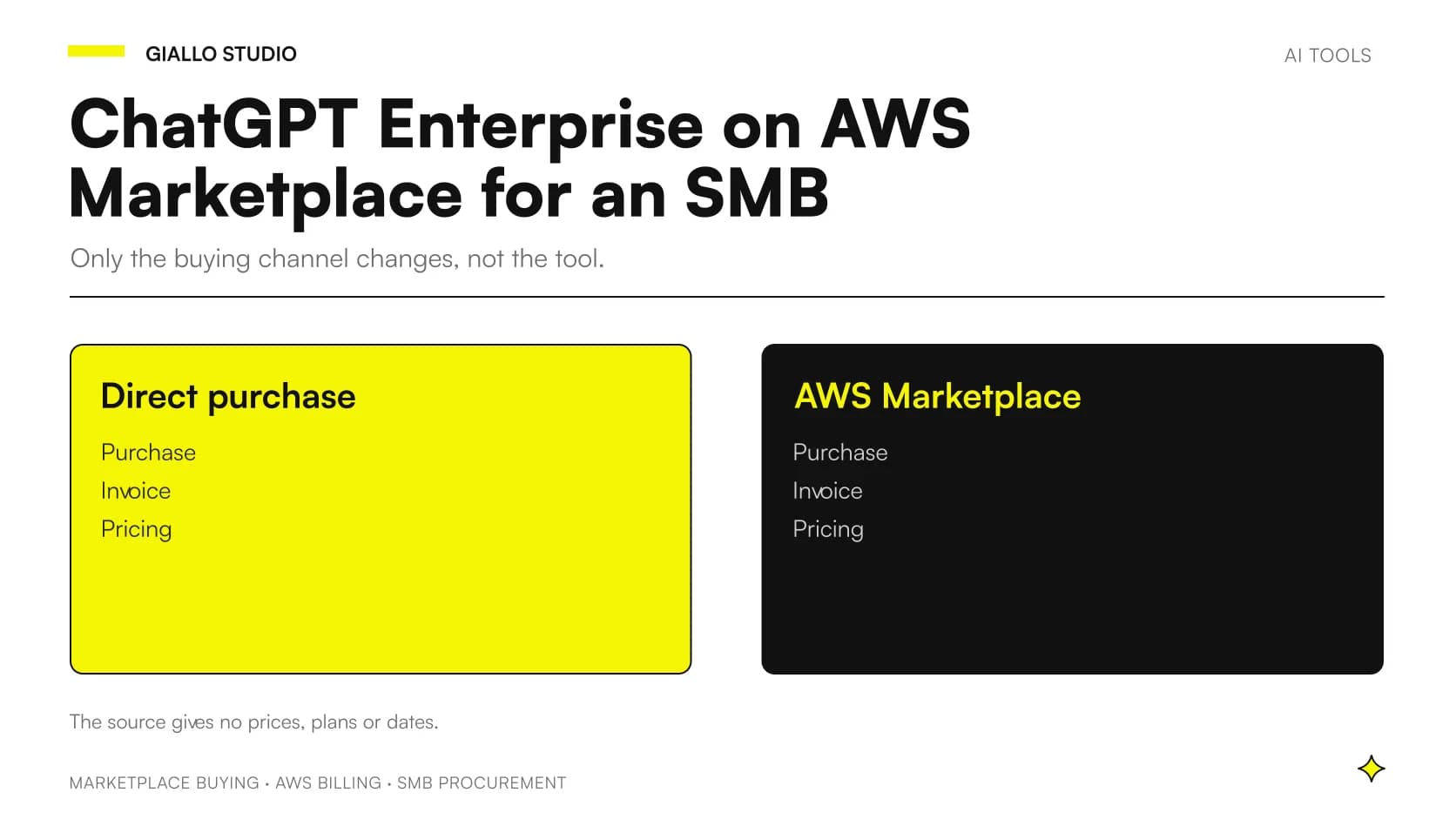
ChatGPT Enterprise can now also be bought through AWS Marketplace. OpenAI says so in an official announcement, according to which the channel helps organizations simplify purchasing through their existing AWS procurement and billing relationships (source: OpenAI). In other words, what changes is the front door through which you buy the service, not what the service can do.
A cloud marketplace is a catalog of software sold by third-party vendors, which you buy inside your cloud provider's account instead of opening a separate contract. That is why the announcement matters mostly to those who already have an AWS account and a purchasing office, or an administrator, used to that flow. For everyone else the news is less relevant.
In this article we separate, in an orderly way, what the announcement states from what it does not state: prices, countries and terms are not given in the source, so we do not reconstruct them. Instead, you will find a practical way to assess whether this channel makes sense for your SME and which checks to run before deciding.
In summary
- ChatGPT Enterprise is available through AWS Marketplace, according to OpenAI's official announcement.
- The stated benefit concerns purchasing: you use the AWS procurement and billing relationships already in place.
- The source gives no prices, plans, countries or availability dates: these must be requested from OpenAI or AWS.
- The channel can make sense for those who already use AWS; for those who don't, it offers no obvious advantage.
- Before activating, it is worth checking the contract, data handling and who, in the company, will manage access.
What was actually announced?
The announcement is short and says one thing only: ChatGPT Enterprise is available through AWS Marketplace and this helps simplify purchasing, because it relies on existing AWS procurement and billing relationships (source: OpenAI). It is not a new model and not a new feature of the assistant: it is a new commercial channel for a product that already existed.
It is worth keeping this in mind: the novelty here is administrative. If ChatGPT Enterprise does not meet a need of your work today, the fact that it can be bought from AWS does not change the assessment.
Why does the purchasing channel matter for an SME?
In small companies, the obstacle to trying a new tool is often more bureaucratic than technical. Opening a new vendor means a vendor record, verification of tax details, internal approval, another deadline to remember. If the service goes through the AWS relationships already active, at least some of these steps can become lighter, and that is exactly the goal stated in the announcement (source: OpenAI).
Be careful, though, not to push the conclusion too far. The source quantifies neither the time saved nor any financial savings. How much simpler a marketplace purchase really is depends on how your company is organized, who manages the AWS account and how expenses are approved. To go deeper on how to approach choosing a vendor, you can read our guide on how to choose an AI provider.
What do we still not know?
The list of what is missing is long, and it is right to say so clearly. In the verified material there are no prices, pricing plans, countries or regions where the service is available, or activation dates. There is not even a description of the requirements for accessing the channel. This is a single short announcement, and the purchase terms must be checked on the official page.
For this reason you will not find in this article any cost comparisons between buying directly and buying from the marketplace. They would be invented numbers. If cost is your first doubt, the guide on how much AI costs in the company helps you think through the items to consider, without replacing the official quote.
Rule of thumb: until a term is written on an official OpenAI or AWS page, treat it as a question to ask, not as a certainty. This applies to prices, availability in your country and billing arrangements.
Buying directly or through the marketplace: how do they compare?
The table below declares no winners. It reports only what the announcement states and, in the next column, what remains to be verified for yourself.
| Appearance | What the source says | What to Check | Source |
|---|---|---|---|
| Availability | ChatGPT Enterprise is available through AWS Marketplace | Countries and regions covered | OpenAI |
| Purchasing | Simplified by using existing AWS procurement relationships | Who approves the spend in the AWS account | OpenAI |
| Billing | Goes through existing AWS billing relationships | How the item appears on the invoice | OpenAI |
| Prices and plans | Not indicated | Price list and terms, to be requested from the vendors | OpenAI |
The correct reading is this: the table shows three benefits stated by the announcement, on availability, purchasing and billing, and one point that is not stated: prices and plans. Those who already have an established purchasing path with another vendor may have no reason to change channel.
How could an Italian SME use it? Two examples
The examples that follow are working hypotheses built to explain the reasoning, not client stories or data from the announcement.
An engineering firm with infrastructure on AWS. Imagine a firm that already stores models and project documents on AWS and has a person who manages the account and cloud purchases. If it wants to try ChatGPT Enterprise to draft reports and summarize specifications, the marketplace channel would let it use the procurement relationship it already knows, as the announcement describes (source: OpenAI). It remains to be decided which documents can be uploaded: on this, our guide to Business Data and AI It's a good place to start.
A software house that invoices several clients. Imagine a small software house that uses AWS to host its clients' products. For its internal team it would like an assistant for documentation and text review. The administration prefers not to open a new vendor and would like to understand whether the item could flow into the AWS relationships. First of all, it should ask for confirmation of the terms, because the source does not explain how billing is handled in detail.
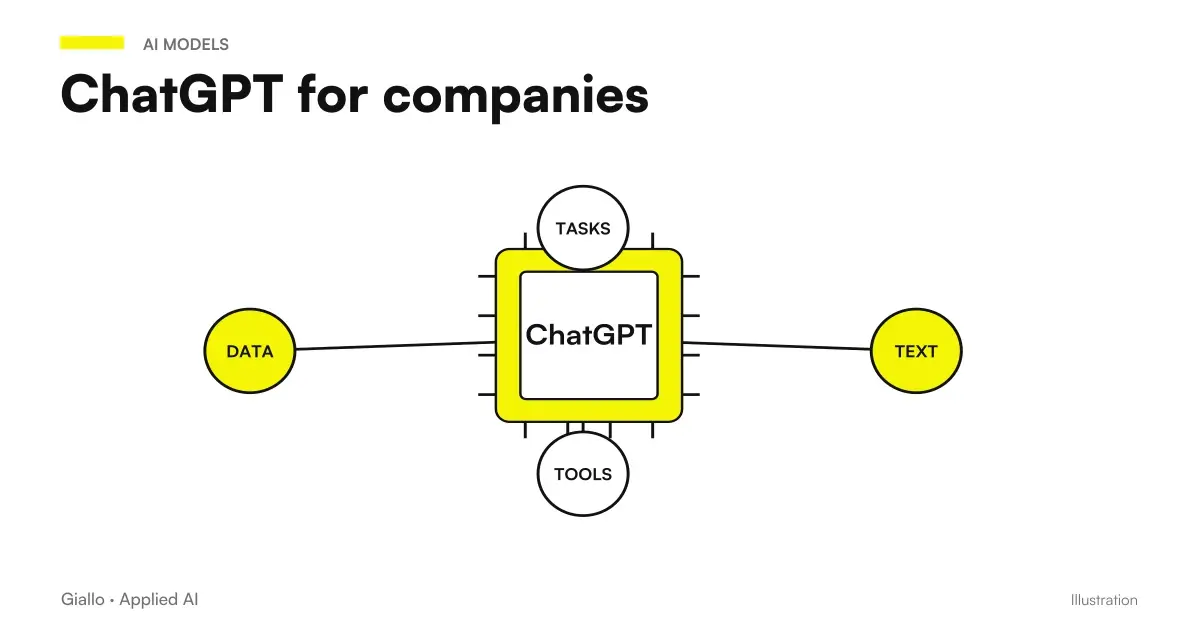
In both cases the right question is not "can I buy it from AWS?", but "do I have a specific job this tool is for, and someone responsible for checking its results?". For those starting from zero, it is also worth reading ChatGPT for companies.
Which mistakes should you avoid before activating it?
Mistaking a channel for a technical novelty
It can happen that an announcement like this is read alongside news about new models. The result is expecting new capabilities that were not announced. Avoid it by rereading the source: it talks about availability and purchasing, not features (source: OpenAI).
Taking prices and discounts for granted
It is natural to think a marketplace brings favorable terms, but the source says nothing about it. Avoid it by asking for a written offer and comparing it with the direct one, item by item.
Forgetting the contract
The convenience of a simple purchase can lead you to skip reading the terms. Before signing, check duration, withdrawal, data handling and liability. The guide to the contract with an AI provider.
Activating without a usage rule
If buying is easy, activating for everyone is easy too. Without guidance on what can be entered into the tool, each person decides alone. Avoid it by writing a corporate policy on the use of AI before handing out access.
Starting without a measurable goal
A tool bought in a hurry and used at random becomes a recurring cost with no results. Avoid it with a limited trial, an owner and a success criterion defined in advance, as we explain in the guide to the AI pilot project.
How do you apply it in practice?
If you already have an AWS account and are evaluating ChatGPT Enterprise, an orderly path can be this one.
- Define the work to improve: for example drafting reports, answering recurring requests or summarizing documents.
- Check on the official page the availability in your country and the purchase terms, because the source does not report them.
- Ask for a written offer and, if possible, compare it with the one for buying directly.
- Talk to whoever manages the AWS account: who approves the spend and how it will appear on the invoice.
- Write the usage rule: which data can be entered, who has access, who checks the answers.
- Start with a small group, measure the result and decide whether to extend.
Before launching the trial group, a short checklist avoids the most common oversights.
- Availability confirmed on the official page
- Written offer received and read
- AWS account owner involved
- Data usage rule shared with the team
- Success criterion defined before starting
If the project then continues, the budget should be considered over time: for this reason we recommend also looking at the AI budget for SMEs.
When is it better to skip this channel?
If your company does not use AWS, or if adding a new vendor is not a problem for you, the benefit stated by the announcement matters little to you (source: OpenAI). In that case what matters more is understanding whether the tool fits the work, so the assessment stays the same as ever: goal, data involved, responsible people and a controlled trial.
The same goes for those trying to decide quickly: a more convenient channel is not a sufficient reason to buy. It is an opportunity to remove an administrative friction, only after understanding that the tool is needed.
What can a company do now?
The most useful step, today, is to get organized: work out whether you have a concrete job where an AI assistant would help, check the channel's official terms and prepare a small trial, with clear rules on data. If you want to discuss the path best suited to your case, you can look at our AI consulting and start from there.
Giallo Studio guides: methodology and sources
Want to apply this to your business?In 30 minutes, free of charge: the first process to automate and its estimated return, in writing.
Book the free auditHow we apply it in the company
Related resources
FAQ
Is ChatGPT Enterprise really available on AWS Marketplace?
Yes, according to OpenAI's official announcement. The service is presented as a way to simplify purchasing by using existing AWS procurement and billing relationships. The detailed terms should be checked on the official page.
How much does ChatGPT Enterprise cost through AWS Marketplace?
The source gives no prices or pricing plans. To learn the costs you need to request a quote from OpenAI or consult the listing on AWS Marketplace. Until there is an official document, any figure would be a guess.
Does the AWS Marketplace channel add new features to ChatGPT Enterprise?
The announcement does not mention new features. It only describes a new purchasing channel for an existing product. To assess the features, it is better to look at the product documentation.
Do I need an AWS account to use this channel?
The announcement refers to existing AWS procurement and billing relationships, so the channel is designed for those who have them. The precise requirements are not stated in the source. It is best to ask AWS or OpenAI directly.
Should an SME go through AWS Marketplace?
It depends on how it buys its tools today. If it already uses AWS and wants to avoid a new vendor, the channel can be convenient. If it does not use AWS, the stated benefit matters little and the choice rests on how useful the tool is.