
AI Act: penalties and enforcement
AI Act penalties: up to 35 million or 7% of turnover, the more favourable rule for SMEs and small mid-caps, application dates and Italian oversight.
Reading time: 11 min
The sanctions of the AI Act make news for maximum amounts, up to 35 million euros or 7% of the world's turnover for prohibited practices (Article 99 of Regulation (EU) 2024/1689). For a normal Italian company though the concrete risk is another, and reasoning only on figures leads to wrong decisions: one buys conformity where it is not needed and neglects where it would be needed.
The sanctioning system is graded like the rest of the regulation: The more severe the violation, the higher the band. At the top are prohibited practices; at the base, inaccurate or misleading information provided to authorities. And for small businesses the cap is calculated backwards from large ones.
In summary
- There are three groups: up to 35 million or 7% for prohibited practices, up to 15 million or 3% for other main obligations, up to 7.5 million or 1% for inaccurate or misleading information to the authorities (Art. 99).
- For companies, the highest value is between fixed figure and percentage; for SMEs and start-ups the lowest.
- The Omnibus has extended the lowest value rule to small mid-cap companies, for the 15 and 7.5 million ranges (Article 99(6)a).
- The Head on Sanctions applies from 2 August 2025, but only an already applicable obligation is sanctioned (Art. 113).
- For an SME the realistic risk is not the record fine: it is the blocking of a project or the loss of B2B customers.
- Supplier and user each meet their own obligations.
The amounts of Article 99, band by band
The sanctioning logic follows that of the risk classification, explained in the four levels of risk. These are the maximums set by the Article 99 of the AI Act, with the modifications of the Digital Omnibus on AI.
| Violation | Maximum for businesses | Rule for SMEs and small mid-caps | Source |
|---|---|---|---|
| Prohibited Practices of Article 5 | €35,000,000 or 7% of the previous year's annual world turnover, if higher | SMEs and start-ups: the lowest of the two. Small mid-caps: no dedicated rules | Art. 99(3) and (6) |
| Obligations of suppliers, representatives, importers, distributors, deployers, notified bodies and transparency of Article 50; after the Omnibus also cooperation along the chain (Articles 25(2) and (4)). | 15,000,000 € or 3%, if higher | SMEs, start-ups and small mid-caps: the lowest of the two | Art. 99(4) and (6), paragraph 4, point d bis, and paragraph 6 bis |
| Inaccurate, incomplete or misleading information to notified bodies or authorities | 7,500,000 € or 1%, if higher | SMEs, start-ups and small mid-caps: the lowest of the two | Art. 99(5) and (6), paragraph 6 bis |
| Model providers for general purposes, sanctioned by the Commission from 2 August 2026 | 15,000,000 € or 3%, if higher | No dedicated rules | Art. 101 and Art. 113 |
For businesses the mechanism is reminiscent of the GDPR: the highest value applies between fixed figure and percentage, so for very large companies it bites the percentage. For SMEs and start-ups the rule overturns and is worth the lowest value (Article 99(6)). In one example: a company with €2 million in turnover that violates the transparency of Article 50 risks at most 3%, i.e. €60,000, not €15 million.
What changed the Omnibus about sanctions
The Regulation (EU) 2026/1744, in force since 27 July 2026, changed Article 99 in three areas. When setting penalties, Member States must also take account of the interests and economic viability of small mid-cap enterprises (paragraph 1). For these enterprises, the lower of the fixed amount and the percentage applies to the bands in paragraphs 4 and 5, but not to prohibited practices (new paragraph 6 bis). The 15 million band also covers cooperation obligations along the value chain under Article 25, paragraphs 2 and 4 (new point d bis).
The postponement of the high risk also shifts the time when those obligations become punishable: for the systems of Annex III from 2 December 2027, for those of Annex I from 2 August 2028. Prohibitions and transparency remain where they were: from 2 February 2025 and from 2 August 2026 (Article 113 of the AI Act). All dates are in AI Act schedule.
Who watches
The control system is two-tiered. At European level, the Commission's AI office, which supervises model providers for general purposes and, after the Omnibus, also has exclusive competence over systems built on those models by the same supplier (Article 75(1), replaced by Reg. (EU) 2026/1744). For companies that use those systems only, national authorities remain competent.
In Italy the Law 132/2025 has designated the National Cybersecurity Agency (NCA) as a market surveillance authority, with inspection and sanctioning activities, and the Agency for Digital Italy (AgID) as a notifying authority, dealing with bodies responsible for verifying compliance. For banks, intermediaries and insurances remain Bank of Italy, CONSOB and IVASS; the Privacy Guarantor retains all its powers.
The power to apply the sanctions of Article 99 comes with the legislative decrees that the same law has delegated to the Government, to be adopted within twelve months of its entry into force (Art. 24). If you need to know to whom you would answer in concrete, check on Normattiva if those decrees have been published.
What is the real risk for an SME
Here a distinction must be made which is usually lacking.
Theoretical risk
- Sanction in the maximum range
- Presupposes a prohibited practice
- Remote scenario for a normal enterprise
Concrete risk
- Project blocked due to lack of documentation
- Dispute by an interested party
- B2B customer who asks for guarantees in contract and does not get them
- Lost race for non-provable compliance requirements
The right column is the one that really materializes, and it is also the one that no one tells. The typical cost of non-compliance for an SME is not a fine: it is a skipping contract. More and more B2B chapters and more and more structured customers are asking to state which AI systems are being used and with what guarantees. Not having a ready answer is a business problem before sanctioning.
Three situations and the band that risk
Management software provider that integrates a scoring. The company sells to other businesses a form that assigns scores to people, for example for credit or selection. It is a supplier of an Annex III system: the obligations apply from 2 December 2027 (Reg. (EU) 2026/1744) and violating them falls into the band up to 15 million or 3%. The risk, however, comes first: to the first structured customer who requests the documentation of compliance during the tender phase, the absence results in lost sale.
Company using a CV screening tool. A discarded candidate asks on what basis the decision was made. The company is user: from 2 December 2027 will have the obligations of Article 26, including human surveillance and information to people, punishable in the same band (Article 99(4)). If it cannot prove that a competent person has been able to evaluate and flip, the position is weak, regardless of who wrote the software.
Small e-commerce with assistant on site. The obligation is transparency, from August 2, 2026. It is not the lowest range: the violation of Article 50 lies in the same range of obligations for high risk, up to 15 million or 3%, and for an SME it is worth the lowest of the two (Article 99(4) and (6)). Fulfillment costs a quarter of an hour: it is the classic case in which the relationship between compliance cost and risk makes sense to postpone.
How it proves to be in order
The moment someone asks for an account, whether it's a client in the race, an interested party contesting or an authority verifying, what matters is not what you've done, but what you can show.
The minimum documentation that makes an SME defensible is lighter than feared. Time estimates are indicative, for a company with few tools:
| Document | What it is used for | Indicative effort |
|---|---|---|
| Inventory of AI systems | Prove that you know what you use | 1-2 hours |
| Classification by band | Prove that you have evaluated | 1 hour |
| Internal Policy | Prove that you have governed the use | half a day |
| Trace the training of those who use AI | Demonstrates the literacy measures of Article 4 | 1 hour |
| Proof of Transparency | Screenshot of the disclaimer with date | 10 minutes |
| Agreements with suppliers | Covers the data front | Document Recovery |
| Note on human supervision | Who controls what in sensitive processes | 1 hour |
An overall working day, updated once a year. It is disproportionately little compared to the value it has at the time it is needed: in most cases it never serves an authority, but it does so when a structured customer sends their supplier questionnaire.
The front that strikes first: the supplier questionnaires
Many Italian SMEs will encounter the AI Act not through an authority, but through a module. More and more structured companies include questions in the supplier qualification processes such as: "Do you use artificial intelligence systems in the delivery of the service?", "What guarantees do you offer on data processing?", "Do you have an internal policy on the use of AI?".
These are questions that must be answered in the commercial phase, with short times and no margin to improvise. Those with the inventory and policy respond in ten minutes. Who doesn't have them, either loses time or loses the race.
- Prepare a standard half-page answer to typical questions
- Keep policy and inventory ready in shareable format
- Be precise about what you do and what you don't do: generic answers generate more questions
- If you use third-party providers, know which and with what guarantees
It is the reason why it is better to do this work now and not at the deadline: the commercial deadline comes before that regulation. The complete framework is in AI Act: The Business Guide and the contractual part in contract with an AI provider.
Five Risk Assessment Mistakes Penalties
- Deciding based on the maximum amount. It leads to overinvesting where it is not needed and ignoring the trivial obligations that really apply.
- Reading the best as if it applies to everyone. For SMEs and start-ups the cap is the lowest between fixed figure and percentage of turnover.
- Assuming that only the provider is liable. The obligations of the user are autonomous.
- Ignoring the contract front. For many SMEs compliance becomes a business requirement before a controlled obligation.
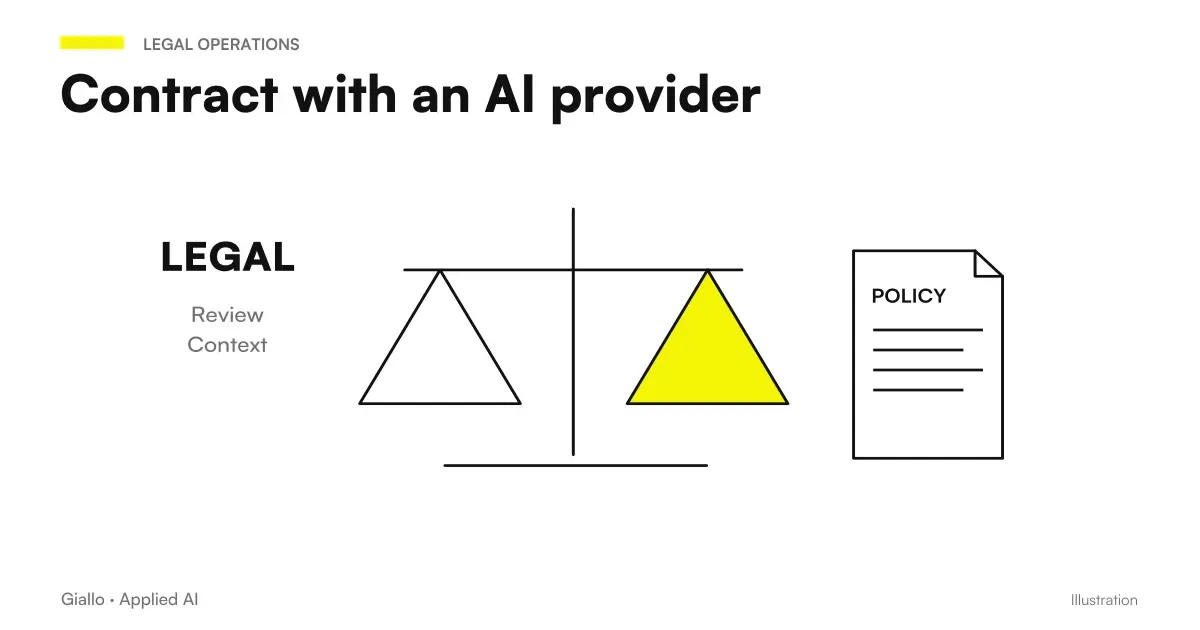
- Not writing anything in the contract with the supplier. See contract with an AI provider: that's where the responsibilities are distributed.
Five moves to be defensible
The most effective precaution measure is not a compliance budget: it is Being able to prove what you do.
- Keep inventory of AI systems in use, up-to-date and dated.
- For each note risk range and role (supplier or user).
- Where AI talks to someone, it retains evidence of having declared the automatic nature.
- Where AI supports decisions about people, it documents who exercises human surveillance and with what power.
- In contracts with suppliers, ask in writing for guarantees of compliance and who answers for what.
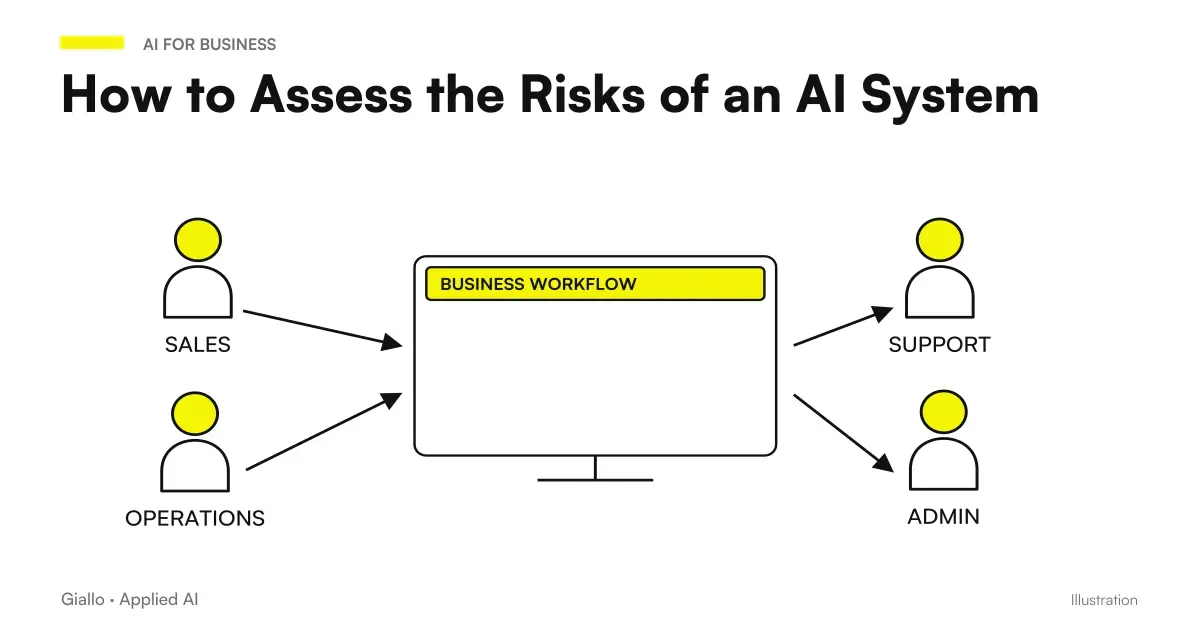
These five points cost a few hours and cover both the sanctioning and, more useful, the commercial front. The method of assessment is in How to Assess the Risks of an AI System.
The real risk is not knowing how to answer
The penalties of the AI Act are serious but proportionate: the maximums they make relate to behaviour that a normal SME does not keep, and for small businesses the cap is still the lowest value between fixed figure and percentage (Article 99(6)). Building your own strategy on the maximum amount means spending badly.
The correct way to look at risk is to ask yourself: if tomorrow someone asked me what AI systems I use, for what, and with what guarantees, could I answer? If the answer is yes, you are covered on the front that matters. If it is no, the problem will present itself first as a lost contract than as a sanction.
If you want to get to the next supplier questionnaire with inventory, classification and policies ready, we can prepare them together starting from a AI consulting for SMEs. The general picture is in AI Act: The Business Guide.
Giallo Studio guides: methodology and sources
How we apply it in the company
Related resources
FAQ
How high are the penalties of the AI Act?
Article 99 sets three maximum penalties: up to 35 million euros or 7% of global annual turnover in the preceding financial year for prohibited practices; up to 15 million euros or 3% for obligations on providers, deployers, importers, and distributors, and for transparency under Article 50; and up to 7.5 million euros or 1% for inaccurate, incomplete, or misleading information supplied to authorities and notified bodies. For businesses, the higher of the two amounts applies; for SMEs and start-ups, the lower amount applies.
Do sanctions already apply?
The chapter on penalties applies from 2 August 2025, but penalties can only be imposed for an obligation that already applies: prohibitions from 2 February 2025; transparency under Article 50 from 2 August 2026; high-risk obligations from 2 December 2027 or 2 August 2028 following Regulation (EU) 2026/1744. In Italy, Law 132/2025 (Article 24) authorised the Government to give national authorities the power to impose penalties under Article 99: the status of the implementing decrees must be checked on Normattiva.
Who controls the application of the AI Act in Italy?
Law 132/2025 (Article 20) designates the National Cybersecurity Agency (ACN) as the market surveillance authority, with inspection and sanctioning powers, and the Agency for Digital Italy (AgID) as the notifying authority. In the financial sector, the Bank of Italy, CONSOB and IVASS supervise, and the Italian data protection authority retains its powers. At European level, the AI Office supervises general-purpose models and, after the Omnibus, systems built on those models by the same provider.
Does an SME really risk a million-euro fine?
It is the least likely scenario. For SMEs and start-ups the maximum is the lowest between fixed figure and percentage of turnover (Article 99(6)): in one example, a company with 2 million euros of turnover that violates transparency risks at most 3%, i.e. 60,000 euros, not 15 million. And the realistic risk remains another: a blocked project, documentation that is missing during a verification, a B2B customer asking for guarantees in the tender or in the contract.
Do sanctions take into account the size of the enterprise?
Yes. Article 99 requires effective, proportionate and dissuasive penalties that take into account the interests and economic viability of SMEs and start-ups and, following the Omnibus, small mid-cap enterprises. For SMEs, the maximum is the lower of the fixed amount and the percentage; for small mid-cap enterprises, the same rule applies to the bands in paragraphs 4 and 5, but not to prohibited practices (paragraph 6 bis). The actual amount takes account of severity, duration, size and cooperation (paragraph 7).
What if the violation concerns the provider rather than my business?
Each party is responsible for its own obligations. If the supplied system has a compliance defect, the provider is primarily responsible. But if you used the system outside the instructions, without human oversight, or without informing the people affected, those are your obligations and you are responsible. This is why the contract with the provider needs to be well written.